Introduction
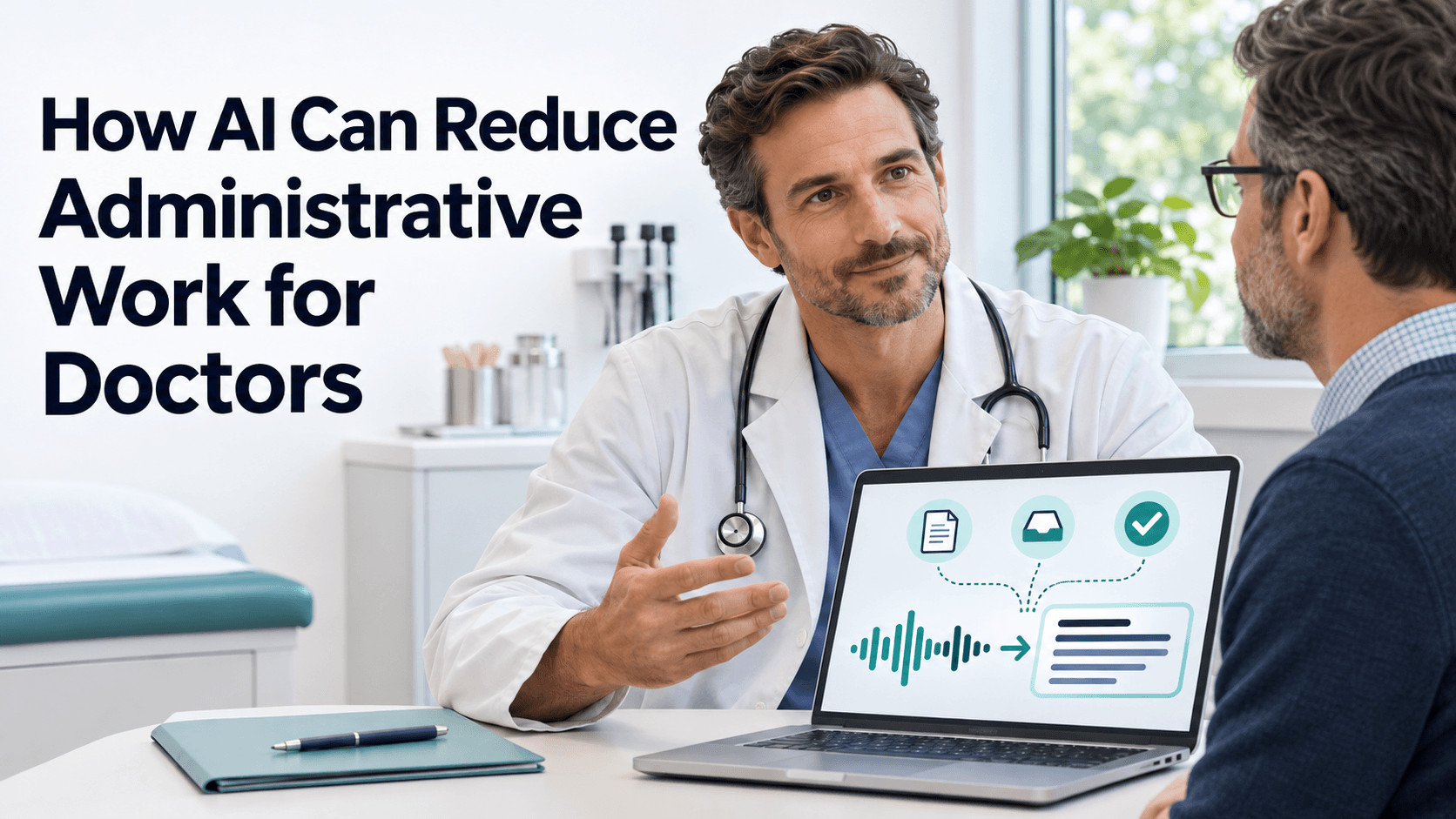
Artificial intelligence (AI) is changing the way healthcare professionals manage clinical documentation, patient information, and administrative responsibilities. One emerging technology attracting attention across healthcare systems is the AI medical scribe. These AI-powered tools help doctors document patient consultations by converting conversations into structured clinical notes, reducing the need for manual data entry and repetitive administrative tasks.
Overview of Content
ToggleTraditional medical documentation requires healthcare professionals to record patient symptoms, medical histories, examination findings, diagnoses, and treatment plans. Although accurate documentation is essential for patient care, completing these tasks can take considerable time and contribute to administrative workload. AI medical scribes aim to simplify this process by using speech recognition, natural language processing (NLP), and large language models (LLMs) to generate draft clinical notes from doctor-patient conversations.
AI medical scribes may improve documentation efficiency, support more patient-focused consultations, and reduce some of the administrative burden experienced by clinicians. However, their use also introduces important concerns involving patient privacy, documentation accuracy, algorithmic bias, informed consent, and professional accountability. Understanding the benefits and risks of AI medical scribes is essential for healthcare organizations considering their implementation.
What Are AI Medical Scribes?
AI medical scribes are artificial intelligence-powered documentation systems designed to assist healthcare professionals during patient consultations. They capture or process clinical conversations, identify relevant medical information, and generate structured documentation for electronic health records (EHRs).
Unlike traditional human medical scribes, who manually document conversations and clinical observations, AI medical scribes use automated technologies to process spoken language and organize information into written medical notes.
Many modern systems use ambient clinical documentation technology. This allows an AI application to listen to a consultation in the background, with appropriate patient permission, while the healthcare professional interacts with the patient.
AI medical scribes can help generate several types of clinical documentation, including:
- History of present illness (HPI).
- Patient symptoms and medical history.
- Review of systems (ROS).
- Physical examination summaries.
- Clinical assessment and diagnosis documentation.
- Treatment plans and follow-up instructions.
- Referral and consultation summaries.
The generated documentation is generally intended as a draft. Healthcare professionals must review and correct the information before approving it for inclusion in the patient’s medical record.
How Do AI Medical Scribes Work?
AI medical scribes combine several artificial intelligence technologies to transform spoken clinical conversations into structured medical documentation.
1. Audio Capture and Speech Recognition
The process begins when an AI scribe receives audio from a patient consultation. Depending on the system, this may involve a microphone, mobile device, computer application, or integrated clinical platform.
Automatic speech recognition (ASR) converts spoken words into text. The technology is designed to recognize different speakers, medical terminology, and conversational language.
2. Natural Language Processing (NLP)
Natural Language Processing helps the system interpret the meaning and context of spoken language. Instead of simply transcribing every sentence, NLP technologies identify relevant information, such as symptoms, medications, medical history, and clinical observations.
For example, an AI medical scribe may recognize that a patient is describing a symptom that began several days earlier and organize that information into the appropriate section of a clinical note.
3. Large Language Models (LLMs)
Large language models analyze the transcribed conversation and generate readable clinical summaries. They can organize unstructured information into standardized documentation formats, such as SOAP notes.
SOAP stands for:
- Subjective: Information reported by the patient.
- Objective: Observable findings and examination results.
- Assessment: The clinician’s evaluation of the patient’s condition.
- Plan: The proposed treatment, investigation, or follow-up approach.
The AI system may also identify missing information or organize relevant details into specific sections. However, it must not be treated as an independent diagnostic authority.
4. Electronic Health Record Integration
After generating a draft, some AI medical scribes transfer the documentation into an electronic health record system.
This integration can reduce repetitive data entry and help clinicians maintain organized patient records. The exact workflow depends on the software, healthcare organization’s systems, and available integrations.
5. Clinician Review and Approval
The final stage involves human review. Healthcare professionals check the generated notes for incorrect terminology, missing information, inaccurate details, and contextual errors.
The clinician makes necessary corrections and approves the documentation before it becomes part of the official medical record.
Benefits of AI Medical Scribes
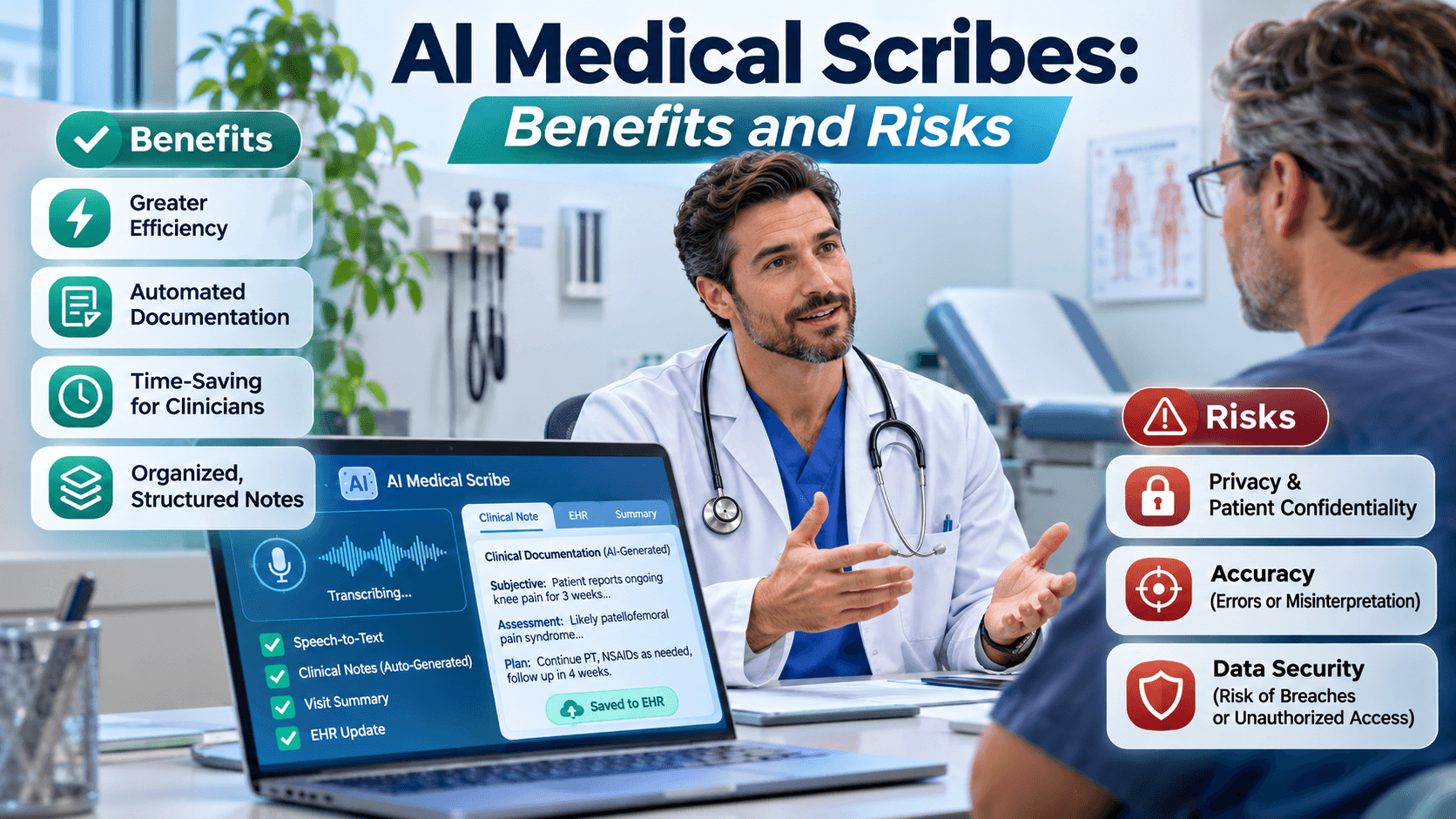
AI medical scribes offer several potential advantages for healthcare professionals, patients, and healthcare organizations. Their primary purpose is to simplify clinical documentation while supporting the quality and efficiency of healthcare workflows.
1. Reduced Administrative Workload
One of the main benefits of AI medical scribes is their potential to reduce the administrative workload associated with clinical documentation.
Doctors traditionally spend time typing consultation notes, updating electronic health records, and organizing patient information. AI-powered documentation tools can automate parts of this process by generating draft notes from clinical conversations.
A 2026 report from the U.S. Government Accountability Office describes evidence of reduced documentation time in one study, including an approximately 20% reduction, equivalent to two minutes per appointment. However, results may vary across healthcare settings and AI systems.
Reducing repetitive documentation tasks may allow healthcare professionals to allocate more time to clinical responsibilities and patient communication.
2. More Patient-Focused Consultations
Traditional documentation often requires doctors to divide their attention between patients and computer screens.
AI medical scribes may reduce this distraction by capturing and organizing consultation information in the background. This can allow doctors to maintain better eye contact, listen more attentively, and engage in more natural conversations.
Improved patient interaction may also help healthcare professionals understand patient concerns and communicate more effectively.
3. Improved Clinical Documentation Efficiency
AI medical scribes can organize information into structured clinical notes, helping healthcare professionals prepare documentation more efficiently.
These systems may identify important details from consultations, organize symptoms and medical histories, and create summaries that can be reviewed and edited by clinicians.
Structured documentation can also support continuity of care by making relevant patient information easier for other authorized healthcare professionals to understand.
4. Reduced Documentation-Related Stress
Administrative responsibilities are one factor contributing to clinician workload and occupational stress.
Completing medical records after appointments can extend working hours and create additional pressure for healthcare professionals.
AI medical scribes may reduce some of this documentation burden by automating repetitive tasks. However, their impact on long-term burnout remains uncertain and depends on factors such as system accuracy, workflow integration, and the amount of editing required.
5. Better Organization of Patient Information
AI medical scribes can organize unstructured conversations into readable clinical summaries.
For example, patient-reported symptoms, relevant medical history, and consultation plans can be arranged into separate documentation sections.
This may improve the consistency and readability of clinical notes, particularly in healthcare environments with high documentation demands.
However, better organization does not automatically guarantee greater clinical accuracy. Human verification remains necessary.
6. Support for Healthcare Workflow Efficiency
AI medical scribes may help healthcare facilities streamline documentation processes and reduce repetitive administrative work.
When integrated effectively with electronic health record systems, they can support faster note preparation, standardized documentation, and more organized information management.
These improvements may benefit hospitals, outpatient clinics, and private medical practices, although implementation costs and technical requirements must be considered.
Risks and Challenges of AI Medical Scribes
Despite their potential benefits, AI medical scribes introduce several technological, ethical, and operational challenges. Their outputs are not always accurate, and inappropriate implementation can create risks for patients and healthcare professionals.
1. Patient Privacy and Data Security
Patient privacy is one of the most important concerns associated with AI medical scribes.
These systems may process sensitive information, including personal details, medical histories, symptoms, medications, and other confidential health information.
Depending on the software, audio recordings and transcripts may be transmitted to external servers or processed by third-party AI providers.
If healthcare organizations do not implement appropriate security measures, patient information may become vulnerable to unauthorized access, accidental disclosure, or data breaches.
Healthcare providers should evaluate data encryption, access controls, data retention policies, vendor agreements, and applicable privacy regulations before implementing AI documentation systems.
2. Inaccurate Medical Documentation
AI medical scribes can misunderstand conversations, misinterpret medical terminology, or generate incorrect information.
For example, a system may incorrectly recognize a medication name, record an inaccurate numerical value, or confuse information reported by a patient with information observed by a clinician.
Such errors can affect the completeness and reliability of medical records.
A 2025 review of AI scribe technology published in Plastic and Reconstructive Surgery Global Open identifies omissions, fabrications, and substitutions as important limitations of AI-generated clinical documentation.
For this reason, healthcare professionals must verify generated notes before signing or approving them.
3. AI Hallucinations
AI hallucinations occur when an artificial intelligence system generates information that appears reasonable but is not supported by the original input.
In medical documentation, this may involve adding an examination finding, medication detail, symptom, or clinical statement that was never mentioned during the consultation.
This is particularly concerning because inaccurate information can appear convincing when presented in professional medical language.
AI medical scribes should therefore be designed and evaluated to minimize unsupported content, while clinicians should independently verify important statements.
4. Algorithmic Bias and Language Limitations
AI medical scribes may perform differently depending on accents, speaking patterns, languages, background noise, and the complexity of clinical conversations.
Systems trained on limited or unrepresentative datasets may struggle to accurately interpret certain speech patterns or medical terminology.
This can result in missing information, inaccurate transcriptions, or unequal documentation quality across patient populations.
Multilingual consultations may present additional challenges, especially when patients and clinicians switch between languages during a conversation.
Healthcare organizations should evaluate system performance across different patient populations, languages, and clinical specialties.
5. Dependence on Artificial Intelligence
Overreliance on AI-generated documentation can create problems if healthcare professionals become less attentive to reviewing the information.
Although AI scribes can assist with administrative tasks, they cannot independently replace clinical judgment, professional expertise, or direct patient assessment.
Clinicians must remain responsible for verifying medical information and ensuring that documentation accurately reflects the consultation.
AI-generated notes should support professional decision-making rather than determine it.
6. Legal and Ethical Responsibility
The introduction of AI medical scribes raises questions about professional accountability, documentation ownership, and responsibility for errors.
If an AI system generates inaccurate information that enters a patient’s medical record, healthcare organizations must have clear policies for reviewing, correcting, and documenting such errors.
The clinician approving the medical record must maintain responsibility for the accuracy of the final documentation, in accordance with applicable professional and legal requirements.
Healthcare providers should also establish clear policies governing patient consent, data processing, record retention, and vendor responsibilities.
7. Implementation Costs and Technical Limitations
Introducing AI medical scribes may require investment in software subscriptions, compatible devices, technical infrastructure, staff training, and ongoing support.
Smaller healthcare practices may find these costs challenging.
Technical compatibility can also become an issue when AI systems do not integrate smoothly with existing electronic health record platforms.
Internet connectivity, system interruptions, and software maintenance may further affect daily clinical workflows.
Healthcare organizations should evaluate the total cost of implementation rather than considering software subscription prices alone.
AI Medical Scribes vs. Traditional Human Medical Scribes
AI medical scribes and traditional human medical scribes share the same general purpose: supporting clinical documentation and reducing administrative responsibilities.
However, their working methods and operational requirements are different.
| Feature | AI Medical Scribes | Human Medical Scribes |
|---|---|---|
| Documentation method | Automated AI processing | Manual documentation |
| Speech recognition | Automated | Human listening |
| Note generation | AI-generated drafts | Human-written notes |
| Availability | Depends on software access | Depends on staff availability |
| Contextual interpretation | May misunderstand context | Can use human judgment |
| Documentation review | Requires clinician verification | Human scribe and clinician review |
| Scalability | Can be deployed across multiple users | Requires additional personnel |
| Privacy considerations | Digital data and vendor security | Human confidentiality and access controls |
| Operating costs | Software and infrastructure costs | Staffing and training costs |
Neither approach is automatically suitable for every clinical environment. Healthcare organizations should evaluate documentation accuracy, workflow requirements, privacy, and overall costs when selecting a documentation method.
Ethical Considerations When Using AI Medical Scribes
Responsible implementation requires healthcare organizations to consider patient rights, confidentiality, transparency, and professional accountability.
Informed Patient Consent
Patients should be informed when AI technology is being used to process their consultations.
Healthcare professionals should explain what information is collected, how it is processed, and whether recordings or transcripts are retained.
Patients should have a clear opportunity to ask questions and decline AI scribe use where applicable.
Confidentiality and Data Protection
AI medical scribe providers should implement appropriate safeguards to protect sensitive patient information.
Healthcare organizations should understand how vendors process, store, transfer, and retain patient data.
Access should be restricted to authorized individuals, and data handling should follow applicable privacy requirements.
Human Oversight
AI-generated documentation should be reviewed by qualified healthcare professionals.
Clinicians should verify important details, correct errors, and ensure that the final record accurately represents the consultation.
Transparency and Accountability
Healthcare organizations should establish clear policies describing the responsibilities of clinicians, administrators, and technology providers.
Transparent documentation practices can help maintain patient trust and ensure that AI is used as a supporting technology rather than an independent medical authority.
Best Practices for Implementing AI Medical Scribes
Healthcare organizations can improve the safety and effectiveness of AI medical scribes by establishing appropriate implementation and monitoring procedures.
Important considerations include:
- Evaluate documentation accuracy: Test AI-generated notes against independently reviewed clinical records before wider adoption.
- Establish consent procedures: Inform patients about AI-assisted documentation and explain available choices.
- Protect patient information: Review data encryption, access controls, storage, and retention policies.
- Train healthcare professionals: Ensure clinicians understand how the system works and recognize its limitations.
- Maintain human oversight: Require clinicians to review and approve generated documentation.
- Monitor system performance: Regularly assess errors, omissions, and documentation quality.
- Evaluate workflow integration: Confirm compatibility with existing electronic health record systems.
- Review implementation costs: Consider software, training, maintenance, and technical support expenses.
These measures can help healthcare facilities introduce AI documentation technology while maintaining appropriate standards of patient safety and professional responsibility.
Future of AI Medical Scribes
The future of AI medical scribes will depend on improvements in speech recognition, natural language processing, clinical language models, and electronic health record integration.
Emerging systems may become better at recognizing medical terminology, handling multilingual consultations, distinguishing between speakers, and organizing complex clinical conversations.
Greater integration with healthcare information systems may also allow AI scribes to support more comprehensive documentation workflows.
However, technological improvements alone will not guarantee safe implementation. Independent validation, privacy protections, appropriate regulation, and human oversight will remain essential.
As healthcare organizations gain more experience with these systems, future research will help establish which applications provide meaningful improvements in documentation quality, clinician workload, and patient experience.
FAQs
1. What is an AI medical scribe?
An AI medical scribe is an artificial intelligence-powered tool that processes doctor-patient conversations and generates draft clinical documentation. It uses technologies such as speech recognition, natural language processing, and large language models to organize medical information.
2. How do AI medical scribes work?
AI medical scribes capture or process consultation audio, convert spoken language into text, identify relevant clinical information, and generate structured medical notes. Healthcare professionals review and approve the resulting documentation.
3. What are the main benefits of AI medical scribes?
The main potential benefits include reduced administrative workload, faster clinical documentation, more patient-focused consultations, improved organization of medical information, and support for healthcare workflow efficiency.
4. What are the risks of AI medical scribes?
Important risks include inaccurate documentation, AI hallucinations, patient privacy concerns, data security vulnerabilities, algorithmic bias, technical limitations, and overreliance on automated systems.
5. Can AI medical scribes replace human medical scribes?
AI medical scribes can automate parts of clinical documentation, but they do not eliminate the need for human oversight. Healthcare professionals remain responsible for verifying the accuracy and completeness of medical records.
6. Are AI medical scribes accurate?
Their accuracy varies depending on the technology, clinical specialty, conversation complexity, language, and environmental conditions. They can generate omissions and incorrect information, so clinicians must review the documentation before approval.
7. Do AI medical scribes record patient conversations?
Many ambient AI scribes process audio from clinical consultations. The specific recording, transcription, storage, and deletion practices depend on the software provider and the healthcare organization’s policies.
8. How do AI medical scribes protect patient privacy?
Privacy protections may include encryption, access restrictions, secure data processing, retention limits, and contractual safeguards. Healthcare organizations must evaluate these protections before using an AI scribe.
9. Can AI medical scribes integrate with electronic health records?
Many AI scribe platforms offer integration with electronic health record systems. Integration capabilities vary depending on the software provider and the healthcare organization’s technical infrastructure.
10. What is the future of AI medical scribes?
Future developments may improve medical speech recognition, documentation quality, multilingual support, and healthcare system integration. Their long-term success will depend on clinical validation, responsible implementation, and appropriate human supervision.
Conclusion
AI medical scribes represent an emerging development in healthcare documentation, offering opportunities to reduce administrative workload, improve documentation efficiency, and support more patient-focused consultations. By using speech recognition, natural language processing, and large language models, these systems can transform clinical conversations into structured medical notes.
However, their implementation also introduces important challenges involving patient privacy, inaccurate documentation, AI hallucinations, algorithmic bias, technical limitations, and professional accountability.
AI medical scribes should therefore be considered supportive documentation tools rather than replacements for healthcare professionals. Their effectiveness depends on reliable technology, informed patient consent, appropriate data protection, continuous evaluation, and human verification.
A balanced approach combining artificial intelligence with clinical expertise can help healthcare organizations improve documentation workflows while maintaining patient safety, confidentiality, and the quality of healthcare delivery.