What Are the Best Uses of AI for Independent Physician Practices?
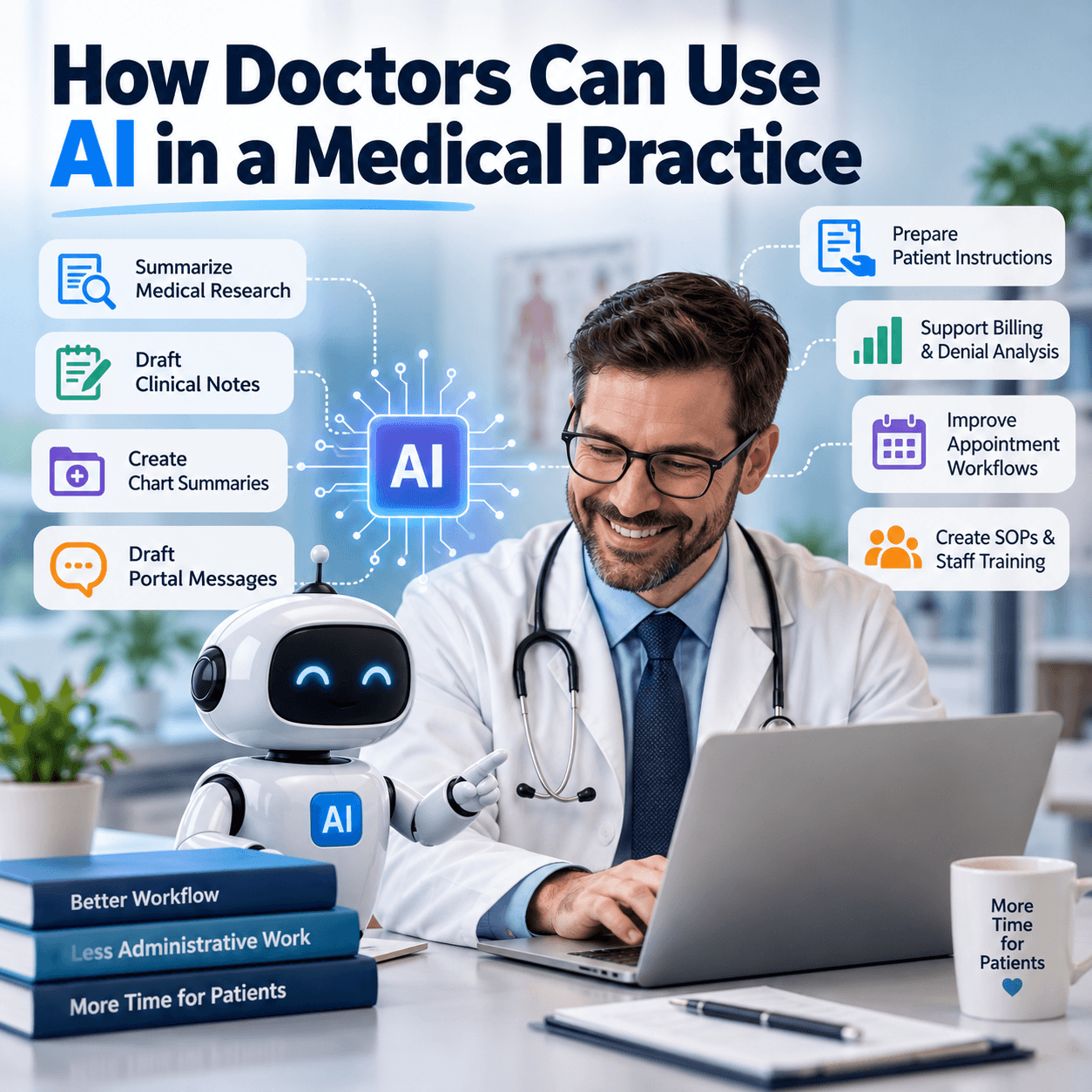
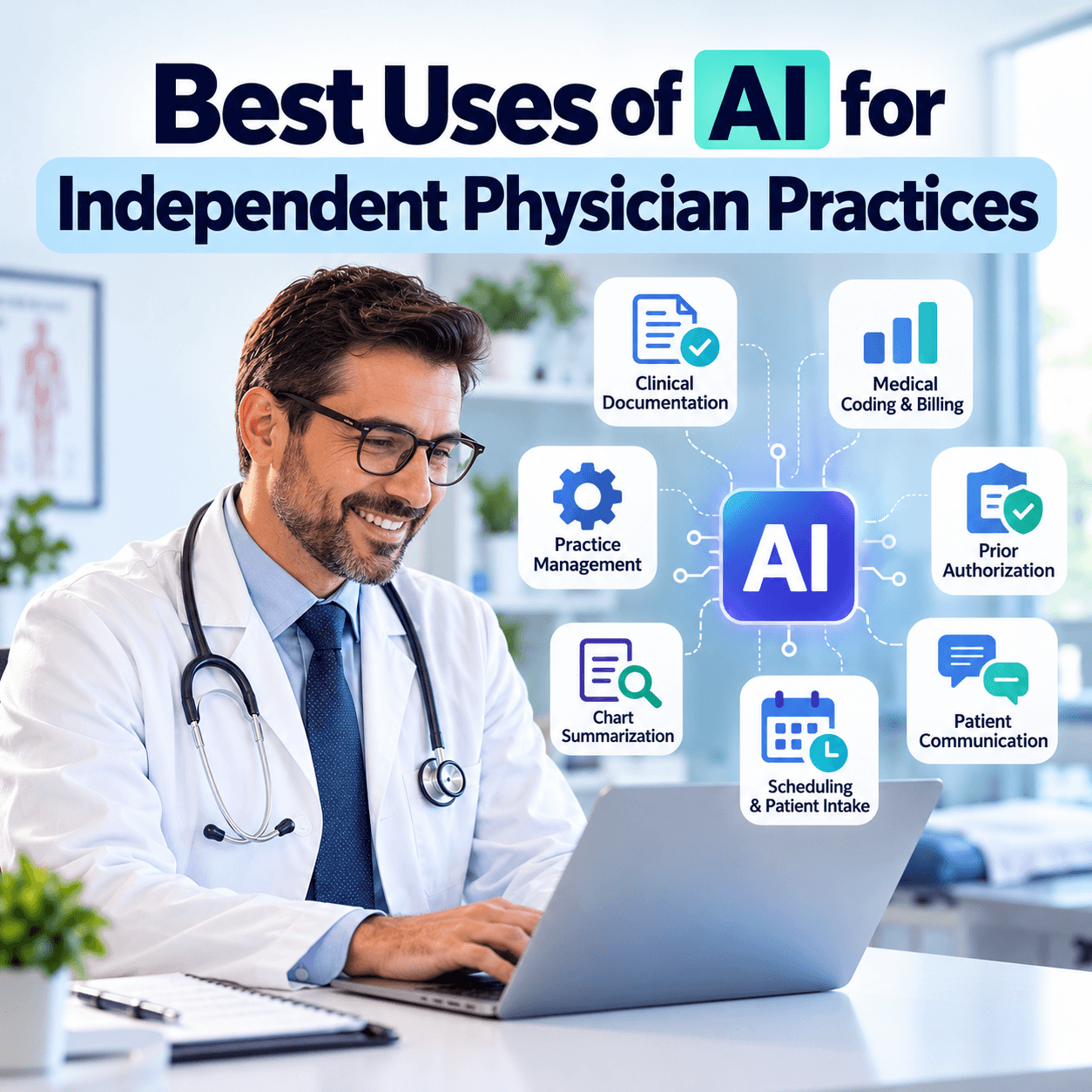
The best uses of AI for independent physician practices include clinical documentation, medical coding, prior authorization, patient messaging, scheduling, chart summarization, patient education, and practice analytics.
Table of Contents
ToggleFor most independent practices, AI is most valuable when it removes repetitive administrative work. The goal is not to replace physicians. It is to give physicians and staff more time for patient care and other work that requires human judgment.
AI adoption among physicians is also growing quickly. According to the American Medical Association (AMA), 81% of physicians surveyed in 2026 reported using AI professionally, compared with 38% in 2023.
Why Should Independent Physician Practices Use AI?
Independent practices can use AI to reduce administrative workload and make everyday workflows more efficient. This can be especially valuable for smaller practices with limited staff and technology resources.
Administrative burden is one of the clearest opportunities. AMA research found that physicians see reducing administrative burden through automation as one of AI’s biggest potential benefits.
AI can help a practice spend less time on repetitive tasks such as:
- Writing clinical notes
- Reviewing long patient records
- Preparing prior authorizations
- Drafting routine patient messages
- Processing intake information
- Reviewing coding information
- Managing schedules
The strongest AI use cases usually support physicians and staff rather than make important decisions independently.
What Are the Best Uses of AI for Independent Physician Practices?
The most useful AI applications solve frequent and measurable workflow problems. Documentation is often a strong place to start, followed by administrative and revenue-cycle tasks.
| AI use | Main benefit | Priority |
|---|---|---|
| Ambient AI scribe | Reduces documentation work | Very high |
| Chart summarization | Speeds record review | High |
| Coding assistance | Supports billing workflows | High |
| Prior authorization | Reduces repetitive work | High |
| Patient messaging | Reduces inbox workload | High |
| Scheduling and intake | Reduces front-desk work | High |
| Research summarization | Saves research time | Medium |
| Practice analytics | Finds workflow problems | Medium |
How Can AI Reduce Clinical Documentation Work?
Ambient AI scribes can listen to physician-patient conversations and create draft clinical notes. The physician then reviews, edits, and approves the note.
This is one of the most promising uses of AI for physicians.
A 2025 multicenter study involving 263 ambulatory clinicians found that reported burnout decreased from 51.9% before ambient AI scribe use to 38.8% after 30 days of use. Researchers also reported improvements in cognitive task load and after-hours documentation.
AI scribes can potentially help physicians:
- Spend less time typing during appointments
- Reduce after-hours charting
- Focus more attention on patients
- Complete notes faster
However, AI-generated notes should always be reviewed. Research has also found occasional clinically significant inaccuracies in AI-generated documentation.
How Can AI Help With Medical Coding and Billing?
AI can analyze clinical documentation and suggest relevant billing or medical codes for human review.
AI can help identify:
- Possible ICD-10-CM codes
- Potential CPT codes
- Missing documentation
- Coding inconsistencies
- Claims that need additional review
- Common reasons for denials
AMA research found that physicians consider AI applications involving billing codes, medical charts, and visit documentation highly relevant to their practices.
AI should assist the coding process rather than submit unchecked claims automatically. The practice remains responsible for accurate documentation and billing.
How Can AI Simplify Prior Authorization?
AI can reduce prior authorization work by collecting information, identifying missing documents, drafting supporting summaries, and tracking authorization status.
For example, AI may help staff:
- Find relevant diagnoses and treatment history
- Gather required documentation
- Identify missing information
- Prepare supporting summaries
- Track authorization requests
Prior authorization is also becoming more digital. CMS has introduced interoperability and prior authorization requirements intended to improve electronic information exchange and reduce administrative burden.
Human review remains important, particularly when medical necessity or patient-specific clinical information is involved.
How Can AI Improve Patient Communication?
AI can draft routine patient messages that physicians or staff review before sending.
Common examples include:
- Appointment instructions
- Routine follow-up messages
- Referral information
- Test preparation instructions
- General educational information
- Draft explanations of routine results
This can reduce the amount of time physicians spend writing similar messages repeatedly.
AI should not independently respond to urgent symptoms, medication changes, abnormal findings, or complex medical questions. Those situations require appropriate clinical review.
How Can AI Improve Scheduling and Patient Intake?
AI can automate routine front-office tasks such as scheduling, reminders, intake processing, and message routing.
For example, AI can help:
- Categorize appointment requests
- Send appointment reminders
- Fill cancelled appointment slots
- Process intake forms
- Identify incomplete forms
- Route messages to the correct staff member
- Answer approved administrative questions
The safest approach is to automate clearly defined administrative tasks.
An AI assistant answering, “What time is my appointment?” carries much less clinical risk than one answering, “Should I stop taking my medication?”
How Can AI Summarize Patient Records and Medical Research?
AI can summarize long patient charts, medical studies, and clinical guidelines so physicians can find important information faster.
For patient records, AI can organize:
- Diagnoses
- Medications
- Recent laboratory results
- Imaging
- Previous encounters
- Treatment history
For research, AI can summarize studies or help identify relevant evidence.
However, AI summaries should be treated as navigation tools rather than replacements for original medical records or research.
Physicians should verify important information before using it for clinical decisions.
How Can AI Improve Practice Management?
AI can analyze practice data and identify operational problems that may otherwise be difficult to notice.
Examples include:
- High no-show periods
- Scheduling bottlenecks
- Common claim denials
- Patient-message volume
- Staff workload patterns
- Referral delays
- Revenue-cycle trends
The value comes from turning data into an action.
For example, AI might identify that cancellations are consistently higher on certain days. The practice could then change reminder timing or scheduling policies.
Which AI Use Cases Should a Small Practice Start With?
Small practices should start with AI applications that solve a frequent problem, are easy to measure, and carry relatively low clinical risk.
A practical priority order is:
- Clinical documentation
- Chart summarization
- Patient-message drafting
- Coding and billing support
- Prior authorization
- Scheduling and intake
- Research and patient education
- Practice analytics
Start with one workflow instead of introducing several AI systems at once.
For example, if physicians spend hours finishing notes after clinic, an ambient AI scribe may provide more immediate value than an advanced predictive analytics platform.
What Are the Risks of Using AI in a Medical Practice?
The biggest risks include inaccurate information, privacy problems, overreliance on AI, weak security, bias, and poor workflow integration.
Independent practices should pay particular attention to protected health information.
HHS guidance explains that when a cloud service provider creates, receives, maintains, or transmits electronic PHI on behalf of a HIPAA-covered organization, the provider generally acts as a business associate. An appropriate business associate agreement may therefore be required.
Before sending PHI to an AI platform, practices should check:
- Whether the vendor signs a BAA
- How patient information is stored
- Whether data is used to train models
- How long data is retained
- Who can access the information
- Whether data is encrypted
- How security incidents are handled
Accuracy is equally important.
Generative AI can produce confident but incorrect information. Clinical outputs should therefore be reviewed by qualified professionals.
A simple rule is:
AI generates → human reviews → important information is verified → authorized person approves.
How Can Independent Practices Choose the Right AI Tool?
Choose AI based on the workflow problem it solves rather than how impressive the technology sounds.
Before purchasing a healthcare AI product, ask:
- Does it integrate with the existing EHR?
- What evidence supports its claims?
- Does it protect PHI appropriately?
- Will the vendor sign a BAA when required?
- Can physicians easily review its output?
- How are errors reported?
- How is data retained or deleted?
- What training will staff need?
- What is the total cost?
- How will ROI be measured?
For clinical AI, practices should also determine whether relevant FDA requirements apply.
The FDA’s clinical decision-support guidance explains important distinctions between certain non-device clinical decision-support functions and software that may be regulated as a medical device.
A small pilot is usually better than immediate practice-wide implementation.
What Are the Key Takeaways?
The best uses of AI for independent physician practices focus on reducing administrative burden while keeping humans responsible for important clinical decisions.
AI can provide practical value through:
- Clinical documentation
- Chart summarization
- Medical coding support
- Prior authorization
- Patient messaging
- Scheduling and intake
- Research summarization
- Patient education
- Practice analytics
Independent practices should start with one clear problem, test the technology on a limited scale, protect patient information, verify AI-generated clinical content, and measure results.
The best AI system is not necessarily the most advanced one. It is the system that solves a real practice problem safely and measurably.
Frequently Asked Questions
What is the best AI use for a small medical practice?
Clinical documentation is often a strong starting point. Ambient AI scribes can reduce note-writing and after-hours documentation while allowing physicians to review the final output.
Can AI reduce physician documentation time?
Yes. Research suggests ambient AI scribes can reduce documentation burden and improve some measures of physician workload, although results vary by tool and setting.
Can AI perform medical coding?
AI can assist with medical coding by suggesting codes and identifying documentation gaps. A qualified person should verify coding before claims are submitted.
Can AI help with prior authorization?
Yes. AI can collect information, identify missing documentation, draft supporting summaries, and track authorization workflows.
Is AI safe for patient information?
It can be, but practices must evaluate the specific system. HIPAA requirements, PHI handling, security, data retention, access controls, and business associate arrangements should be reviewed before patient information is used.
Can AI respond to patient messages?
AI can draft routine responses, but clinical messages should receive appropriate human review. Urgent symptoms, medication changes, and complex medical questions should not be left to an autonomous chatbot.
Will AI replace independent physicians?
AI is better suited to supporting physicians than replacing them. Its strongest current applications reduce administrative and information-processing work while physicians remain responsible for patient care.
What should a practice check before buying an AI tool?
Check EHR integration, accuracy, evidence, HIPAA and security controls, BAA availability, human-review requirements, regulatory considerations, total cost, and measurable ROI.