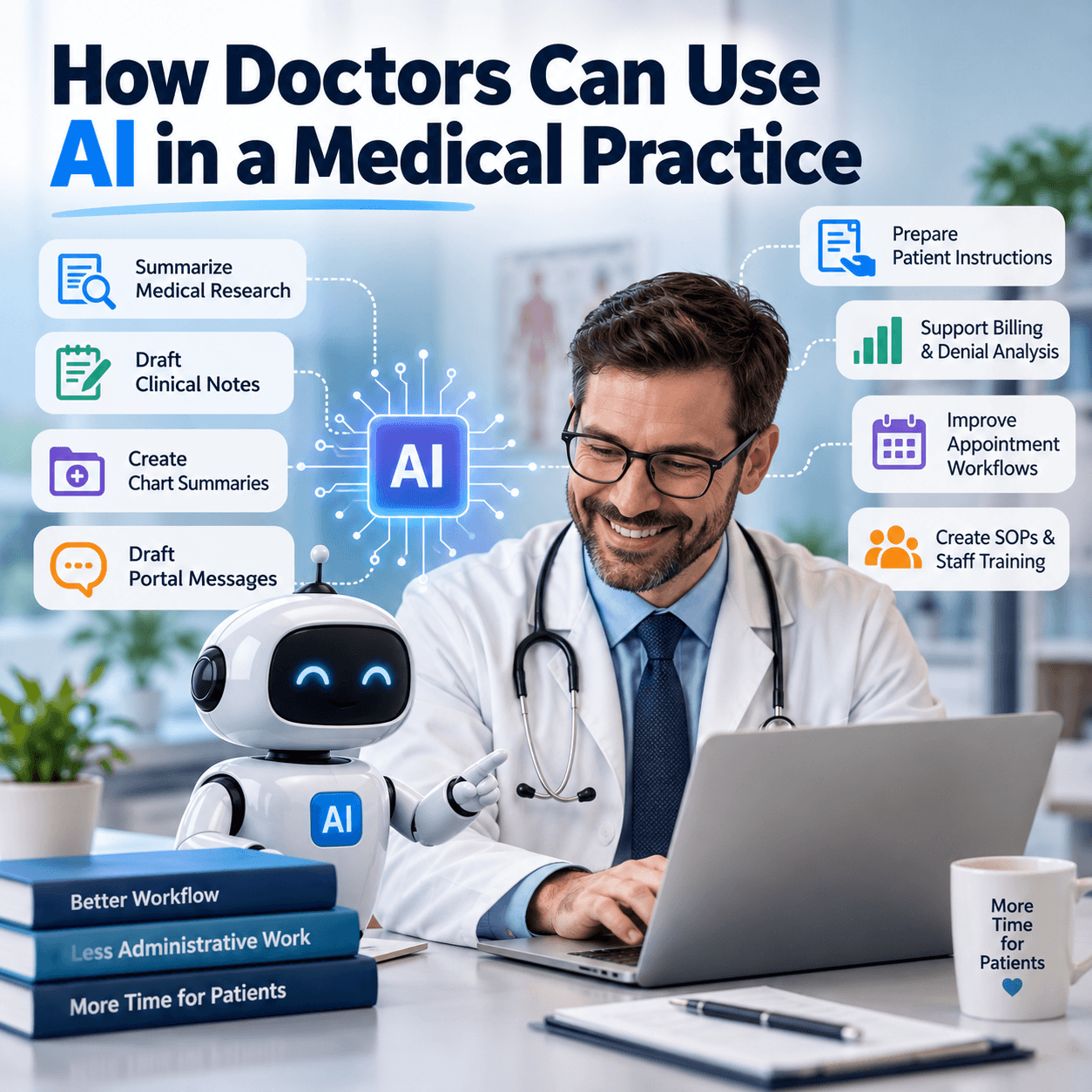
How Doctors Can Use AI in a Medical Practice Without Losing the Human Side of Care
Artificial intelligence is no longer something physicians can treat as a “future trend.”
It is already inside medical practices.
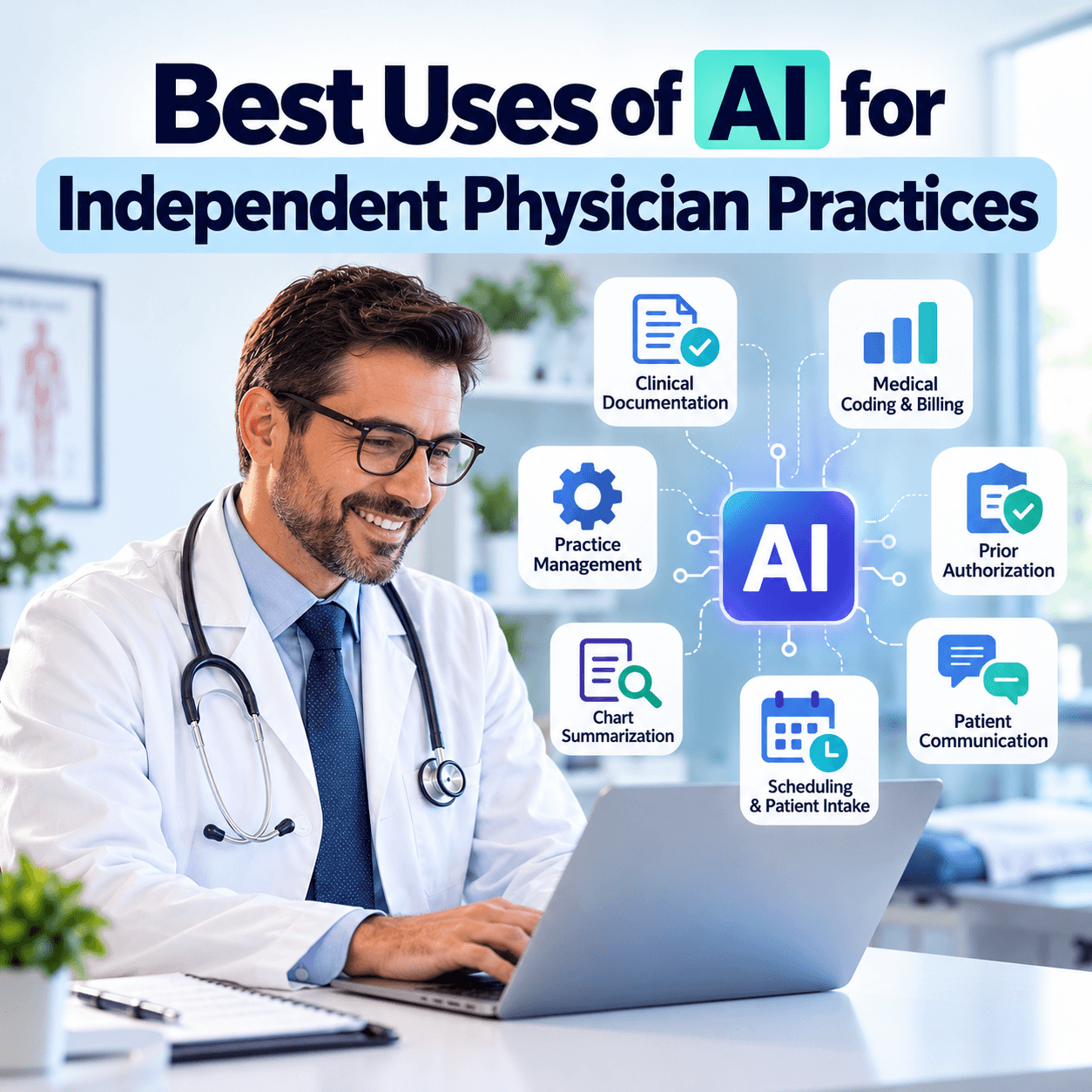
Doctors are using AI to summarize research, draft notes, prepare patient instructions, review charts, respond to portal messages, and support clinical decisions. In the AMA’s 2026 physician survey, 81% of physicians said they use AI professionally, more than double the 38% reported in 2023. The most common use was summarizing medical research and standards of care. American Medical Association
That sounds impressive.
But here is the more useful question:
How should a doctor actually use AI in daily practice without creating new risks, extra work, or problems with patient trust?
Because the real value of AI is not that it can “do medicine.”
The value is that it can remove friction around the work physicians already do.
And when used well, that can mean more time for patients, less time on repetitive administrative work, and fewer hours spent after clinic trying to catch up.
Table of Contents
ToggleAI Should Support the Physician, Not Replace the Physician
This is the principle I would keep at the center of every AI decision in a medical practice.
AI can:
- organize information,
- summarize,
- draft,
- suggest,
- flag,
- compare,
- automate repetitive tasks.
But the physician still needs to apply:
- clinical judgment,
- patient context,
- professional responsibility,
- communication,
- empathy,
- and final decision-making.
The AMA has been very clear on this point. Its current guidance emphasizes AI as an assistive technology that should enhance physician work rather than replace physician judgment. American Medical Association
That distinction matters.
A good AI workflow looks like:
AI prepares → physician reviews → physician decides
Not:
AI decides → physician signs
1. Use AI to Summarize Medical Research
This is one of the most practical uses of AI for busy physicians.
Medical research changes constantly.
No physician can realistically read every new paper, guideline update, specialty bulletin, and regulatory change.
AI can help summarize:
- new studies,
- clinical guidelines,
- review articles,
- standards of care,
- policy updates,
- drug safety information,
- specialty recommendations.
In the AMA’s 2026 survey, 39% of physicians reported using AI to summarize medical research and standards of care, making it the most commonly reported use case. American Medical Association
Good use
Ask AI to help you quickly understand:
- What changed in this guideline?
- What are the key findings of this paper?
- What is different from the previous recommendation?
- What are the limitations of this study?
Important caution
Do not rely only on the AI-generated summary.
Check the original source when the information will influence patient care.
AI is useful for:
finding the important part faster
not replacing the source itself.
2. Use AI to Reduce Documentation Burden
For many physicians, documentation is one of the biggest reasons work follows them home.
AI can help with:
- draft visit notes,
- structured summaries,
- progress-note organization,
- discharge instructions,
- chart summaries,
- documentation cleanup,
- converting dictated information into structured text.
The AMA found that 30% of physicians surveyed were using AI for discharge instructions, care plans, or progress notes, while 28% used it for billing codes, charts, or visit documentation. American Medical Association
This can be extremely valuable.
But the workflow matters.
Better workflow
Physician sees patient.
↓
AI creates draft documentation.
↓
Physician reviews clinical accuracy.
↓
Physician corrects errors or missing context.
↓
Final note is signed.
Poor workflow
AI creates note.
↓
Nobody carefully checks it.
↓
Incorrect information becomes part of the medical record.
That is exactly the kind of shortcut practices should avoid.
3. Use AI to Create Chart Summaries
Imagine a patient with:
- ten years of history,
- multiple specialists,
- dozens of medications,
- repeated hospitalizations,
- hundreds of notes.
Reading the entire chart before a short appointment can be difficult.
AI can help generate a structured summary of:
- major diagnoses,
- recent hospitalizations,
- medications,
- lab trends,
- imaging,
- specialist recommendations,
- pending follow-up,
- significant changes.
The AMA reported that 28% of surveyed physicians were using AI to generate chart summaries in 2026. American Medical Association
This is one of the most useful examples of AI reducing cognitive overload.
But again:
The physician should treat the summary as an aid, not as the complete record.
Important details can be missed or misinterpreted.
4. Draft Patient Portal Responses
Portal messages can consume a surprising amount of physician and staff time.
AI can help draft responses for common questions such as:
- medication refill requests,
- follow-up instructions,
- appointment reminders,
- general education,
- lab-result explanations,
- next-step guidance.
The AMA found that 19% of physicians were already using AI to draft patient portal messages. American Medical Association
A good process is:
AI drafts → clinician reviews → clinician personalizes → message is sent
The patient should still feel that a healthcare professional understood their question.
That human element matters.
5. Create Patient-Friendly Instructions
Doctors often know exactly what they want the patient to do.
The challenge is explaining it in language the patient can easily understand.
AI can help turn complex clinical wording into:
- simpler discharge instructions,
- plain-language care plans,
- medication explanations,
- preparation instructions,
- follow-up steps,
- patient FAQs.
For example, a physician could convert:
“Maintain glycemic surveillance and return for reassessment in three months.”
into:
“Continue checking your blood sugar as directed and schedule a follow-up visit in about three months.”
That is not sophisticated medicine.
But it can significantly improve communication.
6. Translate Patient Communication
AI can assist with translation and multilingual communication.
The AMA’s 2026 survey reported that 18% of physicians were using AI for translation services. American Medical Association
This may help practices create:
- appointment instructions,
- educational materials,
- follow-up messages,
- general administrative communication.
But practices should be careful when the information is clinically sensitive.
For complex medical discussions, informed consent, or situations where misunderstanding could affect care, qualified interpreter services may still be necessary.
AI translation should not automatically replace professional medical interpretation.
7. Support Clinical Decision-Making Carefully
This is where AI becomes more powerful—and where caution becomes more important.
Some AI tools can support physicians by:
- organizing differential diagnoses,
- identifying patterns,
- highlighting abnormal findings,
- prioritizing information,
- assisting with imaging interpretation,
- estimating risk,
- suggesting evidence to review.
The FDA regulates certain AI-enabled medical devices and clinical software depending on their intended function. As of September 2026, the FDA reports that more than 1,600 AI-enabled medical devices had been authorized for marketing in the United States. U.S. Food and Drug Administration
The FDA also distinguishes between certain clinical decision-support functions that may fall outside the definition of a medical device and functions that remain regulated as devices. U.S. Food and Drug Administration
Practical rule
If an AI tool influences diagnosis, treatment, risk prediction, or clinical decisions, physicians should understand:
- what the tool is intended to do,
- what information it uses,
- how it was validated,
- whether clinicians can understand the basis for its output,
- what limitations exist,
- whether it is appropriate for the patient population.
Do not treat an AI recommendation as automatically correct because it appears sophisticated.
8. Use AI for Billing and Coding Support
AI can also support revenue-cycle workflows.
Potential uses include:
- identifying possible missing codes,
- suggesting coding based on documentation,
- detecting claim inconsistencies,
- checking for incomplete information,
- highlighting documentation gaps,
- organizing denial reasons,
- prioritizing A/R follow-up.
This can save time.
But coding still needs proper oversight.
AI should not be used to:
- invent documentation,
- increase codes without support,
- automatically select higher-level services,
- bypass coding rules.
The safest principle is:
Use AI to improve accuracy and identify issues—not to manufacture reimbursement.
9. Use AI to Analyze Denials
This is one of the most valuable operational uses for a medical practice.
Instead of manually reviewing hundreds of denials, AI can help categorize them into patterns such as:
- eligibility,
- authorization,
- coding,
- medical necessity,
- timely filing,
- credentialing,
- documentation,
- duplicate claims.
Then the practice can ask:
Which denial category is costing us the most money?
Which payer creates the most rework?
Which problems are preventable?
This turns AI into a process-improvement tool.
It is not just saving time.
It is helping management see patterns that may otherwise stay hidden.
10. Use AI for Accounts Receivable Prioritization
Not every unpaid claim deserves the same attention at the same time.
AI can help prioritize A/R based on:
- balance amount,
- age,
- payer,
- denial reason,
- previous follow-up,
- timely-filing limits,
- likelihood of recovery.
Instead of staff randomly working through a list of claims, the practice can focus first on:
high-value + high-risk + actionable accounts
That can make A/R work far more efficient.
11. Improve Appointment Scheduling
AI can support scheduling by helping identify:
- open slots,
- cancellation opportunities,
- appointment patterns,
- no-show risk,
- provider availability,
- patient recall opportunities.
For example:
A practice may have 15 cancellations this week.
AI could help identify patients who:
- are overdue for follow-up,
- asked for an earlier appointment,
- live nearby,
- are appropriate for the available slot.
That does not require clinical AI.
It is simple operational intelligence.
And it can improve practice utilization.
12. Reduce No-Shows
AI can also help practices identify patterns behind missed appointments.
For example:
- certain appointment times,
- certain visit types,
- long booking lead times,
- patients with repeated no-shows,
- specific reminder patterns.
That can help the practice improve:
- reminders,
- confirmations,
- waitlist management,
- rescheduling.
The goal is not to label patients.
It is to improve the scheduling process.
13. Support Front Desk Teams
Your front desk deals with repetitive questions every day:
- What time is my appointment?
- Do you accept my insurance?
- What should I bring?
- Where is the office?
- How do I reschedule?
- When will I receive my forms?
AI can support administrative workflows by helping staff:
- draft standardized responses,
- organize frequently asked questions,
- summarize incoming requests,
- prioritize messages,
- prepare call notes.
This is one area where AI can reduce repetitive work without touching clinical decision-making.
14. Create Standard Operating Procedures
Many medical practices have workflows stored in one person’s memory.
That becomes a problem when that employee:
- takes leave,
- resigns,
- changes roles,
- becomes overloaded.
AI can help practices turn informal processes into written SOPs for:
- patient intake,
- insurance verification,
- prior authorization,
- referrals,
- credentialing,
- billing follow-up,
- patient calls,
- fax handling,
- records requests.
A manager can describe the current workflow and use AI to structure it.
Then the practice reviews and approves the final SOP.
That is an excellent use of AI.
15. Train New Staff Faster
Once SOPs exist, AI can help convert them into:
- training guides,
- checklists,
- quizzes,
- role-play scenarios,
- onboarding plans,
- quick-reference sheets.
For example:
Instead of handing a new receptionist a 50-page policy manual, the practice could create:
“Top 20 things you need to know during your first week.”
That makes onboarding more practical.
16. Use AI to Prepare Meetings and Reports
Practice managers spend time collecting information for:
- monthly revenue meetings,
- provider meetings,
- billing reviews,
- quality meetings,
- staffing discussions.
AI can help summarize:
- KPI reports,
- denial trends,
- A/R changes,
- call-volume reports,
- staffing data,
- patient feedback.
Instead of presenting 12 spreadsheets, management can present:
What changed → Why it matters → What needs action
That is a much better use of everyone’s time.
Where Doctors Should Be Careful With AI
AI can save time.
But it also introduces new risks.
The AMA’s 2026 physician research found that physicians continue to have significant concerns about patient privacy and the integrity of the physician-patient relationship. American Medical Association
The areas that deserve the most attention are:
Patient privacy
Do not paste identifiable patient information into a consumer AI tool simply because it is convenient.
Before using AI with protected health information, practices should understand:
- who receives the data,
- how it is stored,
- whether the vendor uses it for training,
- how long it is retained,
- what security controls exist,
- what contractual protections are available,
- whether the workflow complies with applicable privacy obligations.
Accuracy
AI can sound confident while being wrong.
That makes human review essential.
Bias
AI may perform differently across populations depending on the data used to develop or validate it.
The federal HTI-1 rule introduced transparency requirements for predictive algorithms included in certified health IT, with the goal of giving clinical users more information to evaluate fairness, validity, effectiveness, appropriateness, and safety. ONC Health IT
Overreliance
The more convenient AI becomes, the easier it is to stop checking.
That is exactly what practices should avoid.
Patient trust
If AI is heavily involved in a workflow, especially patient-facing or clinical workflows, practices should consider whether transparency with patients is appropriate.
The AMA now specifically provides guidance around AI transparency, governance, liability, privacy, and ethical use. American Medical Association
A Simple AI Risk Framework for Medical Practices
Before implementing any AI tool, ask five questions:
1. What problem are we solving?
Do not buy AI simply because it is AI.
Start with a real workflow problem.
2. Does the tool handle patient information?
If yes, privacy and security need much closer review.
3. Is this administrative or clinical?
Administrative uses generally carry different risks than tools influencing diagnosis or treatment.
4. Who reviews the AI output?
Every workflow should have clear human ownership.
5. What happens when the AI is wrong?
This is one of the most important questions.
If nobody has an answer, the workflow is not ready.
A Better Way to Start Using AI
Do not try to “AI-enable the entire practice” in one month.
Start small.
Phase 1 — Low-risk administrative work
Try AI for:
- meeting summaries,
- SOP drafting,
- staff training materials,
- patient FAQ drafts,
- policy organization,
- nonclinical email drafts.
Phase 2 — Clinical-adjacent workflows
Then consider:
- chart summaries,
- note drafting,
- discharge instructions,
- portal-message drafts.
Add physician review and clear policies.
Phase 3 — Clinical decision support
Only then evaluate more advanced tools involving:
- diagnosis,
- imaging,
- prediction,
- treatment support.
At this level, validation, regulation, clinical oversight, and vendor due diligence become much more important.
AI Implementation Checklist for a Medical Practice
Before rolling out a new AI tool, check:
☐ What specific problem will it solve?
☐ Who owns the workflow?
☐ Will it receive protected health information?
☐ Has privacy/security been reviewed?
☐ Has the vendor been evaluated?
☐ Does the team understand the tool’s limitations?
☐ Will a physician or qualified staff member review outputs?
☐ How will errors be reported?
☐ How will performance be monitored?
☐ Do we need to update policies or staff training?
☐ How will patients be informed where appropriate?
☐ What happens if the tool becomes unavailable?
That checklist alone can prevent many bad AI implementations.
Do Not Use AI Just to Make Staff Work Faster
This is an important point.
If your process is already broken, adding AI may simply make the broken process move faster.
For example:
If your practice has poor denial workflows, an AI tool will not automatically solve the management problem.
If your staff do not know who owns prior authorization follow-up, AI will not fix ownership.
If your CAQH data is wrong, AI will not magically make payer credentialing accurate.
First fix the workflow.
Then use AI to make the good workflow more efficient.
What AI Could Save Physicians the Most Time?
For many practices, I would look first at:
- documentation
- chart summarization
- research summarization
- portal-message drafting
- administrative communication
- billing review
- denial analysis
- SOP creation
- report summarization
- staff training
These are all areas where AI can reduce repetitive work without asking it to replace the physician.
The Best AI Strategy Is Usually Boring
People often imagine medical AI as:
AI diagnoses disease.
But some of the highest-value use cases are much less dramatic:
AI helps a doctor spend 10 fewer minutes documenting.
AI helps a practice manager understand a denial report.
AI turns a messy procedure into a clear SOP.
AI summarizes 40 pages of policy updates.
AI drafts a patient-friendly explanation.
AI organizes a long chart before an appointment.
Those “boring” improvements can add up to a meaningful change in daily practice.
How Vital Health Services Fits Into This
AI can reduce administrative work.
But technology alone does not run a medical practice.
Practices still need reliable workflows for:
- medical billing,
- revenue cycle management,
- credentialing,
- payer enrollment,
- prior authorization,
- front desk operations,
- documentation handling,
- fax management,
- insurance verification.
Vital Health Services helps medical practices combine people, processes, and administrative support so physicians can spend less time managing operational problems.
If your practice is exploring AI because your team is overloaded, the right first question may not be:
“Which AI tool should we buy?”
It may be:
“Which administrative work should we automate, improve, delegate, or outsource?”
That gives you a much better starting point.
🌐 Vital Health Services
Visit vitalhealthservice.com
Frequently Asked Questions
Can doctors use AI in medical practice?
Yes. Physicians are already using AI for research summaries, documentation, chart summaries, patient communication, translation, and clinical support. In the AMA’s 2026 survey, 81% of physicians reported professional AI use. American Medical Association
Can AI replace doctors?
AI can assist with many tasks, but current medical guidance emphasizes supporting rather than replacing physician judgment. Physicians remain responsible for interpreting patient context and making appropriate clinical decisions. American Medical Association
Can doctors use ChatGPT for patient information?
Doctors and practices should be very cautious about entering identifiable patient information into general-purpose AI systems. Privacy, security, contractual safeguards, and applicable HIPAA obligations should be reviewed before any tool processes protected health information.
Can AI write medical notes?
AI can help draft notes, and many physicians already use AI for documentation. But a qualified clinician should review and correct the output before it becomes part of the medical record. American Medical Association
Is AI regulated in healthcare?
Some AI-enabled technologies, particularly software that qualifies as a medical device, fall under FDA oversight. Other clinical decision-support functions may be treated differently depending on their intended use and characteristics. U.S. Food and Drug Administration
What is the safest way for a small practice to start using AI?
Start with lower-risk administrative tasks, establish clear policies and human review, then gradually evaluate more complex uses. Avoid putting sensitive patient information into tools until privacy and security have been properly assessed.
Final Takeaway
The question is no longer:
“Will doctors use AI?”
They already are.
The more useful question is:
“Which parts of medical practice should AI help with—and which decisions should remain firmly human?”
The practices that benefit most from AI will probably not be the ones that automate everything.
They will be the ones that use it selectively:
AI handles repetition.
Staff manage the workflow.
Physicians apply judgment.
Patients still experience human care.
That is where AI becomes useful rather than distracting.