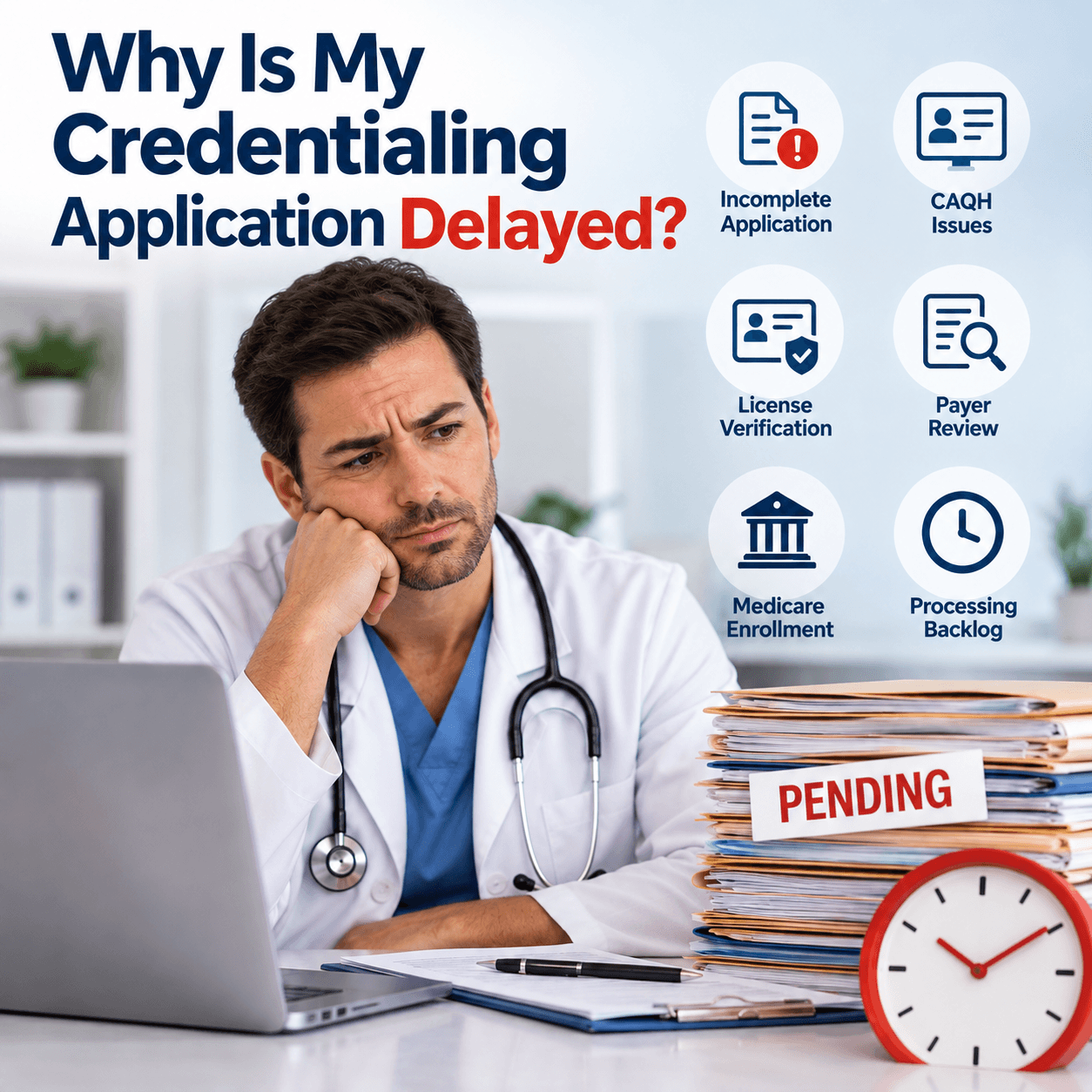
Why Is My Credentialing Application Delayed? 12 Common Causes and What to Do Next
A delayed credentialing application can affect much more than paperwork. It may delay a provider’s start date, payer participation, reimbursement, scheduling, and the practice’s ability to bill certain insurance plans correctly.
If your credentialing application has been pending longer than expected, the problem is often not simply that “credentialing takes time.” There may be a specific issue holding the application at one stage.
Table of Contents
Toggle12 Common Causes of Credentialing Delays
- Incomplete application information
- Missing or expired documents
- Outdated CAQH information
- Inconsistencies between provider records
- Primary-source verification delays
- State licensing issues
- DEA or professional information pending verification
- Unanswered payer requests for additional information
- Medicare enrollment or PECOS processing issues
- Medicare revalidation requirements
- Work history gaps or unclear professional history
- Payer processing backlogs or internal review delays
The key is to identify exactly where the application is stuck instead of repeatedly asking the payer, “Is my credentialing complete?”
A better question is:
“What exact stage is my application in, and what is preventing it from moving to the next step?”
Credentialing Delay Diagnostic Table
Use this table before contacting the payer.
| What You Are Seeing | What May Be Happening | What to Check First | Next Action |
|---|---|---|---|
| Application says “Incomplete” | Missing fields or documents | Application checklist | Ask payer exactly what is missing |
| Application says “Pending” | Verification or internal review | Submission date and current stage | Ask what department currently has it |
| CAQH issue | Profile incomplete or not recently attested | CAQH status and documents | Update, review and attest |
| Payer cannot verify provider | Information does not match | NPI, CAQH, license, W-9 | Correct inconsistent data |
| License verification pending | State license issue or verification delay | State licensing board | Confirm active license information |
| Primary-source verification pending | Education/training/certification being verified | School, residency, board certification | Confirm information and dates |
| Medicare application pending | PECOS or MAC processing | PECOS status | Contact your Medicare Administrative Contractor |
| Medicare payments affected | Revalidation may be overdue | CMS Revalidation List | Complete required revalidation |
| Credentialing approved but claims cannot be billed | Enrollment/effective date may still be pending | Payer participation status | Confirm effective date before billing |
| No response from payer | Internal backlog or application not assigned | Reference/application number | Escalate and establish next follow-up date |
This distinction is important because “pending” does not tell you what is actually pending.
Your goal should be to identify the exact stage:
Submitted → Application Review → Verification → Credentialing Approval → Contracting/Enrollment → Effective Date
How Long Does Medical Credentialing Take?
There is no universal credentialing timeline.
The time required depends on the payer, provider type, state, specialty, application completeness, verification requirements, and whether additional information is requested.
Credentialing involves validating professional information such as medical education, postgraduate training, state licensure, board certification, DEA registration, and other provider data. The American Medical Association explains that health care organizations and payers may use primary-source-verified physician information when evaluating providers for privileges, enrollment, or reimbursement.
Official AMA resource:
AMA — Credentialing 101 for Physicians
Because several organizations may need to verify different parts of a provider’s history, practices should begin credentialing as early as practical.
1. Your Application Is Incomplete
One of the first things to check is whether the payer considers your application complete.
Missing information might include:
- medical education,
- residency or fellowship history,
- employment history,
- state license details,
- malpractice coverage,
- board certification,
- professional references,
- DEA information,
- practice location,
- tax information,
- hospital affiliations,
- ownership details,
- signatures, or
- supporting documentation.
A credentialing department may not be able to move the application forward until required information is received.
What to do
Do not simply ask:
“What is the status of my application?”
Instead ask:
“Is the application considered complete, and is there any document, signature, explanation, or verification currently outstanding?”
That question is much more useful.
2. Your Provider Information Does Not Match Across Systems
Credentialing becomes more difficult when provider data differs across systems.
Review information in:
- CAQH,
- NPPES/NPI records,
- payer applications,
- W-9 documentation,
- professional licenses,
- malpractice insurance,
- Medicare enrollment records,
- group information, and
- practice locations.
Examples of potentially problematic inconsistencies include:
Application: 123 Main Street, Suite 200
CAQH: 123 Main Street, Suite 220
or:
W-9: ABC Primary Care PLLC
Payer application: ABC Primary Care Clinic
Not every formatting difference creates a problem, but material inconsistencies may trigger additional review.
What to check
Compare:
- provider legal name,
- practice legal name,
- NPI,
- taxonomy,
- TIN,
- practice address,
- billing address,
- license number,
- group affiliation, and
- contact information.
CMS also instructs Medicare providers to keep enrollment information current.
Official CMS resource:
CMS — Medicare Provider Enrollment Guide
3. Your CAQH Profile Is Incomplete or Out of Date
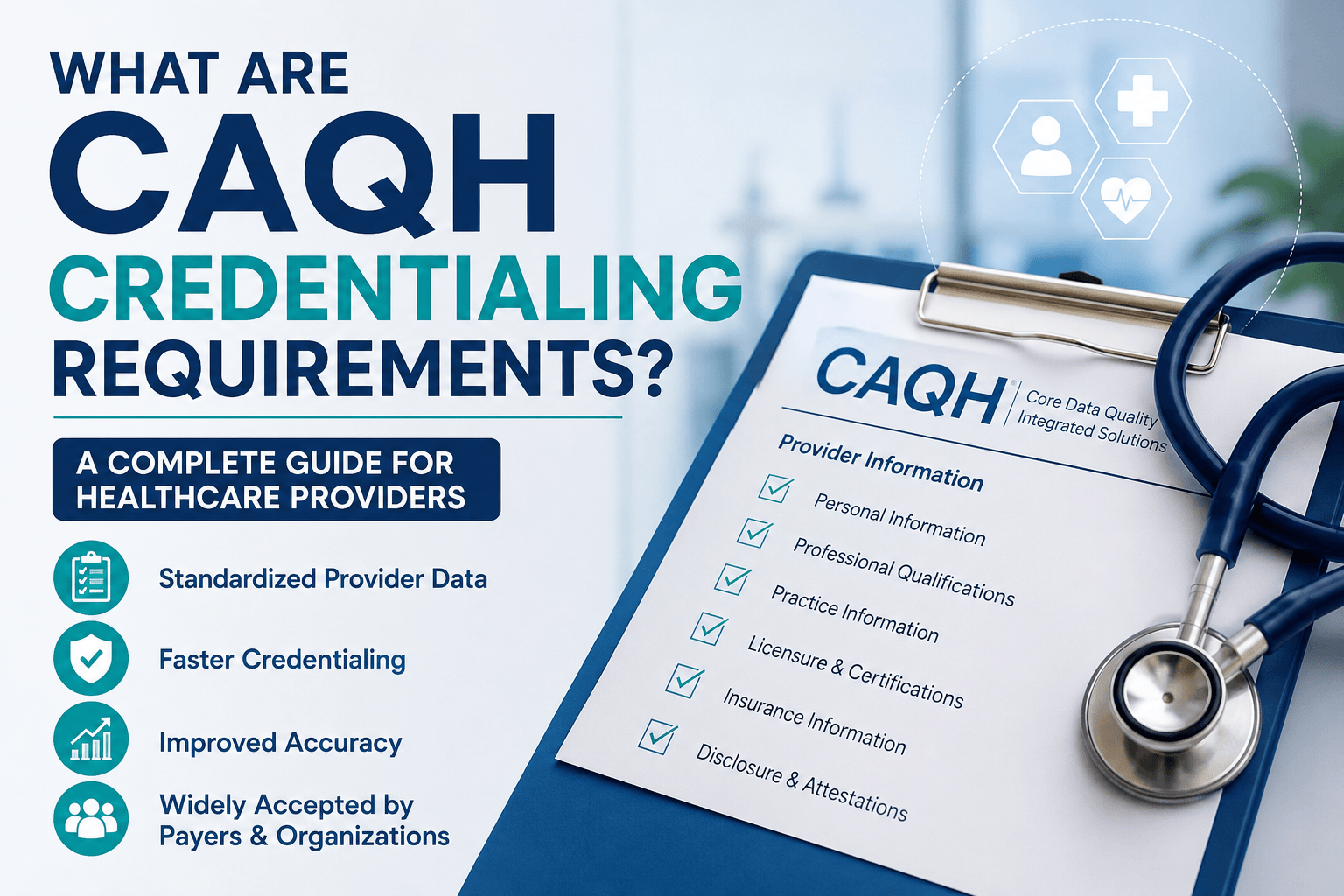
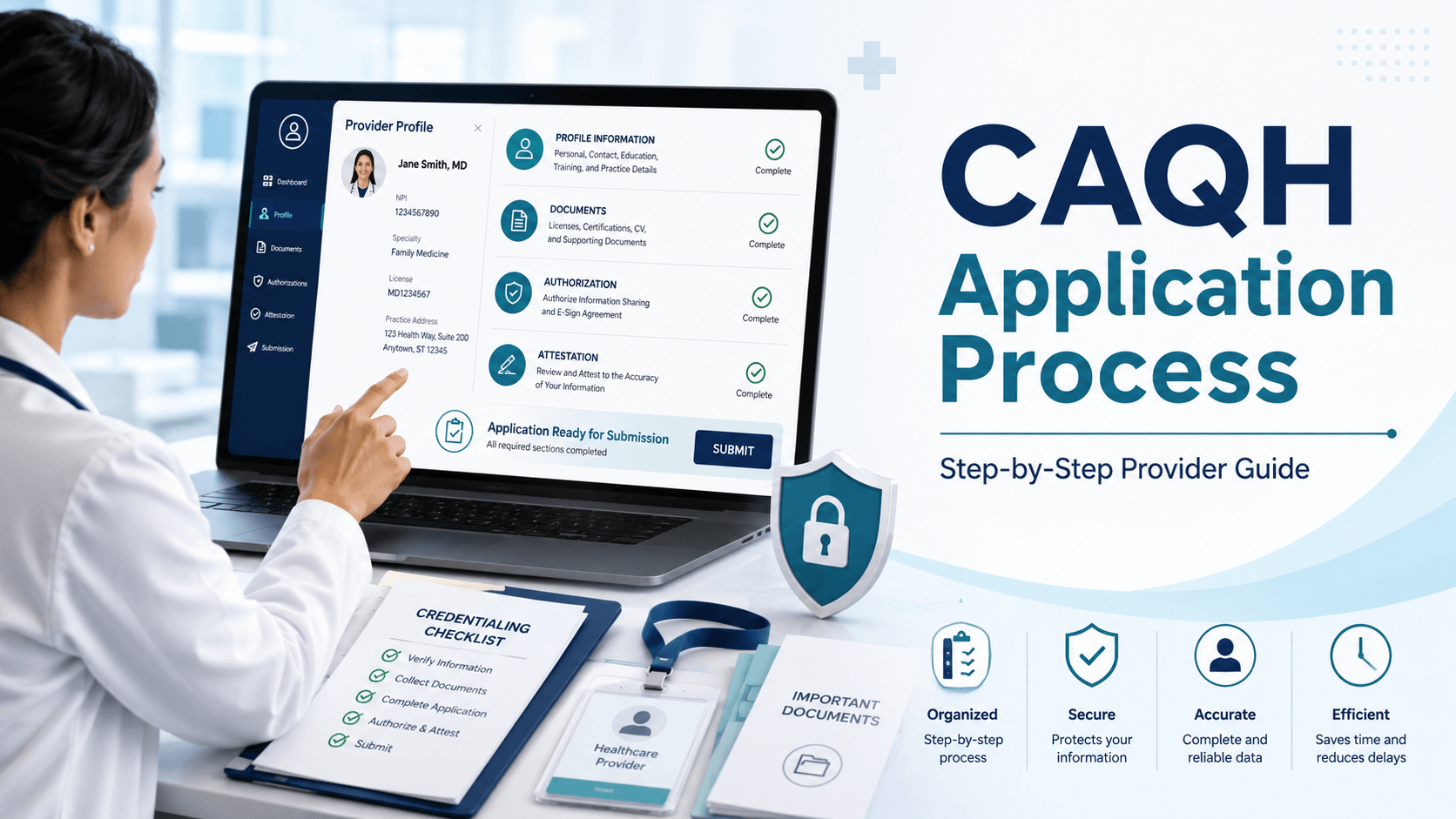
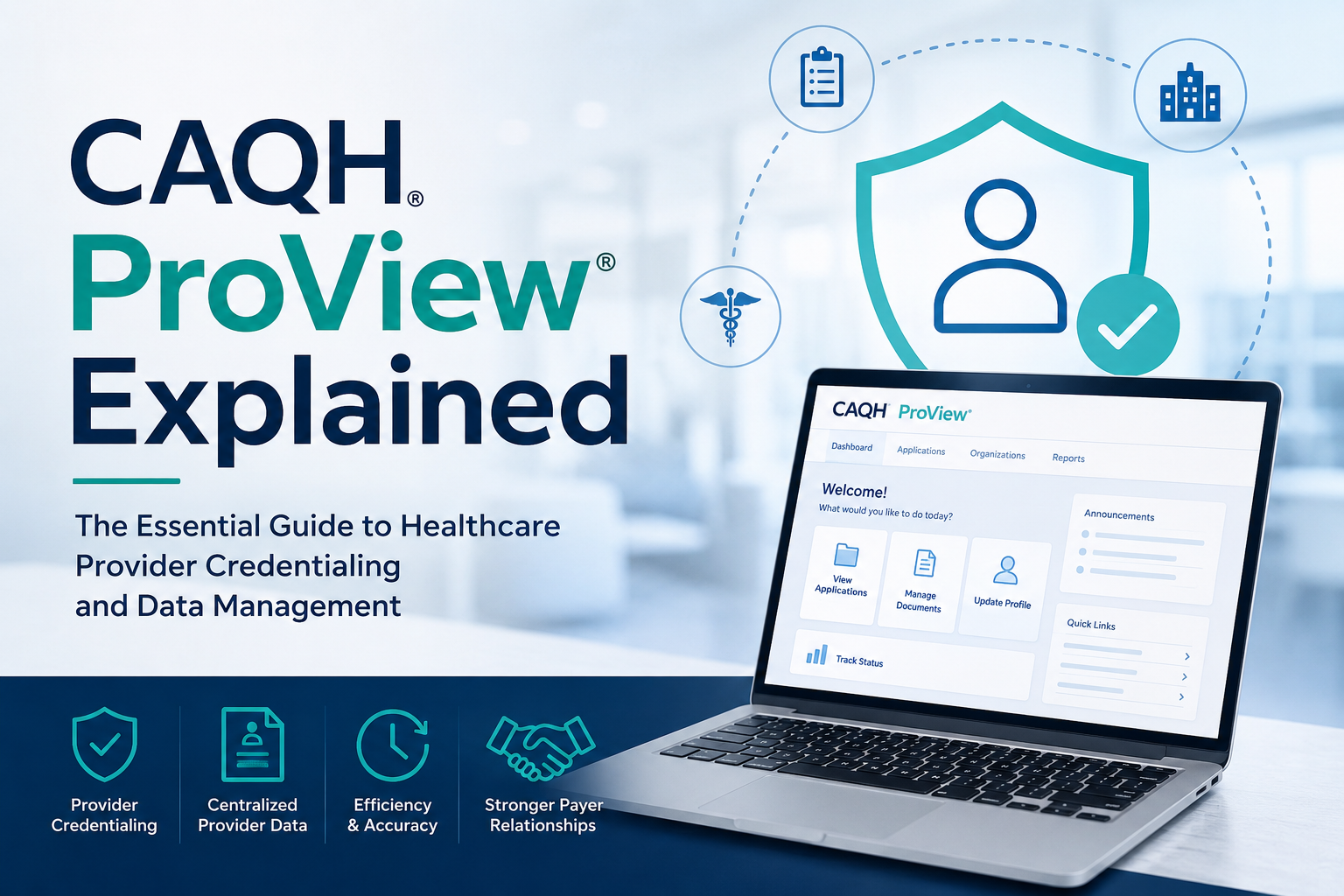
CAQH Provider Data Portal is widely used to maintain provider professional and practice information that can be shared with authorized health plans for credentialing and related purposes.
The CAQH portal includes provider information and supporting documentation. CAQH instructs providers to complete their profile, review their information, attest to its accuracy, and maintain supporting documentation.
Common problems include:
- expired malpractice insurance,
- missing documents,
- incomplete work history,
- outdated practice location,
- incorrect contact information,
- unanswered questions,
- profile changes that have not been reviewed, or
- failure to complete required attestation.
What to do
Log into CAQH and verify:
☐ Profile is complete
☐ Required documents are current
☐ Professional liability information is current
☐ Practice locations are correct
☐ Work history is complete
☐ Licenses are current
☐ Authorization settings are appropriate
☐ Profile has been reviewed and attested
CAQH’s practitioner guidance also states that providers are periodically prompted to re-attest their information.
Official CAQH resource:
CAQH — Provider Data Portal
4. Primary Source Verification Is Taking Time
Credentialing is not simply a matter of reading the information entered on an application.
Certain credentials may need to be verified against authoritative sources.
The AMA states that its physician credential data may include primary-source verification of information such as:
- medical school,
- graduate medical education,
- specialty board certification,
- state licensure,
- DEA registration,
- NPI,
- ECFMG information, and
- sanctions data.
Why this matters
Suppose you write on an application that you completed residency at a certain institution.
The credentialing organization may need verification from an authoritative source rather than relying solely on the information entered by the physician.
If dates, names, or institutions do not match, verification can take longer.
What to do
Make sure your:
- school names,
- residency programs,
- fellowship information,
- graduation dates,
- certification details, and
- license information
are accurate before submission.
Official AMA reference:
AMA — Primary Source Verification and Physician Profiles
5. Your Work History Contains Unexplained Gaps
Credentialing applications commonly request detailed professional history.
A gap does not automatically mean there is a credentialing problem, but an unexplained period may lead to additional questions.
Examples include periods between:
- medical school and residency,
- residency and employment,
- two physician positions,
- relocation between states, or
- time away from clinical practice.
What to do
Create one consistent professional timeline before completing payer applications.
Include:
Month + Year → Month + Year
for relevant:
- education,
- training,
- employment, and
- other professional activities.
If the application asks for an explanation of a gap, provide a clear and accurate explanation instead of leaving the period blank.
6. State License Verification Is Pending
A payer or credentialing organization may need to verify professional licensure.
The physician’s license generally needs to match the state and scope relevant to the intended practice.
The AMA’s credentialing resources identify state licensing information as one of the professional elements that organizations may verify.
Check:
☐ License is active
☐ License number is correct
☐ Name matches provider records
☐ Expiration date is correct
☐ Required state license is in place
☐ Any requested explanation has been provided
If you are moving into a new state, do not leave licensing until the end of the onboarding process.
7. DEA or Other Professional Information Is Pending Verification
For providers whose roles involve prescribing controlled substances, DEA registration information may be relevant to credentialing.
AMA physician credentialing data can include DEA registration information as part of primary-source-verified physician data.
What to check
Confirm that:
- DEA information is accurate,
- applicable addresses are correct,
- registration status is current, and
- information matches the credentialing application.
8. The Payer Requested Additional Information — But Nobody Responded
This is one of the most preventable credentialing delays.
A payer may have already reviewed the application but be waiting for:
- malpractice certificate,
- W-9,
- license documentation,
- explanation of work history,
- ownership information,
- updated CAQH profile,
- provider signature,
- additional application pages, or
- demographic clarification.
The request may have been sent to:
- the physician,
- office manager,
- credentialing specialist,
- old email address, or
- general practice inbox.
What to do
Monitor:
☐ Credentialing inbox
☐ Physician email
☐ Payer portal
☐ CAQH notifications
☐ Physical mail
☐ Voicemail
Make one person responsible for credentialing communication.
If everyone is responsible, frequently nobody actually owns the task.
9. Your Medicare Enrollment Is Still Being Processed
Medicare enrollment uses PECOS, CMS’s online Medicare enrollment management system.
CMS states that PECOS can be used to:
- enroll as a Medicare provider or supplier,
- review existing information,
- upload supporting documents,
- electronically sign applications,
- update enrollment information, and
- complete revalidation.
CMS also says PECOS applications tend to process faster than paper applications.
Official CMS resources:
CMS — PECOS and Medicare Provider Enrollment
CMS — Medicare Enrollment Applications
10. Your Medicare Administrative Contractor Needs More Information
CMS explains that Medicare Administrative Contractors (MACs) process enrollment applications for physicians, group practices, and other applicable providers and suppliers.
Your MAC may request additional documentation while processing the enrollment.
CMS specifically advises providers to work with their MAC and notes that the MAC can answer questions regarding enrollment status.
Better follow-up question
Instead of:
“Is my Medicare application done?”
Ask:
“Has my application been assigned for review, is any additional documentation required, and what is the current processing stage?”
Official source:
CMS — Medicare Enrollment Help and MAC Information
11. You Missed Medicare Revalidation
This can become much more serious than an ordinary credentialing delay.
CMS requires Medicare-enrolled providers and suppliers to periodically revalidate their enrollment information.
In general, CMS says providers and suppliers revalidate every five years, while DMEPOS suppliers generally revalidate every three years. CMS may also request an off-cycle revalidation.
CMS warns that failing to revalidate on time may result in:
- a hold on Medicare reimbursement, or
- deactivation of Medicare billing privileges.
What to do
Check the official Medicare Revalidation List rather than waiting only for a letter.
Official CMS source:
CMS — Medicare Revalidation Requirements
12. The Payer Has an Internal Processing Backlog
Sometimes your application is complete.
The delay is simply occurring inside the payer or credentialing organization.
Possible reasons include:
- high application volume,
- staffing shortages,
- committee schedules,
- verification queues,
- contracting delays, or
- internal administrative processing.
You cannot control the payer’s internal workload.
But you can control your follow-up process.
How to Diagnose a Credentialing Delay in 15 Minutes
Instead of repeatedly calling the payer without a plan, use this sequence.
Step 1 — Confirm Receipt
Ask:
“Can you confirm that the complete credentialing application was received?”
Record:
- submission date,
- confirmation number,
- payer representative, and
- reference number.
Step 2 — Confirm Completeness
Ask:
“Is anything currently missing from the application?”
Do not accept only:
“It is pending.”
Find out why it is pending.
Step 3 — Identify the Exact Stage
Ask:
“What stage is the application currently in?”
Possible answers might include:
- application intake,
- primary source verification,
- credentialing review,
- medical director review,
- committee review,
- contracting,
- enrollment,
- loading into payer system, or
- effective-date processing.
Step 4 — Ask What Is Preventing the Next Step
This is one of the most useful credentialing questions:
“What specifically needs to happen before this application can move to the next stage?”
Now you have an actionable answer.
Step 5 — Check CAQH
Review:
☐ Attestation
☐ Malpractice policy
☐ Licenses
☐ Practice locations
☐ Work history
☐ Supporting documents
☐ Authorization
Official CAQH guidance explains how the Provider Data Portal is used to maintain and share professional and practice information.
Step 6 — Check NPI Information
CMS states that NPIs are issued through the National Plan & Provider Enumeration System, or NPPES.
Important:
An NPI does not itself mean that a provider is licensed or credentialed. CMS specifically notes this distinction in its NPPES information.
Official source:
CMS — NPI/NPPES Information
Step 7 — Check Medicare/PECOS if Applicable
If Medicare enrollment is involved:
☐ Check PECOS
☐ Check for outstanding requests
☐ Confirm supporting documents were received
☐ Contact your MAC if necessary
☐ Check revalidation status
Official CMS PECOS resource:
CMS — Manage Your Medicare Enrollment
15-Point Provider Credentialing Delay Checklist
Before escalating a delayed application, check all 15 items.
Provider Data
☐ 1. Legal provider name is correct
☐ 2. NPI is correct
☐ 3. Taxonomy is correct where applicable
☐ 4. Practice address is accurate
☐ 5. Group/TIN information is accurate
Professional Credentials
☐ 6. State license is active
☐ 7. DEA information is current where applicable
☐ 8. Board certification information is accurate
☐ 9. Education/training dates are accurate
☐ 10. Employment history has no unexplained gaps
CAQH
☐ 11. CAQH profile is complete
☐ 12. CAQH has been reviewed and attested
☐ 13. Required documents are current
Payer
☐ 14. Payer confirms the application is complete
☐ 15. You know the exact current processing stage
If you cannot confidently check all 15 boxes, investigate those items before assuming that the payer is simply “taking too long.”
Credentialing Follow-Up Tracker
Practices should maintain a central credentialing tracker.
A simple structure is:
| Provider | Payer | Submitted | Current Stage | Missing Item | Last Follow-Up | Next Follow-Up |
|---|---|---|---|---|---|---|
| Dr. Smith | Payer A | Jan 10 | Verification | None | Feb 2 | Feb 9 |
| Dr. Jones | Payer B | Jan 15 | Incomplete | W-9 | Feb 3 | After upload |
| Dr. Lee | Medicare | Jan 20 | MAC Review | None | Feb 1 | Feb 8 |
This prevents applications from disappearing into an inbox for weeks.
Credentialing vs Enrollment: Why the Difference Matters
Credentialing and payer enrollment are closely related, but they are not identical processes.
Credentialing
Credentialing generally focuses on verifying that the provider has the appropriate professional qualifications.
This may involve verification of:
- education,
- training,
- licenses,
- certifications,
- professional history, and
- other credentials.
Enrollment
Enrollment generally concerns establishing the provider within a payer’s system so that the provider can participate and bill according to that payer’s requirements.
Therefore:
Credentialing Approved ≠ Automatically Ready to Bill
A practice should also verify:
- network participation,
- enrollment completion,
- payer effective date,
- billing configuration, and
- payer-specific requirements.
Can You See Patients While Credentialing Is Pending?
This question does not have one universal answer.
It depends on:
- the payer,
- contract,
- provider type,
- group arrangement,
- effective-date rules,
- billing requirements, and
- applicable program requirements.
Do not assume:
“The payer will simply backdate everything.”
Before providing covered services under a pending enrollment, confirm the payer’s specific rules.
Ask:
“What effective date will apply if this provider is approved, and how should claims for services before that date be handled?”
Get the answer from the payer and document it.
How Credentialing Delays Can Become Revenue-Cycle Problems
Credentialing should not be treated as an isolated administrative function.
It directly intersects with revenue cycle management.
Consider this sequence:
Provider hired
↓
Credentialing application delayed
↓
Enrollment/effective date delayed
↓
Practice schedules patients
↓
Claims submitted incorrectly or prematurely
↓
Claims denied, held, or require rework
↓
Accounts receivable increases
↓
Cash flow is affected
That is why practice owners should connect:
credentialing + enrollment + billing + payer effective dates
instead of managing them as completely separate departments.
How to Prevent Credentialing Delays Before They Happen
Build a standardized provider onboarding system.
For every new provider:
120–180 days before anticipated start date, where practical
Begin gathering:
- licenses,
- certifications,
- malpractice information,
- professional history,
- CAQH access,
- NPI information,
- payer list, and
- practice details.
Before submitting
Verify:
☐ CAQH
☐ NPI
☐ W-9
☐ License
☐ DEA where applicable
☐ Malpractice coverage
☐ Work history
☐ Practice location
☐ Group information
After submission
Track:
☐ Confirmation number
☐ Payer representative
☐ Application stage
☐ Missing information
☐ Last follow-up
☐ Next follow-up
☐ Approval date
☐ Effective date
When Should a Practice Consider Credentialing Support?
Credentialing management may become difficult when a practice is:
- opening a new clinic,
- adding multiple physicians,
- hiring NPs or PAs,
- entering additional payer networks,
- changing ownership,
- adding practice locations,
- enrolling providers with Medicare,
- maintaining multiple CAQH profiles,
- managing revalidations, or
- dealing with several delayed applications simultaneously.
The value of credentialing support should not simply be:
“We fill out applications.”
A stronger credentialing process should help the practice:
- prepare accurate provider information,
- maintain documentation,
- identify missing requirements,
- submit applications,
- monitor statuses,
- follow up with payers,
- track deadlines,
- record effective dates, and
- communicate enrollment status to the billing team.
Is Your Credentialing Application Stuck?
If your provider application has been sitting in pending, incomplete, verification, or enrollment status, the first step should be identifying exactly where the process has stopped.
Our credentialing team can assist with:
- provider credentialing,
- payer enrollment,
- CAQH profile management,
- Medicare enrollment support,
- PECOS support,
- revalidation tracking,
- application follow-up,
- provider demographic updates,
- new provider onboarding, and
- credentialing status tracking.
Request a Credentialing Status Review
Instead of restarting the entire process, we can help review the current status, identify outstanding requirements, and determine the appropriate next follow-up action.
Frequently Asked Questions
Why is my credentialing taking so long?
Common causes include missing documentation, inconsistent provider information, outdated CAQH data, primary-source verification, licensing issues, unanswered payer requests, Medicare enrollment processing, or internal payer delays.
The correct next step is to identify the exact processing stage and ask whether anything is preventing the application from moving forward.
Can CAQH delay credentialing?
Yes. If a payer relies on CAQH and the provider profile is incomplete, outdated, missing required documentation, or awaiting attestation, additional work may be required before credentialing can move forward.
CAQH provides official guidance for maintaining and attesting provider profiles.
Verify with CAQH Provider Data Portal
How do I know what stage my credentialing application is in?
Contact the payer and ask specifically whether the application is in:
- intake,
- verification,
- credentialing review,
- committee review,
- contracting,
- enrollment, or
- effective-date processing.
Also ask whether any information is currently outstanding.
Why is my Medicare enrollment still pending?
Medicare enrollment applications are processed through the CMS enrollment system and applicable Medicare Administrative Contractor.
CMS advises providers to work with their MAC regarding application status and additional information requests.
Verify with CMS Medicare Enrollment Guidance
What happens if Medicare revalidation is late?
CMS states that failure to revalidate by the required deadline can lead to a hold on Medicare reimbursement or deactivation of Medicare billing privileges.
Verify with CMS Revalidation Guidance
Does having an NPI mean a provider is credentialed?
No.
CMS explicitly notes that issuance of an NPI does not itself ensure or validate that the provider is licensed or credentialed.
Is credentialing the same as payer enrollment?
No.
Credentialing generally involves verification of professional qualifications, while enrollment establishes the provider within the payer’s participation and billing processes.
The two processes may overlap, but they should not automatically be treated as interchangeable.
Can a credentialing company guarantee faster approval?
A credentialing company cannot guarantee or control a payer’s internal processing time.
What credentialing support can do is reduce avoidable delays by helping maintain accurate information, preparing complete applications, tracking requests, following up consistently, and escalating unresolved issues appropriately.
Be cautious of anyone promising:
“Guaranteed credentialing approval in X days.”
The payer ultimately controls its credentialing and enrollment decision.
Trusted Resources for Providers
Readers should not have to take a medical billing company’s word for every credentialing claim.
Use these authoritative sources to verify provider enrollment and credentialing information:
Centers for Medicare & Medicaid Services — Medicare Enrollment
CMS Medicare Provider Enrollment
CMS — PECOS
CMS PECOS Provider Enrollment System
CMS — Medicare Revalidation
CAQH — Provider Data
CAQH Provider Data Portal Information
American Medical Association — Physician Credentialing
AMA — Primary Source Verified Physician Information
AMA Initial and Reappointment Profiles
These sources allow physicians and practice managers to independently verify important information rather than relying only on a vendor’s explanation.
Final Takeaway
When a credentialing application is delayed, the most useful question is not:
“Why is credentialing taking so long?”
It is:
“What exact stage is my application in, what is preventing it from moving forward, and who owns the next action?”
Once you know those three things, credentialing becomes much easier to manage.
Application submitted → Confirm completeness → Identify stage → Resolve missing requirements → Follow up → Confirm approval → Confirm effective date → Notify billing team
That process turns credentialing from an uncontrolled waiting period into a trackable operational workflow.