How to Get Credentialed with Medicare in 2026?
Getting credentialed with Medicare means officially enrolling with CMS so you can bill Medicare and receive payment for services provided to beneficiaries.
This process is required for physicians, nurse practitioners, therapists, and healthcare organizations that want to treat Medicare patients. While the process can feel complex, following the correct steps and submitting accurate documentation can significantly reduce delays.
What does Medicare credentialing mean for healthcare providers?
Medicare credentialing is the process of verifying a provider’s qualifications and enrolling them in the Medicare program so they can receive reimbursement.
This process ensures that providers meet federal standards for:
- Licensing and certifications
- Education and training
- Legal and compliance history
Once approved, providers receive billing privileges and a PTAN (Provider Transaction Access Number).
Who is eligible to enroll as a Medicare provider?
Healthcare providers must meet CMS requirements to enroll in Medicare.
Eligible providers include:
- Physicians (MD, DO)
- Nurse practitioners and physician assistants
- Physical, occupational, and speech therapists
- Clinical psychologists and social workers
- Medical practices and group providers
Basic eligibility requirements:
- Valid state license
- National Provider Identifier (NPI)
- No disqualifying criminal or compliance issues
- Active malpractice coverage (if applicable)
What documents are required for Medicare credentialing?
You need accurate and complete documentation to avoid delays.
Core documents include:
- NPI confirmation
- EIN/TIN (Tax Identification Number)
- State medical license
- Board certifications (if applicable)
- Practice address and contact details
- Bank information for EFT payments
- Malpractice insurance certificate
- Ownership and control disclosures
Tip: Ensure all documents match exactly (name, address, etc.) to prevent rejections.

How do you apply for Medicare credentialing through PECOS?
You apply through PECOS, the official CMS online enrollment system.
What is PECOS, and why is it required?
PECOS (Provider Enrollment, Chain, and Ownership System) is the digital platform used by CMS to process Medicare enrollment applications.
It allows providers to:
- Submit applications online
- Upload documents
- Track application status
PECOS is faster and preferred over paper applications.
What are CMS-855 forms, and when are they used?
CMS-855 forms are standardized enrollment forms used in Medicare credentialing.
Common forms include:
- CMS-855I → Individual providers
- CMS-855B → Group practices
- CMS-855R → Reassignment of benefits
These forms are submitted electronically via PECOS or by paper if needed.
What are the exact steps to complete Medicare provider enrollment?
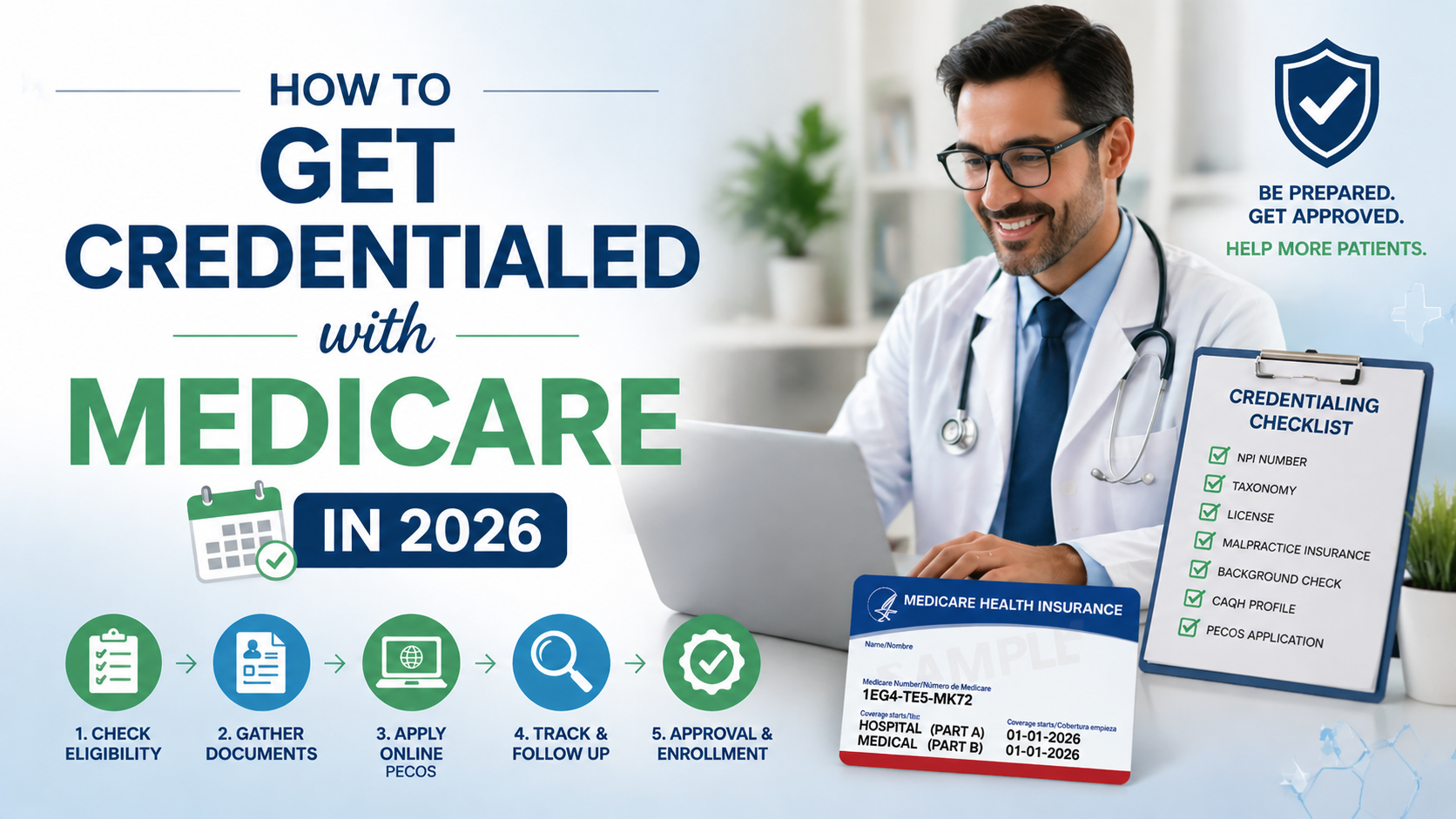
Follow these steps to get credentialed efficiently:
- Obtain an NPI
- Apply through the National Plan and Provider Enumeration System (NPPES)
- Create a PECOS account
- Register and link your NPI
- Complete the enrollment application
- Fill out CMS-855 forms in PECOS
- Upload required documentation
- Ensure accuracy and consistency
- Submit the application to your MAC
- Your regional contractor reviews it
- Respond to requests for additional information
- Delays often occur here
- Receive approval and PTAN
- Enables Medicare billing
How long does Medicare credentialing take?
Medicare credentialing typically takes 30 to 90 days, depending on application completeness and verification requirements.
Factors affecting timeline:
- Accuracy of submitted information
- Responsiveness to MAC requests
- Background checks and verification
- Type of provider (individual vs organization)
CMS states that electronic applications through PECOS are processed faster than paper submissions.
What is the difference between NPI and PTAN?
Both identifiers are required but serve different purposes.
| Identifier | Purpose | Issued By | Use |
|---|---|---|---|
| NPI | Unique provider identifier | Federal system | Used across all payers |
| PTAN | Medicare-specific ID | Medicare contractor (MAC) | Used for Medicare billing |
Key insight:
NPI is universal, while PTAN is specific to Medicare enrollment.
What role do Medicare Administrative Contractors (MACs) play?
MACs are regional contractors that process Medicare enrollment applications.
They are responsible for:
- Reviewing applications
- Verifying credentials
- Requesting additional information
- Issuing PTAN numbers
Each provider is assigned a MAC based on their geographic location.
What are the common mistakes that delay Medicare credentialing?
Avoid these common issues to prevent delays:
- Incomplete or inconsistent information
- Mismatched names or addresses across documents
- Missing signatures or attachments
- Delayed responses to MAC requests
- Incorrect form selection (wrong CMS-855 form)
Pro tip: Double-check every field before submission.
How can you check your Medicare application status?
You can track your application through PECOS or contact your assigned MAC.
Ways to check status:
- PECOS dashboard (real-time updates)
- MAC customer service
- Email notifications from CMS
If delays exceed 90 days, follow up with your MAC directly.
Key Takeaways
- Medicare credentialing is required to bill Medicare patients
- The process is managed by CMS and completed through PECOS
- Most applications take 30–90 days
- Accuracy and complete documentation are critical
- MACs handle review and approval
FAQs
How long does it take to get a Medicare provider number?
Most providers receive a PTAN within 30 to 90 days after submitting a complete application.
Do I need CAQH for Medicare credentialing?
No, CAQH is not required for Medicare enrollment, but it may be used by private insurers.
Can I bill Medicare before approval?
No, you must receive approval and a PTAN before submitting claims.
What happens after Medicare approval?
You receive billing privileges and can start submitting claims for reimbursement.
Is PECOS mandatory for enrollment?
PECOS is not mandatory but strongly recommended because it speeds up processing.
Can a group practice enroll multiple providers?
Yes, group practices can enroll using CMS-855B and reassign benefits using CMS-855R.
What is reassignment of benefits?
It allows individual providers to assign Medicare payments to a group or organization.