What Are the 10 Steps in the Medical Billing Revenue Cycle?
The 10 steps in the medical billing revenue cycle are the complete workflow that healthcare providers use to manage patient billing and receive payment. These steps ensure that services are accurately recorded, billed, and reimbursed.
Understanding this process is essential because even small errors can delay payments, increase claim denials, and reduce revenue. According to the American Medical Association, inefficient billing processes can significantly impact healthcare cash flow and operational stability.
Table of Contents
ToggleWhat Is the Medical Billing Revenue Cycle and Why Does It Matter?
The Medical Billing Revenue Cycle is the end-to-end process of managing patient service revenue—from appointment scheduling to final payment collection.
It matters because:
- It directly impacts healthcare profitability
- It ensures compliance with insurance and regulatory standards
- It reduces claim denials and payment delays
- It improves the patient’s financial experience
In simple terms, it’s how healthcare providers get paid for the services they deliver.
What Are the 10 Steps in the Revenue Cycle Process?
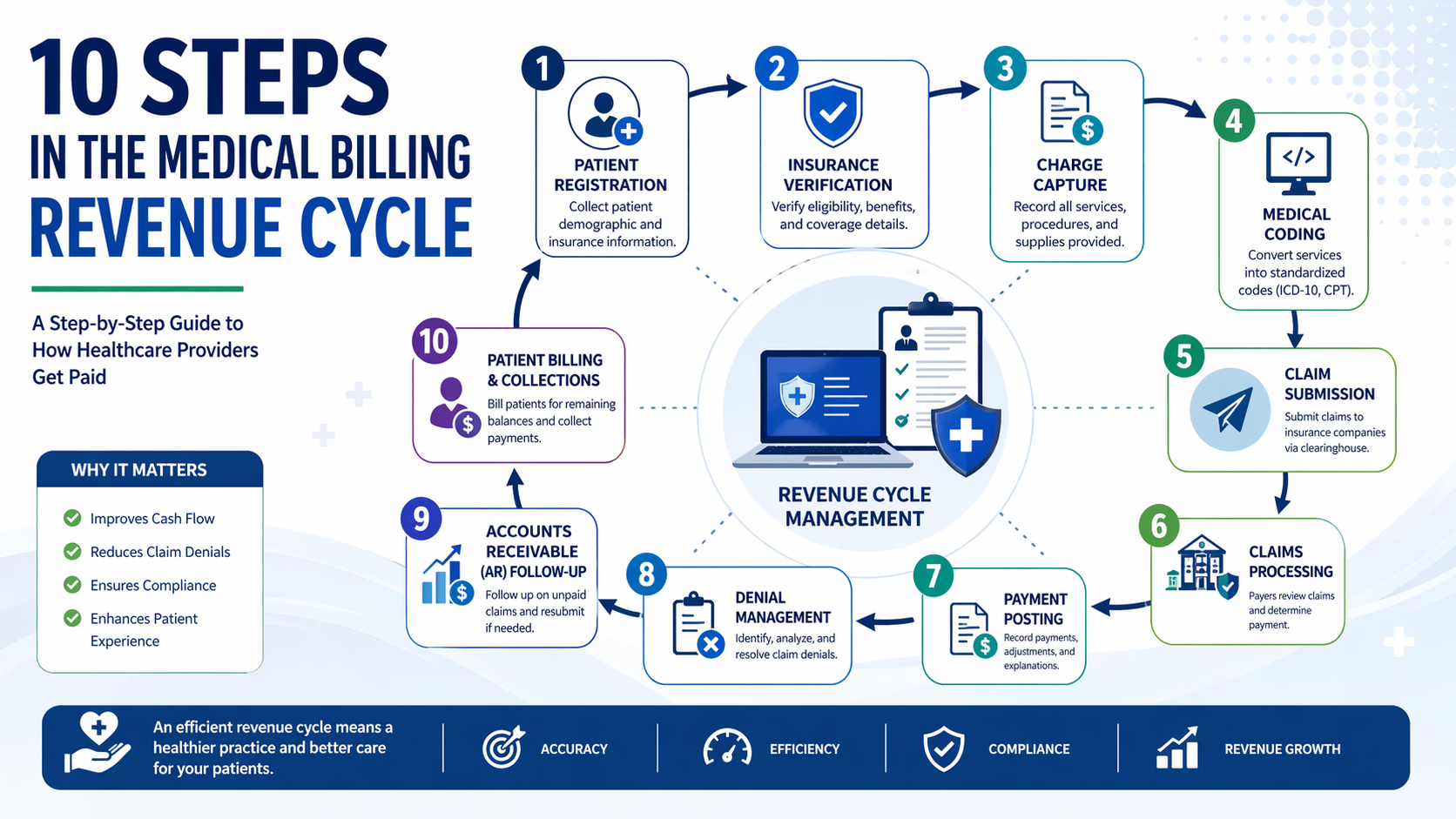
The medical billing revenue cycle consists of 10 structured steps, each playing a critical role in accurate reimbursement.
Step 1: What Happens During Patient Registration?
Patient registration is the process of collecting patient demographic and insurance information before treatment.
This step ensures accurate billing and reduces errors later.
Key tasks:
- Collect patient details (name, DOB, contact info)
- Record insurance information
- Verify identity
Why it matters:
Incorrect data here leads to claim rejections later.
Step 2: How Does Insurance Verification Work?
Insurance verification confirms a patient’s coverage, eligibility, and benefits before services are provided.
Key checks include:
- Policy validity
- Coverage limits
- Co-pays and deductibles
Example:
If a patient’s insurance doesn’t cover a procedure, the provider can inform them upfront.
Step 3: What Is Charge Capture in Medical Billing?
Charge capture records all services provided to a patient for billing purposes.
This step ensures no billable service is missed.
Includes:
- Procedures performed
- Medications administered
- Lab tests and diagnostics
Step 4: How Does Medical Coding (ICD-10, CPT) Work?
Medical coding converts healthcare services into standardized codes like ICD-10 and CPT.
Examples:
- ICD-10: Diagnosis codes
- CPT: Procedure codes
Why it matters:
- Ensures claim accuracy
- Determines reimbursement levels
- Maintains compliance
Step 5: What Happens During Claim Submission?
Claim submission sends coded billing data to insurance companies for reimbursement.
Process:
- Claims are created in billing software
- Sent via a clearinghouse
- Checked for formatting errors
Goal:
Submit “clean claims” to reduce rejections.
Step 6: How Does Claims Processing by Payers Work?
Insurance companies review claims to determine payment eligibility.
They:
- Validate coverage
- Check coding accuracy
- Approve, deny, or partially pay claims
Possible outcomes:
- Approved (paid)
- Denied
- Pending (requires more info)
Step 7: What Is Payment Posting?
Payment posting records payments received from insurance companies and patients.
Includes:
- Matching payments to claims
- Updating account balances
- Identifying underpayments
Step 8: What Is Denial Management and Why Is It Critical?
Denial management identifies, analyzes, and corrects denied claims.
Common reasons for denial:
- Incorrect coding
- Missing information
- Eligibility issues
Why it’s critical:
- Denials directly reduce revenue
- Reworking claims increases administrative costs
Step 9: What Is Accounts Receivable (AR) Follow-Up?
AR follow-up ensures outstanding payments are collected from payers.
Tasks include:
- Tracking unpaid claims
- Contacting insurance companies
- Resubmitting corrected claims
Goal:
Reduce days in accounts receivable (A/R days).
Step 10: How Does Patient Billing and Collections Work?
Patient billing involves sending invoices to patients for remaining balances after insurance payments.
Includes:
- Generating statements
- Offering payment plans
- Collecting co-pays and deductibles
Trend insight:
Patient responsibility is increasing due to high-deductible plans, making this step more important than ever.
How Do These 10 Steps Work Together as a System?
The 10 steps form a continuous loop, not a one-time process.
- Front-end steps prevent errors
- Middle steps ensure accurate billing
- Back-end steps secure payments
Each step depends on the previous one. A mistake early in the process can affect the entire revenue cycle.
What Are Common Errors in the Revenue Cycle Process?
Common revenue cycle mistakes include:
- Incorrect patient information
- Coding errors
- Missing documentation
- Late claim submissions
- Poor denial follow-up
Impact:
- Increased claim denials
- Delayed payments
- Revenue loss
How Can Healthcare Practices Improve Revenue Cycle Efficiency?
Revenue cycle optimization focuses on accuracy, automation, and monitoring.
Best practices:
- Use Electronic Health Records (EHR) systems
- Automate insurance verification
- Train staff on coding updates
- Track key metrics (A/R days, denial rate)
- Use clearinghouses for claim validation
Industry insight:
The Healthcare Financial Management Association (HFMA) recommends continuous monitoring of key performance indicators (KPIs) to improve financial outcomes.
What Is the Difference Between Front-End and Back-End RCM?
| Category | Front-End RCM | Back-End RCM |
|---|---|---|
| Focus | Pre-service activities | Post-service billing |
| Includes | Registration, verification | Claims, payments, collections |
| Goal | Prevent errors early | Ensure payment collection |
Key Takeaways About the Medical Billing Revenue Cycle
- The revenue cycle has 10 essential steps from registration to collections
- Accuracy in early steps reduces costly errors later
- Denial management and AR follow-up are critical for maximizing revenue
- Efficient RCM improves both financial performance and patient satisfaction
FAQs About the Medical Billing Revenue Cycle
What are the 10 steps in the revenue cycle in simple terms?
They are the stages from patient registration to final payment collection, ensuring healthcare providers get paid.
Why is the revenue cycle important in healthcare?
It ensures accurate billing, timely payments, and financial stability for healthcare providers.
What is the most critical step in the revenue cycle?
Patient registration and coding are critical because errors here affect the entire process.
What causes claim denials?
Common causes include incorrect coding, missing data, and insurance eligibility issues.
How can denial rates be reduced?
By improving coding accuracy, verifying insurance, and submitting clean claims.
What is a clean claim?
A claim that is error-free and processed without rejection or delay.
What is AR in medical billing?
Accounts Receivable (AR) refers to unpaid claims that need follow-up for payment.
Conclusion
The medical billing revenue cycle is more than just billing—it’s a structured financial system that ensures healthcare providers are paid accurately and efficiently. Mastering these 10 steps helps reduce errors, improve cash flow, and build a more sustainable healthcare operation.