Is Outsourcing Medical Billing a Good Idea and How Much Does It Cost?
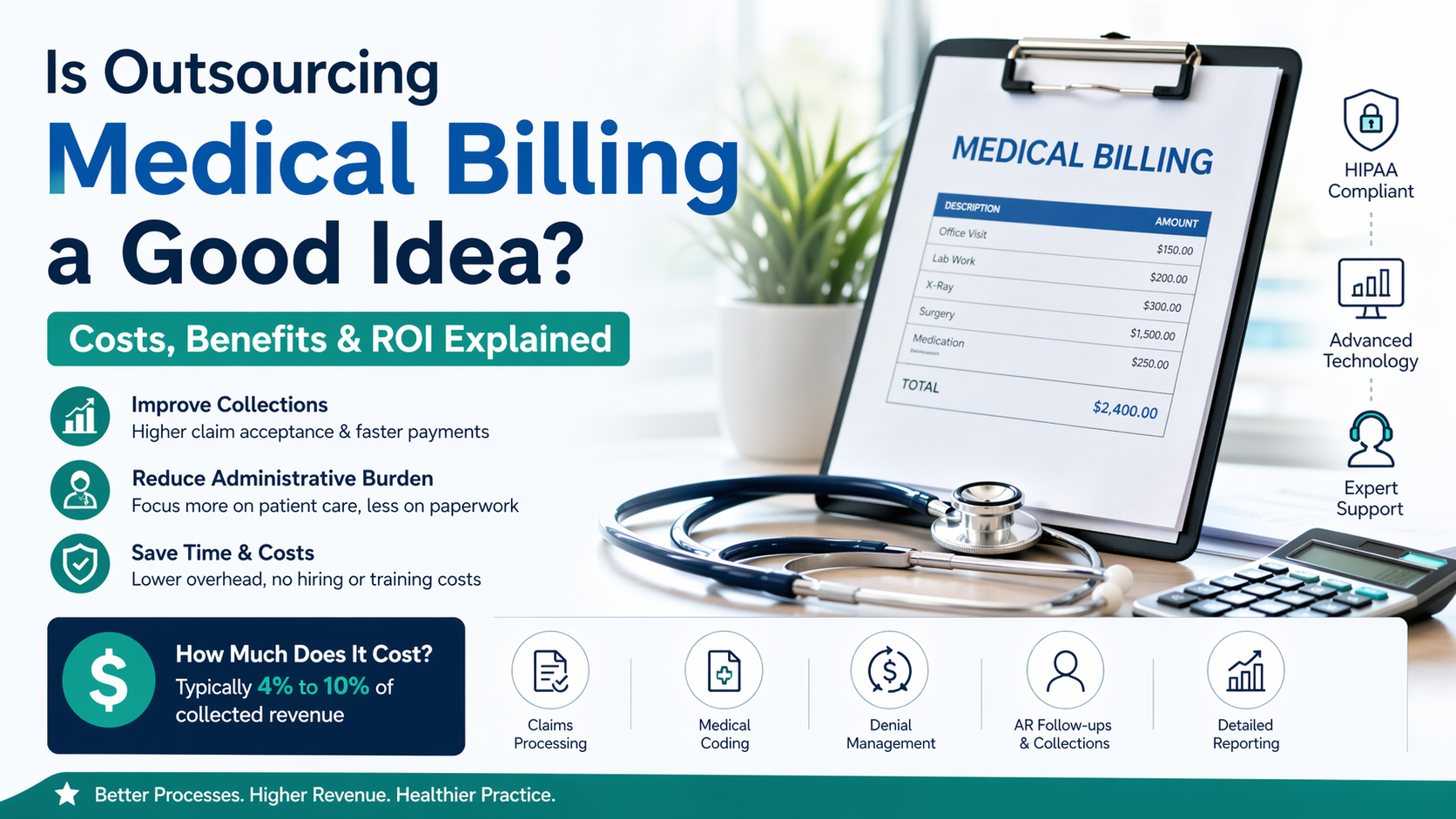
Outsourcing medical billing is often a good idea for healthcare providers who want to improve collections, reduce administrative burden, and focus more on patient care. Costs typically range from 4% to 10% of collected revenue, depending on the complexity of services and provider type.
Medical billing is a critical part of Revenue Cycle Management (RCM), but it’s also time-consuming and prone to errors. Many clinics, hospitals, and private practices struggle with claim denials, staffing costs, and compliance issues—making outsourcing an increasingly popular solution.
Table of Contents
ToggleWhat Is Medical Billing Outsourcing and How Does It Work?
Medical billing outsourcing means hiring a third-party company to handle your billing, coding, claims processing, and revenue collection.
Instead of managing billing in-house, providers rely on specialized billing companies that use trained staff and advanced software.
What services are included in outsourced medical billing?
Most medical billing services cover the full revenue cycle:
- Patient registration and insurance verification
- Medical coding (ICD-10, CPT codes)
- Claims submission to insurers
- Payment posting
- Denial management and appeals
- Accounts receivable (AR) follow-ups
- Patient billing and collections
Some vendors also provide analytics, reporting, and compliance support (including HIPAA).
Is Outsourcing Medical Billing a Good Idea for Healthcare Providers?
Yes, outsourcing medical billing is a good idea for many practices because it improves efficiency, reduces errors, and increases revenue collection.
However, it depends on your practice size, budget, and internal capabilities.
What are the main benefits of outsourcing medical billing?
Outsourcing offers several clear advantages:
- Higher collection rates: Professional billing companies reduce claim denials and improve reimbursements
- Lower administrative burden: Staff can focus on patient care instead of paperwork
- Cost savings: Eliminates hiring, training, and maintaining billing staff
- Access to expertise: Certified coders and billing specialists stay updated with regulations
- Faster payments: Efficient claims processing reduces delays
According to the Medical Group Management Association (MGMA), inefficient billing processes can significantly impact revenue, especially in small practices.
What are the potential drawbacks or risks?
Outsourcing is not perfect and comes with trade-offs:
- Less control: You rely on a third-party vendor
- Data security concerns: Requires strict HIPAA compliance
- Communication gaps: Delays can happen if the vendor is not responsive
- Long-term contracts: Some companies require commitments
The key is choosing a reliable and transparent billing partner.
How Much Does It Cost to Outsource Medical Billing?
Medical billing outsourcing typically costs between 4% and 10% of monthly collections or a flat fee per claim.
This pricing varies widely based on services, specialty, and claim volume.
What are the common pricing models?
There are two primary pricing structures:
- Percentage-based pricing (most common)
- 4% to 10% of collected revenue
- Example: If your practice collects $100,000/month, you pay $4,000–$10,000
- Flat fee per claim
- $3 to $10 per claim
- Suitable for high-volume practices
- Hybrid pricing (less common)
- Base fee + percentage
What factors influence the cost of outsourcing?
Several factors affect pricing:
- Practice size and patient volume
- Medical specialty (e.g., cardiology vs general practice)
- Complexity of claims
- Current denial rate
- Scope of services (full RCM vs partial outsourcing)
- Geographic location (onshore vs offshore vendors)
Is Outsourcing Medical Billing Cheaper Than In-House Billing?
Yes, outsourcing is often cheaper than in-house billing when you factor in salaries, software, and operational costs.
Here’s a direct comparison:
| Cost Factor | In-House Billing | Outsourced Billing |
|---|---|---|
| Staff salaries | High | Included in the fee |
| Training & turnover | Ongoing cost | Not required |
| Billing software | Expensive | Included |
| Compliance (HIPAA) | Internal responsibility | Vendor-managed |
| Error rate | Higher (varies) | Typically lower |
| Total cost | 8%–15% of revenue (est.) | 4%–10% of revenue |
Many practices underestimate the hidden costs of in-house billing, such as staff turnover and claim errors.
What ROI Can You Expect from Medical Billing Outsourcing?
The ROI of outsourcing medical billing is typically positive due to improved collections, reduced denials, and lower administrative costs.
Most practices experience measurable gains in financial performance because specialized billing teams optimize the entire revenue cycle.
- Improved collections:
The Healthcare Financial Management Association reports that effective revenue cycle management practices can significantly increase net patient revenue by reducing inefficiencies and missed charges. - Reduced claim denials:
According to the Medical Group Management Association, claim denial rates in healthcare can range from 5% to 10%, and improving denial management processes directly increases recovered revenue. - Lower administrative costs:
The American Medical Association highlights that physician practices spend a substantial portion of revenue on administrative tasks, including billing and insurance-related activities—costs that outsourcing can reduce. - Faster reimbursements:
Outsourced billing companies typically use automation and dedicated AR teams, which shortens the revenue cycle and improves cash flow.
What this means in practice:
While some vendors market 10%–20% revenue increases, verified industry sources suggest that actual gains depend on baseline inefficiencies—especially denial rates, coding accuracy, and billing delays. Practices with poor internal processes tend to see the biggest improvements after outsourcing.
When Should a Practice Outsource Medical Billing?
You should consider outsourcing when your billing process is inefficient, costly, or limiting growth.
Common signs include:
- High claim denial rates
- Slow reimbursements
- Staff burnout or turnover
- Limited internal expertise
- Rapid practice growth
- Compliance concerns
Small practices and startups benefit the most because they lack internal billing infrastructure.
How Do You Choose the Right Medical Billing Company?
Choose a medical billing company based on experience, transparency, technology, and compliance standards.
Key evaluation criteria:
- Industry experience in your specialty
- Clear pricing structure (no hidden fees)
- HIPAA compliance and data security
- Reporting and analytics capabilities
- Client references and reviews
- Communication and support quality
Ask for performance metrics such as:
- First-pass claim acceptance rate
- Average AR days
- Denial rate
Key Takeaways
- Outsourcing medical billing is often a cost-effective and efficient solution
- Typical costs range from 4% to 10% of collections
- It reduces administrative workload and improves revenue collection
- It’s usually cheaper than in-house billing when all costs are considered
- Choosing the right vendor is critical for success
FAQs
Is outsourcing medical billing safe?
Yes, if the provider is HIPAA-compliant and uses secure systems.
What percentage do medical billing companies charge?
Most charge between 4% and 10% of collected revenue.
Can small practices benefit from outsourcing?
Yes, small practices often benefit the most due to limited resources.
Does outsourcing improve revenue?
Yes, it typically improves collections by reducing errors and denials.
Is offshore billing cheaper?
Yes, offshore billing can be cheaper, but quality and communication must be evaluated.
How long does it take to transition to outsourced billing?
Usually 2 to 8 weeks, depending on practice size and data migration.
Do billing companies handle coding, too?
Yes, most offer certified medical coding services.