What Is a United States Medical License and How Do You Get One?
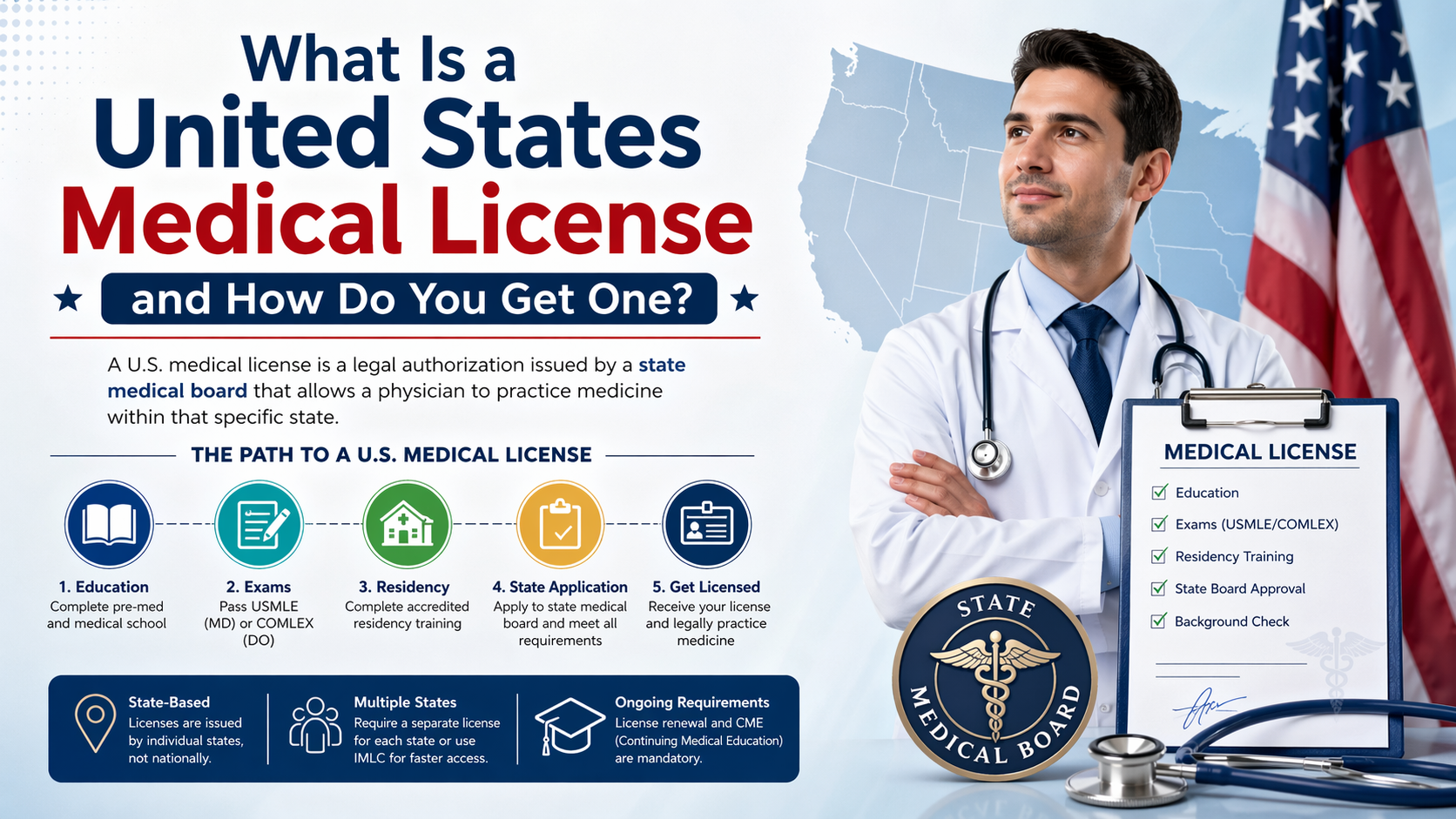
A United States medical license is a legal authorization issued by a state medical board that allows a physician to practice medicine within that specific state. Without this license, no doctor can legally treat patients, prescribe medication, or provide clinical care.
Understanding medical licensure is essential for medical students, international graduates, and practicing physicians—especially because the U.S. system is state-based, not national. That means each state sets its own rules, requirements, and processes.
Table of Contents
ToggleWhat is medical licensure in the United States?
Medical licensure in the U.S. is the regulatory process that ensures physicians meet minimum standards for safe and competent practice. It is designed to protect public health.
In simple terms, a medical license confirms that a doctor:
- Has completed the required education and training
- Has passed standardized exams
- Meets ethical and legal standards
State medical boards oversee licensing and enforce discipline if needed.
Are doctors licensed by the state or nationally?
Doctors in the United States are licensed by individual states, not by a national authority.
Each state medical board:
- Issues its own licenses
- Sets its own requirements (within general national standards)
- Controls physician discipline and compliance
This means a doctor licensed in one state cannot automatically practice in another without obtaining an additional license.
What are the requirements to get a medical license in the U.S.?
To get a United States medical license, you must complete education, pass exams, and finish residency training.
What education is required?
You must earn a medical degree from an accredited institution.
Typical pathways:
- MD (Doctor of Medicine) from a U.S. or accredited international school
- DO (Doctor of Osteopathic Medicine)
For international graduates:
- Certification from the Educational Commission for Foreign Medical Graduates (ECFMG) is required
What exams must you pass (USMLE or COMLEX)?
You must pass a standardized licensing exam depending on your degree.
- USMLE (United States Medical Licensing Examination) for MDs
- COMLEX-USA for DOs
These exams test:
- Medical knowledge
- Clinical reasoning
- Patient care skills
They are typically completed in multiple steps over several years.
Is residency training mandatory?
Yes, residency training is required for full licensure in all states.
Most states require:
- At least 1–3 years of accredited residency training
- Completion of a program recognized by the Accreditation Council for Graduate Medical Education (ACGME)
Residency provides hands-on clinical experience under supervision.
How do you get a medical license step by step?
To obtain a U.S. medical license, follow these steps:
- Complete a bachelor’s degree (pre-medical education)
- Graduated from medical school (MD or DO)
- Pass the USMLE or COMLEX exams
- Complete residency training
- Apply to a state medical board
- Pass background checks and verification
- Receive your license
Each step builds toward proving competence and readiness to practice independently.
How does medical licensing differ by state?
Medical licensing differs by state because each state sets its own rules within a shared framework.
Common differences include:
- Residency length requirements
- Application fees
- Processing time
- Additional exams or jurisprudence tests
Example comparison
| Requirement | State A | State B |
|---|---|---|
| Residency required | 1 year | 3 years |
| Application fee | $300 | $600 |
| Processing time | 4–8 weeks | 3–6 months |
Note: Always check the specific state medical board for current requirements.
Can doctors practice in multiple states?
Yes, but doctors must obtain a separate license for each state.
Options include:
- Applying individually to each state
- Using expedited pathways like the Interstate Medical Licensure Compact (IMLC)
Without proper licensure, practicing across state lines is illegal.
What is the Interstate Medical Licensure Compact (IMLC)?
The Interstate Medical Licensure Compact (IMLC) is a streamlined process that allows eligible physicians to obtain licenses in multiple states faster.
Key features:
- Speeds up multi-state licensing
- Requires eligibility criteria (clean record, board certification, etc.)
- Participating states share verification processes
As of recent data, over 35+ states participate in IMLC [Insert latest FSMB data].
How do international medical graduates (IMGs) get licensed?
International medical graduates must meet additional requirements beyond U.S. graduates.
Key steps:
- Obtain ECFMG certification
- Pass the USMLE exams
- Complete U.S.-based residency training
- Apply for state licensure
IMGs must demonstrate equivalency to U.S. medical education standards.
What types of medical licenses exist?
There are several types of medical licenses depending on purpose and status:
- Unrestricted license – Full practice authority
- Temporary license – Short-term or training-based
- Telemedicine license – For remote care across state lines
- Training license – For residents or fellows
Each type has different limitations and requirements.
How do license renewal and CME requirements work?
Medical licenses must be renewed regularly, typically every 1–3 years, depending on the state.
Most states require:
- Continuing Medical Education (CME) credits
- Payment of renewal fees
- Maintenance of professional standing
CME ensures physicians stay updated with medical knowledge and practices.
What are common mistakes when applying for a medical license?
Common mistakes include incomplete applications and misunderstanding state requirements.
Avoid these errors:
- Submitting incomplete documentation
- Ignoring state-specific rules
- Delays in verification (education, training)
- Failing background checks due to omissions
- Not tracking deadlines
Proper preparation can significantly reduce processing delays.
Key Takeaways
- A United States medical license is required to legally practice medicine.
- Licenses are issued by state medical boards, not nationally.
- Requirements include medical school, exams, and residency training.
- Physicians must apply separately for each state unless using IMLC.
- Ongoing CME and license renewal are mandatory.
FAQs
Do doctors have to be licensed in each state?
Yes. Physicians must hold a valid license in every state where they practice.
How long does it take to get a medical license?
It typically takes several months after residency, depending on the state and application completeness.
What is the difference between USMLE and COMLEX?
USMLE is for MDs, while COMLEX-USA is for DOs. Both assess medical competency.
Can you transfer a medical license between states?
No direct transfer exists, but you can apply for additional licenses or use IMLC for faster processing.
Is board certification the same as licensure?
No. Licensure is mandatory to practice, while board certification is optional and demonstrates specialty expertise.
Do telemedicine doctors need multiple licenses?
Yes, in most cases, doctors must be licensed in the patient’s state.
Conclusion
Getting a United States medical license is a structured but complex process designed to ensure patient safety and physician competence. While the system may seem fragmented due to state-based licensing, pathways like IMLC are making multi-state practice more efficient. Understanding the requirements early can save time, reduce stress, and help you build a successful medical career.
Sources:
- Federation of State Medical Boards
https://www.fsmb.org - United States Medical Licensing Examination
https://www.usmle.org - Educational Commission for Foreign Medical Graduates
https://www.ecfmg.org - Interstate Medical Licensure Compact
https://www.imlcc.org - Accreditation Council for Graduate Medical Education
https://www.acgme.org