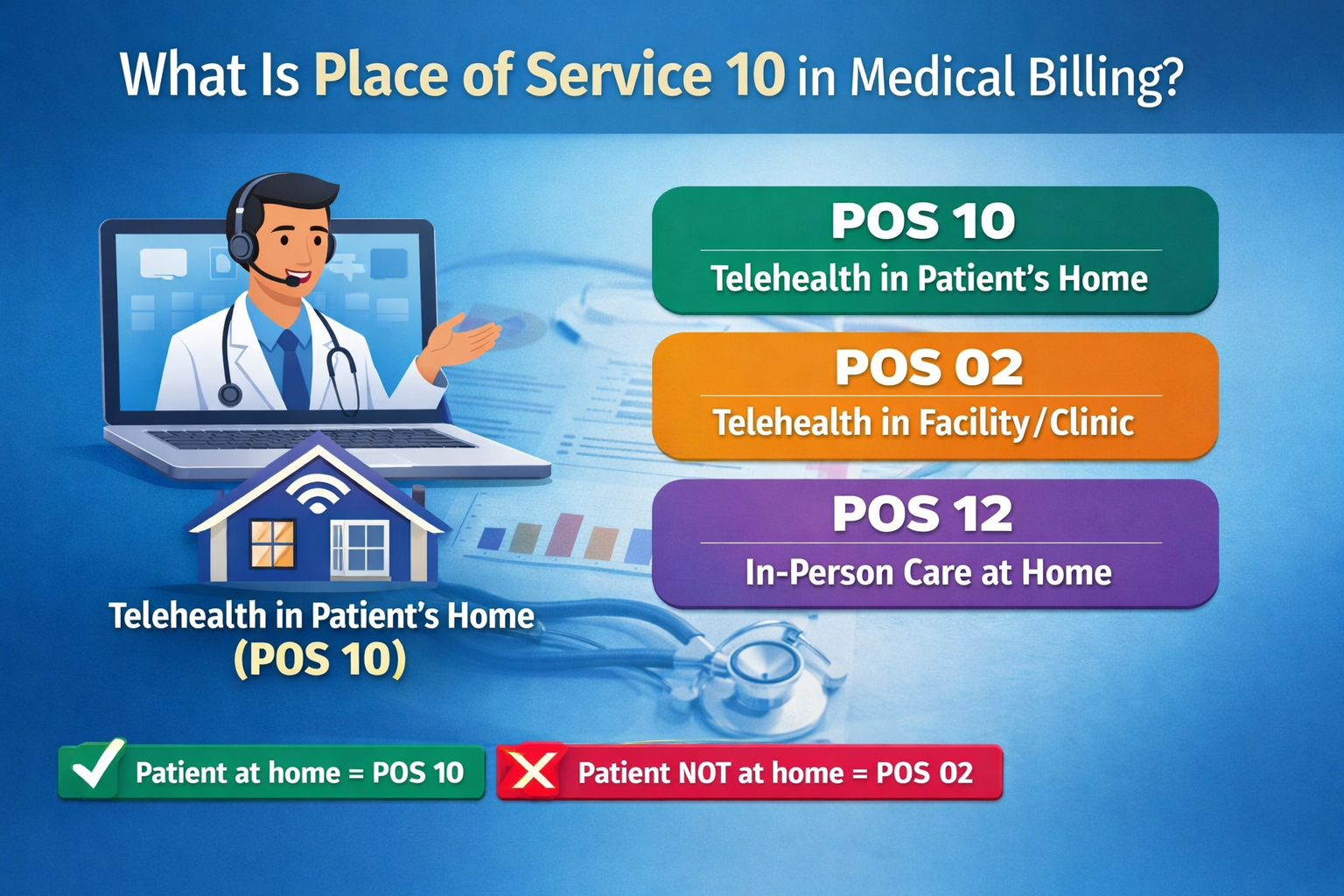
What is the POS 10 (Place of Service 10) in Medical Billing?
POS 10 (Place of Service 10) means telehealth provided in the patient’s home. In medical billing, CMS defines POS 10 as the location where health services are provided through telecommunication technology while the patient is in their home.
This code matters because the place of service is not just a small billing detail. It tells the payer where the service happened, helps determine how the claim should be processed, and can affect reimbursement. CMS says POS codes are two-digit codes on professional claims that indicate where a service was provided.
For beginners, the easiest way to remember POS 10 is this: telehealth + patient at home = POS 10. But there are important exceptions and comparisons that make the full picture clearer.
Table of Contents
ToggleWhat is a place of service code in medical billing?
A place of service code is a two-digit code used on professional claims to show the setting where care happened. CMS maintains the official POS code set and says these codes are used on professional claims to specify where services were rendered.
Place of service codes matter because they help payers understand:
- whether the service was in person or via telehealth
- where the patient received care
- Which reimbursement rules may apply
- whether the claim matches the documentation
In short, the POS code helps translate a clinical event into a billable claim detail.
What does place of service 10 mean in medical billing?
Place of Service 10 means telehealth provided while the patient is located in their home. CMS’s official code set describes POS 10 as telehealth provided in the patient’s home through telecommunication technology.
This means two things must be true at the same time:
- The service is delivered through telehealth technology
- The patient is in their home when receiving the service
That is why POS 10 is not simply a “home” code. It is a telehealth-in-the-home code.
Increase Your Collections by Up to 25%
Let our expert billing team optimize your revenue cycle, reduce denials, and accelerate payments.
What counts as the patient’s home for POS 10?
For POS 10, CMS explains that the patient’s home means a private residence and not a hospital or other facility where the patient receives care in a private residence.
That detail matters because it separates POS 10 from other settings. If the patient is physically located in a hospital, clinic, or another facility during the telehealth service, POS 10 is usually not the right code.
When did POS 10 become effective?
POS 10 became effective in the national POS code set on January 1, 2022, and CMS says it became available to Medicare on April 1, 2022.
This timing matters because older billing guidance and older blog posts may still describe telehealth differently. Current CMS guidance uses POS 10 for telehealth in the patient’s home.
When should the place of service 10 be used?
Use POS 10 when a telehealth service is furnished, and the patient is in their home during the encounter. CMS’s 2026 telehealth FAQ says physicians and practitioners should use POS 10 for telehealth provided in the patient’s home and POS 02 for telehealth provided other than in the patient’s home.
A simple rule is:
- patient at home during telehealth visit = POS 10
- patient not at home during telehealth visit = POS 02
Is POS 10 used on professional claims or facility claims?
POS 10 is used on professional claims. CMS states that the POS code set is used on professional claims to specify the entity where services were rendered.
That means POS 10 is part of professional billing logic, such as claims submitted on the CMS-1500 form or electronic 837P equivalents. It is not a general label for every type of healthcare bill.
Does POS 10 apply to every kind of virtual service?
No, POS 10 does not automatically apply to every virtual or digital healthcare service. CMS says some non-face-to-face services, such as remote monitoring, chronic care management, and similar services, are not subject to Medicare telehealth rules because they are not substitutes for in-person encounters in the same way Medicare telehealth services are.
This is one of the biggest areas of confusion. A service can be “virtual” but still not be billed under the Medicare telehealth framework that uses POS 10.
How is place of service 10 different from place of service 02?
POS 10 and POS 02 both describe telehealth, but the patient’s location is different. CMS says POS 10 is for telehealth in the patient’s home, while POS 02 is for telehealth when the patient is not in their home.
Here is the clearest comparison:
| POS code | Meaning | Patient location |
|---|---|---|
| POS 10 | Telehealth is provided in the patient’s home | Home / private residence |
| POS 02 | Telehealth provided other than in the patient’s home | Any non-home setting used for telehealth |
A fast way to remember it:
- 10 = telehealth at home
- 02 = telehealth not at home
This distinction matters because CMS uses separate definitions for the two codes, and using the wrong one can lead to billing errors.
How is place of service 10 different from place of service 12 and place of service 11?
POS 10 is telehealth in the home, POS 12 is in-person care in the home, and POS 11 is in-person care in an office. CMS’s code set makes these differences clear.
Here is the practical comparison:
| POS code | Meaning | In person or telehealth? |
|---|---|---|
| POS 10 | Telehealth is provided in the patient’s home | Telehealth |
| POS 12 | Home | Usually in person |
| POS 11 | Office | Usually in person |
This comparison helps prevent a common mistake: some people see “home” and choose POS 12 even when the service was delivered by telehealth. If the patient is at home and the service is provided through telecommunication technology, CMS’s current definition points to POS 10, not POS 12.
Does place of service 10 affect Medicare reimbursement?
Yes, POS 10 can affect Medicare reimbursement. CMS says that starting January 1, 2024, claims for Medicare telehealth services provided to patients in their homes are paid at the non-facility payment rate.
That matters because the POS code is not only descriptive. It can also influence how the claim is priced. At the same time, CMS also says providers should check with individual payers, including Medicare, Medicaid, and private insurers, for reimbursement policies regarding POS codes.
So the practical lesson is:
- CMS gives the official POS definitions
- Reimbursement may vary by payer rules
- The correct POS code still has to match the real service setting
What billing mistakes happen most often with place of service 10?
The most common POS 10 mistake is using it for the wrong kind of service or the wrong patient location. Because POS 10 is specific, even a small misunderstanding can create claim problems.
Common mistakes include:
- using POS 12 instead of POS 10 when the patient was at home, but the visit was telehealth
- using POS 10 when the patient was actually in another facility or setting
- assuming every digital service is Medicare telehealth
- forgetting that payer-specific reimbursement rules can differ
- relying on old telehealth guidance instead of current CMS definitions
A simple way to avoid errors is to check three facts before claim submission:
- Was the service really telehealth?
- Where was the patient physically located?
- Does the payer have any special billing guidance for that service?
What is the key takeaway about place of service 10?
Place of Service 10 means telehealth provided while the patient is in their home. That is the clearest and most important answer.
If you remember only one thing, remember this:
- POS 10 = telehealth + patient at home
- POS 02 = telehealth + patient not at home
- POS 12 = in-person home setting
- POS 11 = in-person office setting
That one framework solves most beginner questions about POS 10.
FAQs
Is the place of service 10 only for telehealth?
Yes. CMS defines POS 10 as telehealth provided in the patient’s home through telecommunication technology.
Can the place of service 10 be used when the patient is not at home?
No. If the patient is not at home during the telehealth service, CMS says POS 02 is the correct telehealth code instead.
Is place of service 10 the same as place of service 12?
No. POS 10 is telehealth in the patient’s home, while POS 12 is the home setting itself and is generally used for in-person home services.
Is the place of service 10 used on professional claims?
Yes. CMS states that POS codes are used on professional claims to specify where services were rendered.
Does place of service 10 affect payment?
Yes, it can. CMS says Medicare telehealth services provided to patients in their homes are paid at the non-facility rate beginning January 1, 2024.
Is every virtual service billed with place of service 10?
No. CMS says some non-face-to-face services, such as remote monitoring and chronic care management, are not governed by the same Medicare telehealth rules.
Should providers still check payer-specific rules?
Yes. CMS specifically says providers should check with individual payers for reimbursement policies regarding POS codes.
Conclusion
POS 10 is one of the easiest billing codes to understand once you separate the telehealth location from the physical location. The code does not just mean “home.” It means telehealth delivered while the patient is in their home. Get that distinction right, and the rest of the billing logic becomes much easier.