What Do Ambulatory, Ancillary, Preventive, Lab, Therapeutic, Pharmacy, and Telehealth Services Mean in Medical Billing?
Medical bills often use service labels that sound technical even when the care itself was simple. In billing, these labels usually describe where care happened, why it was provided, or whether it supported another service.
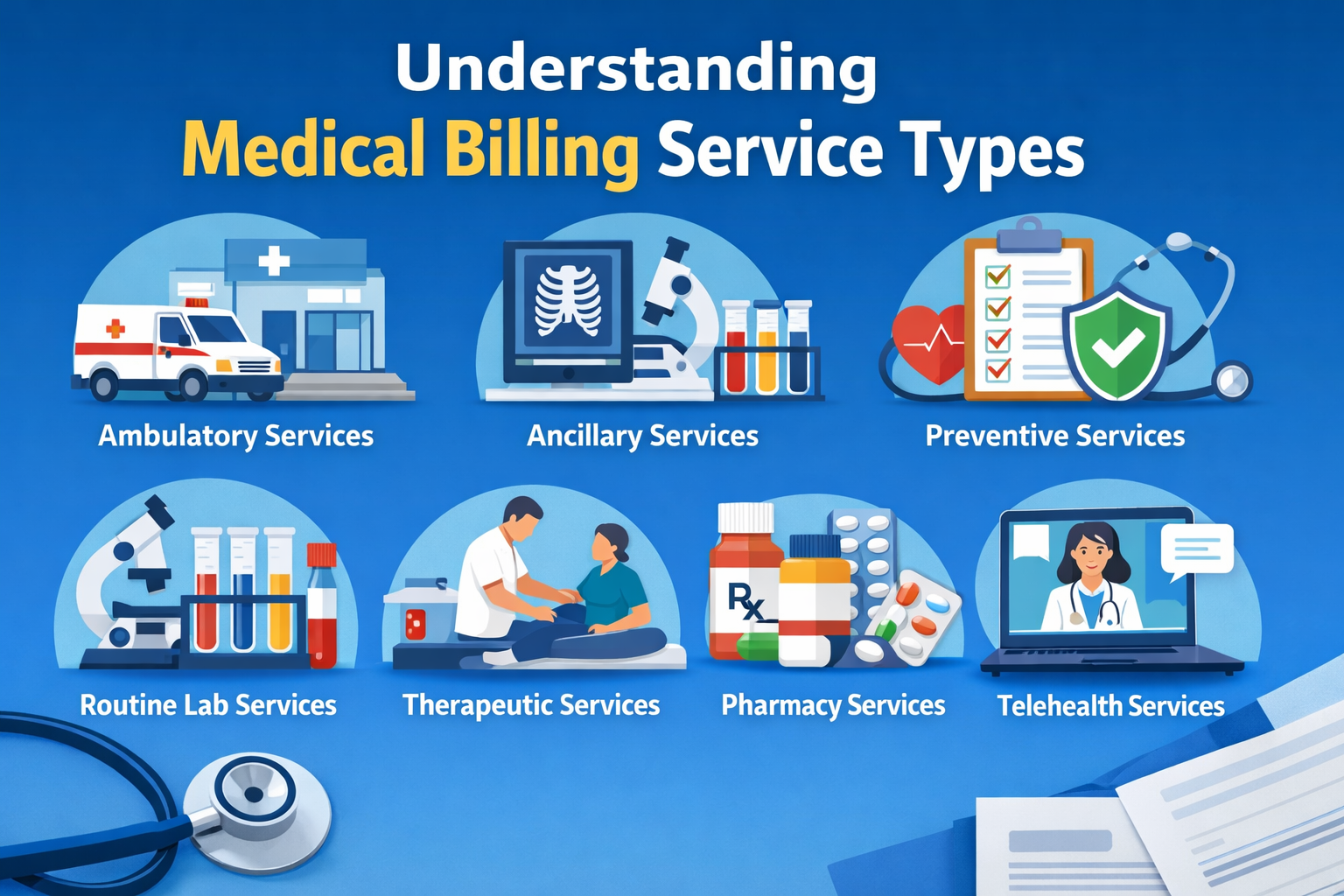
The short answer is this: ambulatory services are outpatient services, ancillary services are supporting services, preventive services focus on prevention, routine lab services are standard diagnostic tests, therapeutic services are treatment-oriented services, pharmacy services are medication-related charges, and telehealth services are services delivered through telecommunications technology.
This matters because the same visit can include more than one billing category. A hospital outpatient visit can be ambulatory, include ancillary lab and pharmacy charges, and still contain a preventive or therapeutic component, depending on what was done.
Table of Contents
ToggleWhat do these service labels mean on a medical bill?
These labels are billing shortcuts that tell payers and patients what kind of care was provided. Some labels describe the setting of care, such as ambulatory or telehealth. Others describe the purpose of care, such as preventive or therapeutic. Others describe supporting components, such as ancillary, pharmacy, or lab services.
When a patient sees one of these labels on a bill, the label does not always mean a separate doctor visit occurred. It may describe one part of a larger claim, a hospital department charge, or a supporting service tied to the main encounter.
What are ambulatory services in medical billing?
Ambulatory services in medical billing mean care delivered in an outpatient setting, without an inpatient hospital admission. AHRQ defines ambulatory care as care provided by health professionals in outpatient settings such as medical offices, clinics, ambulatory surgery centers, and hospital outpatient departments.
In billing terms, ambulatory services often include:
- office visits
- same-day procedures
- outpatient surgery
- clinic-based follow-up care
- hospital outpatient services
Ambulatory care is a major part of U.S. healthcare use. AHRQ’s 2023 National Ambulatory Surgery Sample overview reported 13.5 million in-scope ambulatory surgery encounters, showing how common outpatient care is in real billing and payment systems.
What are ancillary services in medical billing?
Ancillary services in medical billing are supporting services that help diagnose, monitor, or treat a patient alongside the main service. CMS materials describe ancillary hospital or facility services as including items such as laboratory, radiology, drugs, operating room-related services, and therapy services.
In simple terms, ancillary services are usually not the main reason you came in. They are often the support work around the main visit or procedure. Common examples include:
- lab tests
- imaging
- pharmacy or drugs
- anesthesia-related support
- physical, speech, or occupational therapy in some billing contexts
A common misunderstanding is that ancillary means optional or unnecessary. In billing, it usually means the service supports the main service. It does not mean the service had no medical value.
What are preventive services in medical billing?
Preventive services in medical billing are routine health services meant to prevent disease or detect it early. Healthcare.gov defines preventive services as routine health care that includes screenings, check-ups, and patient counseling to prevent illness, disease, or other health problems.
Typical preventive services include:
- screening tests
- annual wellness or preventive visits
- counseling for risk reduction
- immunizations
- certain preventive medications and women’s preventive services under federal coverage rules
For many private plans, preventive services are especially important because federal rules require most plans to cover a set of recommended preventive services without copayments, coinsurance, or deductibles when the rules are met. That is why preventive care is both a clinical category and an important billing category.
What are routine lab services in medical billing?
Routine lab services in medical billing usually mean standard diagnostic laboratory tests that providers commonly order to check health status, monitor treatment, or evaluate symptoms. There is not one single universal federal consumer glossary definition for the exact phrase “routine lab services” across all payers, but official federal sources make clear that laboratory testing involves analyzing blood, urine, tissue, or other specimens, and common routine blood panels include tests such as CBCs and metabolic panels.
Examples often included under routine lab work are:
- complete blood count (CBC)
- basic metabolic panel (BMP)
- comprehensive metabolic panel (CMP)
- urinalysis or culture, depending on the clinical situation
Billing can work differently depending on the setting. CMS says that for hospitals paid under OPPS, outpatient laboratory tests are generally packaged as ancillary services and do not receive separate payment unless certain conditions apply, such as when the patient only receives outpatient lab tests that day.
CMS also publishes compliance data showing why lab billing accuracy matters. For 2024 reporting, CMS said the improper payment rate for routine venipuncture lab tests was 10.1%, with a projected improper payment amount of $21.5 million. That figure shows routine lab billing is common and still vulnerable to documentation or claim errors.
What are therapeutic services on a medical bill?
Therapeutic services on a medical bill are treatment-oriented services, not just diagnostic services. CMS says hospital outpatient therapeutic services are services and supplies provided on an outpatient basis that are incident to physicians’ or practitioners’ services in the treatment of patients.
That means therapeutic services are generally there to treat, improve, or manage a condition, not just identify it. Depending on the setting, examples can include:
- outpatient infusion-related treatment
- clinic treatment services
- emergency room treatment services
- physical therapy
- occupational therapy
- speech-language pathology services
A good rule is this: if the service is mainly about active treatment, rehab, symptom relief, or ongoing management, it is more likely to be therapeutic than preventive or purely diagnostic.
What are pharmacy services on my medical bill?
Pharmacy services on a medical bill usually refer to medication-related hospital or outpatient charges. CMS says a hospital’s pharmacy service is responsible for the procurement, storage, preparation, dispensing, use, tracking, control, and disposal of medications and medication-related devices for both inpatient and outpatient services.
On a patient bill, pharmacy services can therefore mean charges related to:
- medications given during the visit
- preparation or dispensing of those medications
- hospital outpatient drug handling
- medication-related supplies in some settings
This is one reason pharmacy can appear as its own line item. In some hospital settings, the medication is not just part of the room or visit charge. Medicare also notes that if a patient’s Medicare drug plan does not cover a self-administered drug received in the hospital, the patient may have to pay what the hospital charges for that drug.
What are telehealth services in medical billing?
Telehealth services in medical billing are healthcare services delivered through telecommunications technology and billed using telehealth-specific rules. CMS says Medicare pays for certain Part B services that a physician or practitioner provides through two-way interactive technology, and those services substitute for an in-person visit.
Telehealth also has its own place-of-service structure. CMS uses:
- POS 02 for telehealth provided other than in the patient’s home
- POS 10 for telehealth provided in the patient’s home
Telehealth is no longer a niche category. CMS’s Medicare Telehealth Trends Report shows that 24% of Medicare fee-for-service users had a telehealth service in 2023, down from the pandemic peak but still showing lasting use.
How do ambulatory, ancillary, preventive, lab, therapeutic, pharmacy, and telehealth services differ?
The easiest way to separate these terms is to group them by setting, purpose, and support role.
| Service term | What it mainly describes | Simple meaning |
|---|---|---|
| Ambulatory | Setting | Outpatient care |
| Ancillary | Support role | Supporting services like lab, imaging, drugs, therapy |
| Preventive | Purpose | Care meant to prevent illness or catch it early |
| Routine lab | Diagnostic testing | Standard blood, urine, or specimen testing |
| Therapeutic | Purpose | Active treatment or rehabilitation |
| Pharmacy | Medication component | Drug-related hospital or outpatient charges |
| Telehealth | Delivery method and setting | Care delivered through telecommunications technology |
This comparison reflects how federal sources describe outpatient care, preventive care, outpatient therapeutic services, pharmacy functions, telehealth billing, and ancillary support services.
What are the most common mistakes people make when reading these service categories?
The biggest mistake is assuming every service label means a separate office visit. Many labels describe one part of the same encounter. A hospital outpatient claim can include a main service plus ancillary lab, pharmacy, or therapeutic components.
The second mistake is assuming preventive, diagnostic, and therapeutic mean the same thing. They do not. Preventive care is meant to avoid disease or catch it early, diagnostic services help identify a condition, and therapeutic services treat it.
The third mistake is assuming ancillary means minor. In billing, ancillary often means supportive, not trivial. Lab, imaging, drugs, and therapy can all be ancillary and still medically important.
What is the key takeaway for understanding these billing terms?
The key takeaway is simple: some service labels tell you where care happened, some tell you why it was provided, and some tell you which supporting parts were attached to the visit. If you read the bill that way, these labels become much easier to understand.
Key Takeaway
- Ambulatory = outpatient setting
- Ancillary = supporting service
- Preventive = prevention-focused care
- Routine lab = standard diagnostic testing
- Therapeutic = treatment-focused care
- Pharmacy = medication-related charge
- Telehealth = care delivered through telecommunications technology
What are the most relevant FAQs about these medical billing service terms?
Are preventive services always free?
Not always in every situation. Healthcare.gov says most health plans must cover a set of preventive services at no cost, but plan rules, network status, and how the service is billed can affect what the patient owes.
Does ancillary mean unnecessary?
No. In medical billing, ancillary usually means the service supports the main service. Lab, imaging, drugs, and therapy can all be ancillary and still be medically necessary.
Why is a pharmacy charge separate from the visit?
Because medication-related work is often tracked and billed separately from the main encounter. CMS says hospital pharmacy services cover medication procurement, preparation, dispensing, use, tracking, and control for inpatient and outpatient care.
Are routine lab services always billed separately?
No. CMS says outpatient hospital lab tests are often packaged as ancillary services under OPPS, although separate payment can apply in certain situations.
Is telehealth the same as a phone call in billing?
Not necessarily. CMS describes Medicare telehealth as certain services delivered through two-way interactive technology, and telehealth billing uses its own place-of-service rules, such as POS 02 and POS 10.
Can one visit include more than one service category?
Yes. One outpatient visit can be ambulatory, include ancillary lab or pharmacy items, and also be preventive or therapeutic, depending on what the provider did.
What does therapeutic mean compared with diagnostic?
Therapeutic means the service is used to treat or manage a condition. Diagnostic means the service is used to identify or evaluate a condition. CMS distinguishes outpatient therapeutic services from diagnostic services in the hospital outpatient policy.
Conclusion
If you understand whether a billing term describes the setting, the purpose, or the supporting component of care, most medical bill labels become far less confusing. That simple framework is the best way to decode ambulatory, ancillary, preventive, routine lab, therapeutic, pharmacy, and telehealth services on real-world bills and claims.