What Are OT Evaluation CPT Codes (97165, 97166, 97167) and How Do They Work?
Occupational therapy (OT) evaluation CPT codes—97165, 97166, and 97167—are used to classify the complexity of an OT evaluation for billing and documentation purposes. These codes help insurers determine reimbursement based on the level of clinical decision-making and patient needs.
If you’re a therapist, student, or simply researching, understanding these codes is essential because choosing the wrong code can lead to denied claims, audits, or underpayment.
Table of Contents
ToggleWhat are occupational therapy evaluation CPT codes?
Occupational therapy evaluation CPT codes are standardized billing codes used to describe the complexity and scope of an OT assessment.
These codes were introduced in 2017 by the American Medical Association (AMA) to replace older generalized evaluation codes.
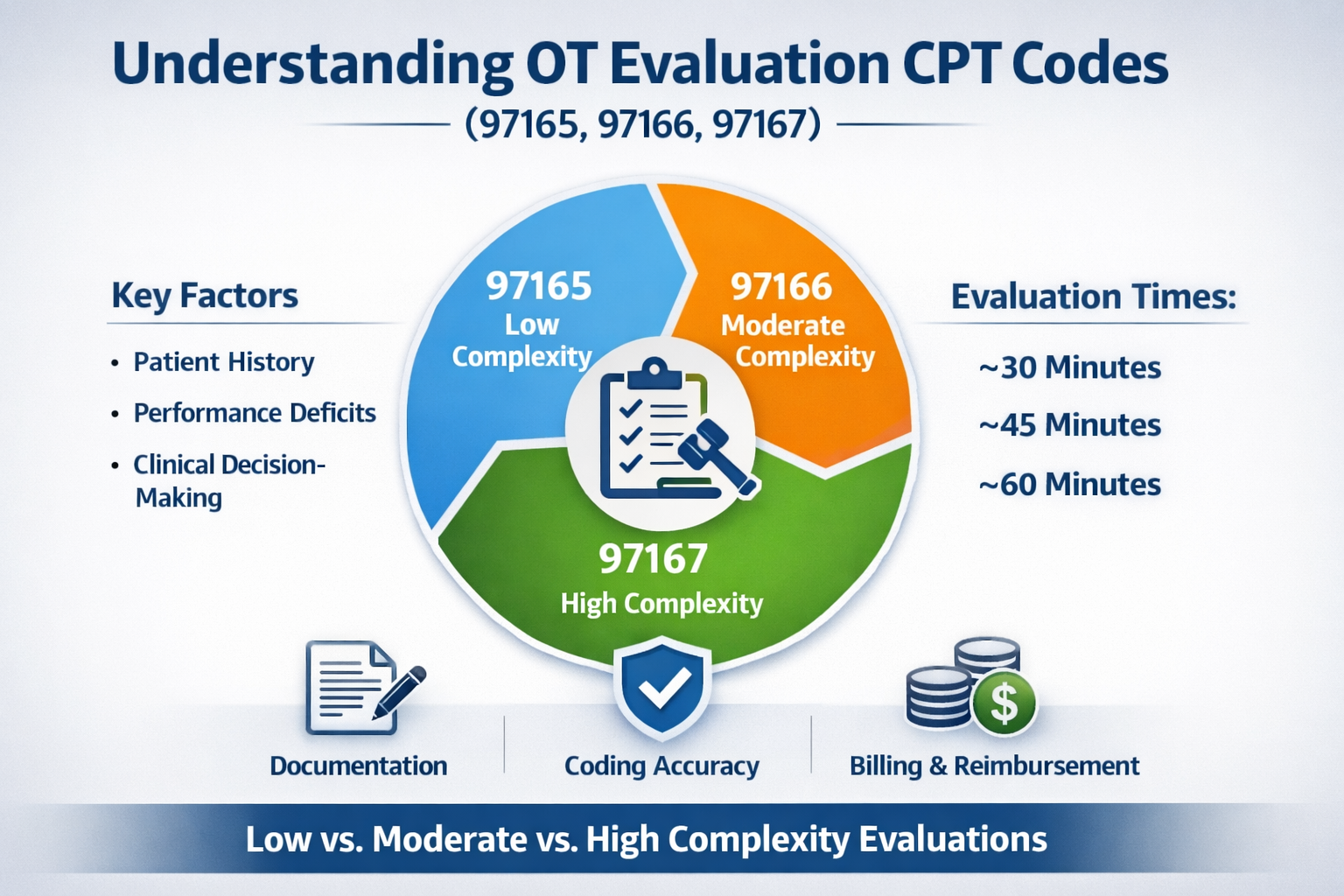
They are divided into three levels:
- 97165 → Low complexity
- 97166 → Moderate complexity
- 97167 → High complexity
Each level reflects:
- Patient condition complexity
- Number of performance deficits
- Clinical decision-making level
- Time required for evaluation
What is CPT code 97165 (low complexity OT evaluation)?
CPT code 97165 represents a low-complexity occupational therapy evaluation involving minimal clinical decision-making.
Key characteristics:
- Brief patient history
- 1–3 performance deficits
- Stable condition
- Low complexity decision-making
- Typically, 30 minutes of face-to-face time
Example:
- A patient recovering from a minor wrist injury
- Minimal functional limitations
This code is used when the therapist can quickly assess and develop a straightforward care plan.
What is CPT code 97166 (moderate complexity OT evaluation)?
CPT code 97166 describes a moderate-complexity OT evaluation requiring more detailed assessment and clinical reasoning.
Key characteristics:
- Expanded patient history
- 3–5 performance deficits
- Evolving clinical presentation
- Moderate decision-making complexity
- Typically, 45 minutes of face-to-face time
Example:
- A stroke patient with moderate functional limitations
- Multiple areas affected (mobility, coordination, ADLs)
This is the most commonly used OT evaluation code in practice.
What is CPT code 97167 (high complexity OT evaluation)?
CPT code 97167 is used for high-complexity evaluations involving significant clinical judgment and multiple functional impairments.
Key characteristics:
- Comprehensive patient history
- 5+ performance deficits
- Unstable or unpredictable condition
- High-level clinical decision-making
- Typically, 60 minutes of face-to-face time
Example:
- A patient with traumatic brain injury
- Multiple cognitive, physical, and emotional impairments
This code reflects the highest level of therapist expertise and evaluation depth.
What is the difference between 97165, 97166, and 97167?
The main difference lies in complexity, not just time.
| Feature | 97165 (Low) | 97166 (Moderate) | 97167 (High) |
|---|---|---|---|
| History | Brief | Expanded | Comprehensive |
| Deficits | 1–3 | 3–5 | 5+ |
| Decision-making | Low | Moderate | High |
| Patient condition | Stable | Evolving | Unstable |
| Time | ~30 min | ~45 min | ~60 min |
Key insight:
Time supports the code, but complexity determines it.
How do you choose the correct OT evaluation CPT code?
You choose the correct OT evaluation code based on clinical complexity, not just duration.
What factors determine the complexity level?
Complexity is determined by three main components:
- Patient history
- Medical and therapy-related background
- Performance deficits
- Limitations in daily activities (ADLs)
- Clinical decision-making
- Therapist judgment and care planning
Additional considerations:
- Comorbidities
- Cognitive status
- Environmental factors
Is OT evaluation coding time-based or complexity-based?
OT evaluation codes are primarily complexity-based, with time as a supporting guideline.
- You cannot choose a code based on time alone
- Time helps validate the level of service
For example:
- Spending 60 minutes doesn’t automatically justify 97167
- Complexity must match documentation
What documentation is required for OT evaluation codes?
Proper documentation must clearly justify the selected complexity level.
Required elements:
- Occupational profile
- Medical and therapy history
- Assessment results
- Number of performance deficits
- Clinical reasoning explanation
- Plan of care
Best practice:
- Clearly state why the case is low, moderate, or high complexity
- Avoid vague notes
What is CPT code 97168 (OT re-evaluation)?
CPT code 97168 is used for occupational therapy re-evaluations when a patient’s condition changes significantly.
When to use 97168:
- Progress is not as expected
- New diagnosis or complication
- Major change in functional status
Key features:
- Updated assessment
- Revised treatment plan
- Clinical decision-making required
Can OT evaluation CPT codes be billed together?
No, only one OT evaluation code (97165, 97166, or 97167) can be billed per evaluation session.
Important rules:
- Choose one code per session
- Do not combine multiple evaluation codes
- You may bill treatment codes separately
What are common mistakes when using OT eval codes?
The most common mistakes involve incorrect code selection and poor documentation.
Frequent errors:
- Choosing codes based only on time
- Overcoding (billing higher complexity than justified)
- Undercoding (losing revenue)
- Missing documentation of deficits
- Not updating evaluations when needed
Tip:
Always align documentation with clinical reasoning.
Why do OT evaluation CPT codes matter for billing and reimbursement?
OT evaluation CPT codes directly impact insurance reimbursement, compliance, and audit risk.
According to the American Medical Association and CMS guidelines:
- Incorrect coding can lead to claim denials or audits
- Accurate coding ensures fair reimbursement
- Proper documentation supports medical necessity
Healthcare audits increasingly focus on therapy services, making accurate coding critical.
Key takeaways about OT evaluation codes
- OT evaluation codes are complexity-based, not just time-based
- 97165 = low, 97166 = moderate, 97167 = high complexity
- Documentation must justify code selection
- Only one evaluation code per session
- Proper coding improves reimbursement and compliance
FAQs about OT evaluation CPT codes
What is CPT code 97166 used for?
It is used for moderate complexity occupational therapy evaluations involving multiple deficits and evolving conditions.
Is 97166 time-based?
No, it is complexity-based, but it typically involves around 45 minutes.
What is the difference between 97165 and 97167?
97165 is low complexity, while 97167 is high complexity with more deficits and clinical decision-making.
Can you bill 97165 and 97166 together?
No, only one evaluation code can be billed per session.
What is the OT re-evaluation code?
The re-evaluation code is 97168.
How many minutes is 97167?
It usually involves about 60 minutes, but complexity matters more than time.
What determines OT evaluation complexity?
Patient history, performance deficits, and clinical decision-making.
Conclusion
Understanding OT evaluation CPT codes isn’t just about memorizing numbers—it’s about applying clinical judgment, accurate documentation, and proper billing practices. When used correctly, these codes ensure both compliance and fair reimbursement while supporting high-quality patient care.