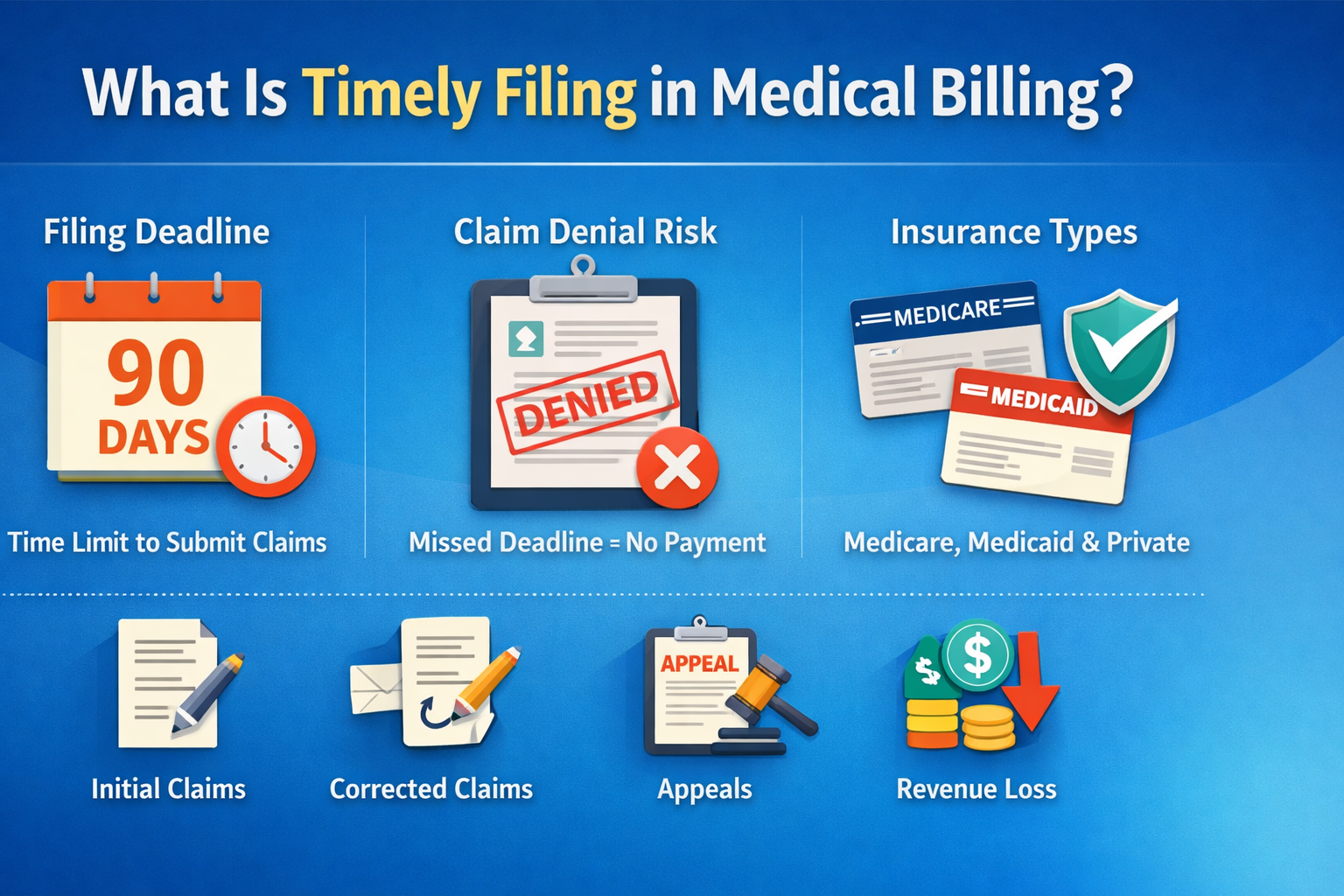
What Is Timely Filing in Medical Billing?
Timely filing in medical billing refers to the maximum time limit a healthcare provider has to submit a medical claim to an insurance company for reimbursement.
If a claim is not submitted within this deadline, the insurer may deny payment completely, regardless of whether the service was valid or medically necessary.
Understanding timely filing is critical because it directly affects how and whether healthcare providers get paid. For patients and billing professionals alike, it’s one of the most important rules in the healthcare revenue cycle.
Table of Contents
ToggleWhat Does Timely Filing Mean in Medical Billing?
Timely filing means submitting a medical claim within a specific deadline set by an insurance payer.
In simple terms:
- A provider treats a patient
- A claim is generated
- That claim must be sent within a defined timeframe
Example:
- A patient visit occurs on January 1
- The insurer requires claims within 90 days
- The claim must be submitted by March 31
If the provider misses that window, the claim may be denied as “untimely filing.”
Why Is Timely Filing Important for Healthcare Providers?
Timely filing is important because it determines whether a provider gets paid or loses revenue.
Key reasons it matters:
- Prevents claim denials: Late claims are often automatically rejected
- Ensures cash flow: Faster submissions lead to faster payments
- Supports compliance: Many regulations require a timely submission
- Improves patient satisfaction: Fewer billing issues
According to the U.S. Centers for Medicare & Medicaid Services (CMS), failure to meet filing deadlines is one of the most common reasons for claim denials in healthcare billing systems.
What Are the Standard Timely Filing Limits for Medical Claims?
Timely filing limits vary but typically fall within 30 days to 1 year, depending on the payer.
Common ranges:
- 30–90 days → Some private insurers
- 90–180 days → Many commercial plans
- Up to 1 year → Government programs like Medicare
There is no universal deadline. Each insurance company sets its own rules.
How Do Timely Filing Limits Differ by Insurance Type?
Timely filing deadlines vary significantly depending on the type of insurance provider.
Comparison Table
| Insurance Type | Typical Filing Limit | Notes |
|---|---|---|
| Medicare | 12 months | Strict federal rule |
| Medicaid | 90 days–12 months | Varies by state |
| Private Insurance | 30–180 days | Depends on plan |
| Workers’ Compensation | Varies widely | State-specific |
What Is the Timely Filing Limit for Medicare?
Medicare requires claims to be filed within 12 months (1 year) from the date of service.
- Set by CMS regulations
- Applies to most Medicare Part B claims
- Late claims are usually denied with no payment
What Is the Timely Filing Limit for Medicaid?
Medicaid deadlines vary by state but typically range from 90 days to 12 months.
- Each state sets its own rules
- Some states allow extensions under special circumstances
What Are Typical Deadlines for Private Insurance?
Private insurers often require claims within 30 to 180 days.
- Highly variable across companies
- Often stricter than government programs
- Policy documents define exact timelines
What Types of Claims Are Affected by Timely Filing Rules?
Timely filing applies to all types of medical claims, including:
1. Initial Claims
- First submission after patient care
- Must meet the standard deadline
2. Corrected Claims
- Resubmitted claims with errors fixed
- Often have shorter deadlines
3. Appeals
- Requests to reconsider denied claims
- Must follow separate appeal timelines
What Happens If a Claim Misses the Timely Filing Deadline?
If a claim is submitted late, it is usually denied with no reimbursement.
Common outcomes:
- Claim marked as “timely filing exceeded”
- No payment issued
- Provider absorbs financial loss
- The patient may or may not be billed
Important:
Even if the service was valid, insurers often refuse payment purely due to lateness.
Are There Exceptions to Timely Filing Deadlines?
Yes, but exceptions are limited and require strong documentation.
Common exceptions:
- Retroactive insurance coverage
- Coordination of benefits delays
- Natural disasters or system outages
- Administrative errors by the payer
Providers must typically:
- Submit proof
- File an appeal
- Explain the delay clearly
How Does the Timely Filing Process Work Step by Step?
Timely filing is part of the larger billing workflow.
Step-by-step process:
- Patient receives care
- Provider documents services
- Medical codes (ICD, CPT) are assigned
- Claim is created
- Claim is submitted (electronically or paper)
- The insurer reviews and processes the claim
Key point:
The clock starts on the date of service, not the billing date.
What Are the Most Common Timely Filing Mistakes in Medical Billing?
Timely filing errors often happen due to operational issues.
Common mistakes:
- Delayed documentation
- Incorrect patient information
- Coding errors requiring resubmission
- Missing insurance verification
- Ignoring payer-specific deadlines
How Can Providers Avoid Timely Filing Denials?
Providers can avoid timely filing issues by improving processes and tracking deadlines.
Best practices:
- Submit claims within 24–72 hours of service
- Use electronic health record (EHR) systems
- Track deadlines with billing software
- Verify insurance at check-in
- Train staff regularly
Technology helps:
Modern billing systems automatically flag approaching deadlines and reduce errors.
What Is the Difference Between Timely Filing and Claim Submission?
Timely filing refers to the deadline, while claim submission refers to the act of sending the claim.
Simple comparison:
| Concept | Meaning |
|---|---|
| Timely Filing | Deadline for submission |
| Claim Submission | Process of sending a claim |
Both are connected, but not the same.
How Does Timely Filing Impact Revenue Cycle Management?
Timely filing is a critical part of revenue cycle management (RCM) because it directly affects income.
Impact areas:
- Cash flow stability
- Denial rates
- Administrative workload
- Financial performance
Healthcare organizations with strong, timely filing processes typically experience:
- Fewer denials
- Faster reimbursements
- Better financial outcomes
Key Takeaways About Timely Filing in Medical Billing
- Timely filing is the deadline for submitting medical claims
- Missing the deadline usually results in claim denial
- Deadlines vary by insurance provider
- Medicare allows 12 months, while private insurers may allow as little as 30 days
- Proper processes and systems can prevent most timely filing issues
FAQs
What is timely filing in simple terms?
Timely filing means submitting a medical claim within the allowed time limit set by an insurance company.
What happens if timely filing is missed?
The claim is usually denied, and the provider may not receive payment.
Can timely filing denials be appealed?
Yes, but only if there is a valid reason and supporting documentation.
How long does Medicare allow for claim submission?
Medicare allows up to 12 months from the date of service.
Do all insurance companies have the same deadlines?
No, each payer has its own timely filing rules.
Does timely filing apply to corrected claims?
Yes, corrected claims also have deadlines, often shorter than initial claims.
When does the timely filing clock start?
It starts on the date of service, not when the claim is created.
Conclusion
Timely filing in medical billing may sound like a simple rule, but it has a major impact on whether healthcare providers get paid. By understanding deadlines, following payer-specific rules, and using efficient billing systems, providers can avoid costly denials and keep their revenue cycle running smoothly.