Table of Contents
ToggleWhat Is Claim Status Tracking in Medical Billing?
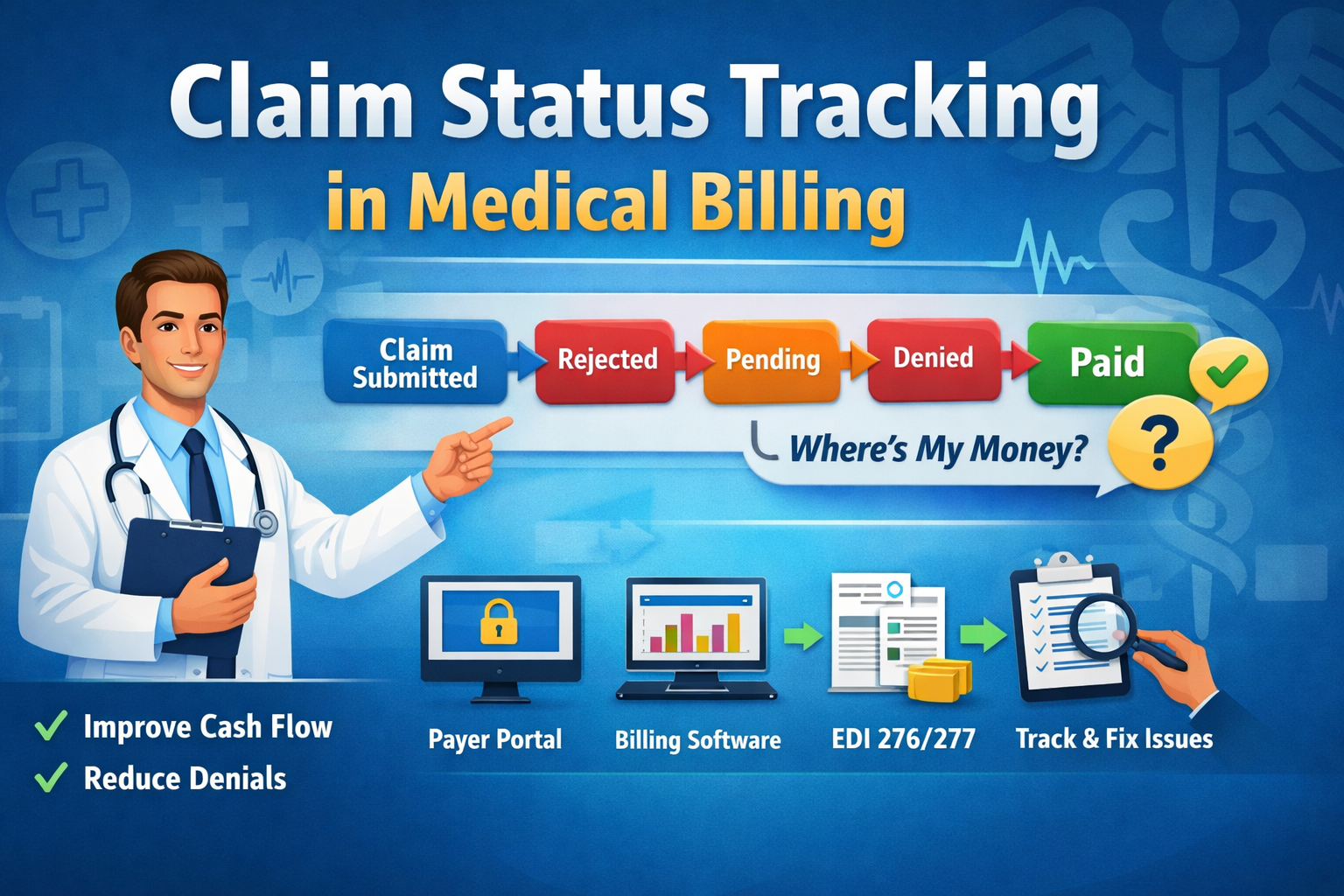
Claim status tracking in medical billing is the process of monitoring a healthcare insurance claim from submission to final payment. It ensures that providers know whether a claim is received, accepted, rejected, pending, denied, or paid — and allows them to take action quickly if something goes wrong.
In simple terms, it answers one question:
“Where is my money?”
Why Claim Status Tracking Matters
Medical practices rely on steady cash flow. If claims are not tracked:
-
Payments get delayed
-
Denials go unnoticed
-
Revenue cycle slows down
-
AR (Accounts Receivable) increases
-
Reimbursement rates drop
Tracking helps reduce aging claims, improve clean claim rate, and maintain a healthy Revenue Cycle Management (RCM) system.
The Claim Status Tracking Process (Step-by-Step)
1️⃣ Claim Submission
-
The provider submits the claim electronically (usually via clearinghouse).
-
Insurance acknowledges receipt.
2️⃣ Claim Acknowledgment
-
Claim is either:
-
Accepted (moves to processing)
-
Rejected (needs correction and resubmission)
-
3️⃣ Payer Processing
-
Insurance reviews:
-
Patient eligibility
-
CPT/ICD coding accuracy
-
Medical necessity
-
Authorization
-
4️⃣ Status Updates
Common claim statuses include:
| Status | Meaning |
|---|---|
| Received | Payer has received the claim |
| In Process | Under review |
| Pending | Waiting for more info |
| Rejected | Not accepted due to error |
| Denied | Processed but not payable |
| Paid | Payment issued |
| Partial Paid | Reduced reimbursement |
5️⃣ Payment or Denial
-
Payment posted in the system
-
OR denial handled through the appeal process
How is Claim Status Checked?
Medical billers use:
-
Payer portals
-
Clearinghouse dashboards
-
Practice Management (PM) software
-
EDI 276/277 transactions (Electronic claim status request & response)
Key Metrics in Claim Tracking
-
Clean Claim Rate
-
First Pass Resolution Rate (FPRR)
-
Days in AR
-
Denial Rate
-
Average Reimbursement Time
Common Problems Found During Tracking
-
Incorrect patient information
-
Invalid CPT/ICD codes
-
Missing prior authorization
-
Coverage termination
-
Duplicate claims
Early tracking helps fix issues before the claim ages beyond 30–60 days.
Best Practices for Effective Claim Status Tracking
✔ Track claims within 7–10 days of submission
✔ Follow up on unpaid claims every 14 days
✔ Separate rejected vs denied claims
✔ Maintain denial reason analysis
✔ Automate alerts in billing software
✔ Keep aging report under control
Example Scenario
A clinic submits 100 claims.
-
80 get paid within 20 days
-
10 are rejected due to coding errors
-
5 are denied for authorization issues
-
5 are pending
Without tracking, those 15 problematic claims may remain unpaid for months.
With tracking, corrections happen within days.
Final Summary
Claim status tracking is a critical part of Revenue Cycle Management. It ensures:
-
Faster payments
-
Lower denial rates
-
Better cash flow
-
Improved billing accuracy
In medical billing, tracking claims isn’t optional — it’s how practices stay financially healthy.