What Is the Difference Between Denials and Rejections?
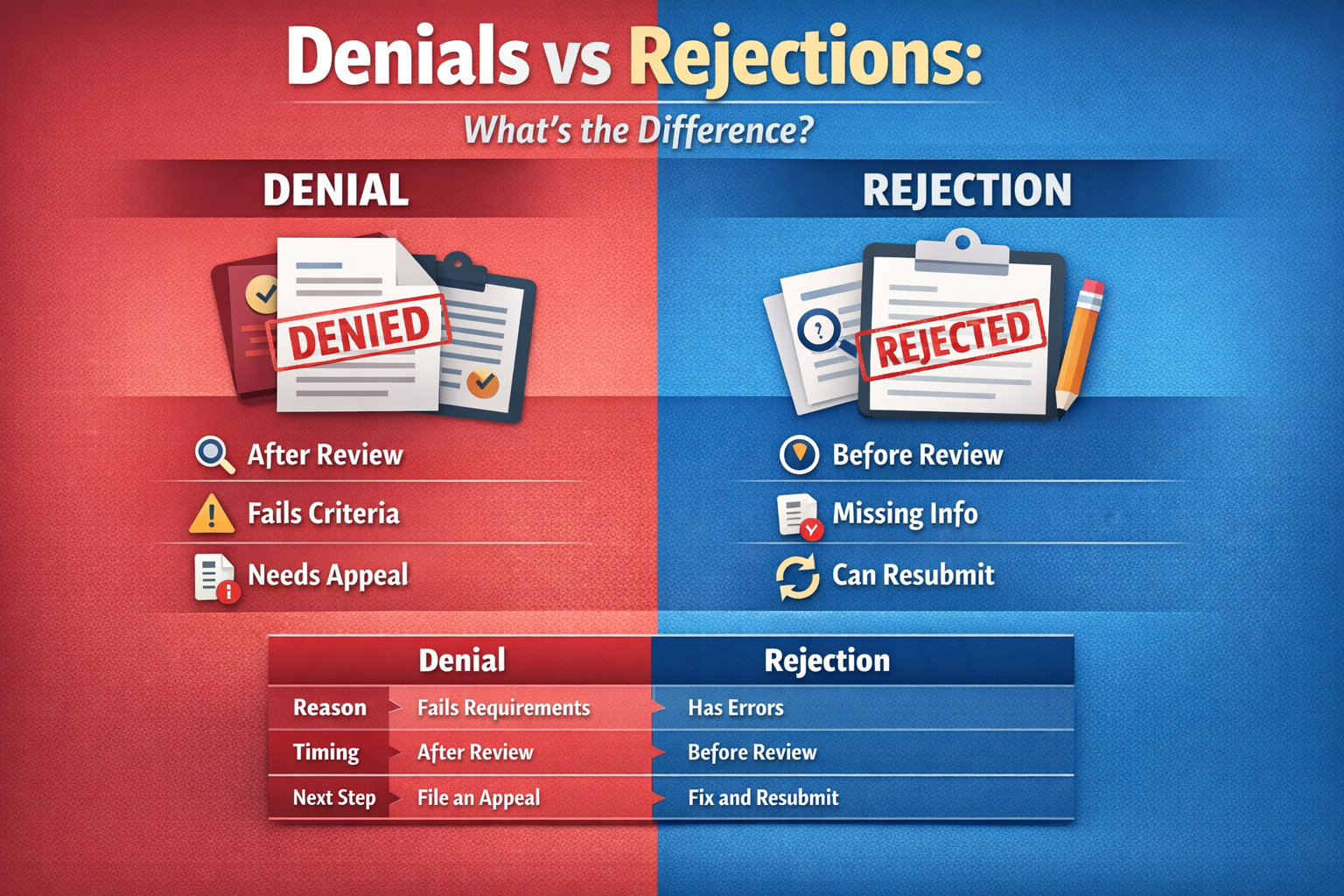
The difference between a denial and a rejection comes down to when and why a request is refused. A rejection happens early due to errors or missing information, while a denial happens after review because the request does not meet the criteria.
This distinction matters more than it seems. Whether you’re dealing with insurance claims, job applications, or loans, knowing the difference helps you respond correctly—either by fixing errors or by appealing the decision.
Table of Contents
ToggleWhat is a denial?
A denial is a refusal that happens after a full review when the request does not meet the required criteria.
In simple terms, a denial means: “We reviewed your request, but it does not qualify.”
Key characteristics:
-
Happens after evaluation
-
Based on rules, policies, or eligibility criteria
-
Usually requires an appeal or additional justification
Example:
-
An insurance claim is denied because the treatment is not covered.
-
A loan is denied due to a low credit score.
What is a rejection?
A rejection is a refusal that happens before full review due to errors, missing information, or formatting issues.
In simple terms, a rejection means: “We couldn’t process your request because something is wrong or incomplete.”
Key characteristics:
-
Happens before evaluation
-
Caused by technical or administrative issues
-
Can usually be corrected and resubmitted
Example:
-
A claim is rejected because the form is incomplete.
-
A job application is rejected due to missing documents.
What is the key difference between denial and rejection?
The key difference is timing and reason.
-
Rejection = administrative issue (before review)
-
Denial = eligibility issue (after review)
Simple comparison:
-
Rejection → Fix and resubmit
-
Denial → Appeal or reconsider
When does a rejection occur in a process?
A rejection occurs at the initial validation stage, before detailed review.
Common triggers:
-
Missing information
-
Incorrect formatting
-
Invalid data entry
-
System errors
Example workflow:
-
Submit application
-
System checks for errors
-
If errors are found → Rejected
When does a denial occur in a process?
A denial occurs after the request passes validation and is reviewed against rules.
Common triggers:
-
Not meeting eligibility criteria
-
Policy exclusions
-
Insufficient qualifications
-
Risk assessment failure
Example workflow:
-
Submit application
-
Pass validation
-
Undergo review
-
Fails criteria → Denied
How do denial and rejection differ in insurance claims?
In insurance, the difference is especially important.
Rejection in insurance:
-
Claim not processed
-
Caused by:
-
Missing codes
-
Incorrect patient info
-
Billing errors
-
Denial in insurance:
-
Claim processed but not approved
-
Caused by:
-
Non-covered service
-
Lack of medical necessity
-
Policy limitations
-
Real-world insight:
According to the American Medical Association, administrative issues are a leading cause of claim rejections, while policy and medical necessity issues often lead to denials.
How do denial and rejection differ in job applications?
In hiring, the difference is more subtle but still meaningful.
Rejection:
-
Application filtered out early
-
Reasons:
-
Missing resume details
-
ATS (Applicant Tracking System) mismatch
-
Incomplete submission
-
Denial:
-
Candidate evaluated but not selected
-
Reasons:
-
Not the best fit
-
Lack of required experience
-
Stronger candidates available
-
Can a rejected application or claim be fixed and resubmitted?
Yes, a rejected request can usually be corrected and resubmitted.
Steps to fix a rejection:
-
Identify the error
-
Correct missing or incorrect information
-
Resubmit promptly
Why this works:
Rejections are technical problems, not judgment decisions.
Can a denied application or claim be appealed?
Yes, a denied request can often be appealed, but it requires stronger justification.
Steps to appeal a denial:
-
Review the reason for denial
-
Gather supporting evidence
-
Submit an appeal or reconsideration request
Important note:
Appeals are not guaranteed. They depend on whether new information changes the decision.
Which is worse: denial or rejection?
A denial is generally more serious than a rejection.
Why:
-
Denial = evaluated and failed criteria
-
Rejection = not evaluated due to errors
Practical meaning:
-
Rejection → easier to fix
-
Denial → harder to overturn
What are the common causes of rejection?
Rejections usually happen due to simple, fixable issues.
Common causes:
-
Missing fields or documents
-
Incorrect formatting
-
Typographical errors
-
Invalid codes (in billing/insurance)
-
System incompatibility
Key insight:
Most rejections are preventable with careful submission.
What are common reasons for denials?
Denials are based on deeper issues related to eligibility or policy.
Common reasons:
-
Not meeting criteria
-
Policy exclusions
-
Insufficient documentation
-
Risk assessment failure
-
Lack of necessity (in healthcare)
Key insight:
Denials often require strategic correction, not just technical fixes.
How can you avoid rejections and denials?
You can reduce both by improving accuracy and preparation.
To avoid rejections:
-
Double-check all entries
-
Submit complete information
-
Follow formatting guidelines
To avoid denials:
-
Understand eligibility criteria
-
Provide strong documentation
-
Align with policies or requirements
What are the key differences summarized in a table?
| Feature | Rejection | Denial |
|---|---|---|
| Timing | Before review | After review |
| Reason | Errors or missing info | Fails criteria |
| Nature | Administrative | Evaluative |
| Fixability | Easily corrected | Requires appeal or justification |
| Example | Missing form field | Not eligible for coverage |
| Next Step | Correct and resubmit | Appeal or reconsider |
What are the key takeaways?
-
A rejection happens due to technical or administrative issues.
-
A denial happens after evaluation when the criteria are not met.
-
Rejections are easier to fix; denials require stronger action.
-
Understanding the difference helps you respond correctly and improve outcomes.
FAQs
What is the simplest way to understand denial vs rejection?
A rejection is due to errors before review, while a denial is due to failing criteria after review.
Can a rejection turn into a denial?
Yes. Once a rejected request is corrected and reviewed, it can still be denied if it does not meet the criteria.
Is denial final?
Not always. Many denials can be appealed with additional evidence.
Why do insurance claims get rejected?
Most are rejected due to missing information, incorrect codes, or formatting errors.
Why do insurance claims get denied?
They are denied when the service is not covered or not considered necessary.
Which is more common: denial or rejection?
Both are common, but rejections often occur more frequently due to administrative errors.
Can you prevent both denial and rejection?
Yes. Accuracy prevents rejections, while proper eligibility and documentation reduce denials.
Learn More:
Clean Claim Submission Process in Medical Billing (2026 Guide)
How to Reduce Denial Rates and Increase Clean Claim Percentage in Medical Billing
Common Medical Claim Denials and How to Avoid Them