WHO Recommends New Tools to Improve TB Detection
The World Health Organization (WHO) has announced new recommendations aimed at improving how tuberculosis, or TB, is diagnosed around the world. The goal is to make testing faster, simpler, and easier to access so more people can be diagnosed early and start treatment sooner. The announcement was released on March 24, 2026, as part of World TB Day.
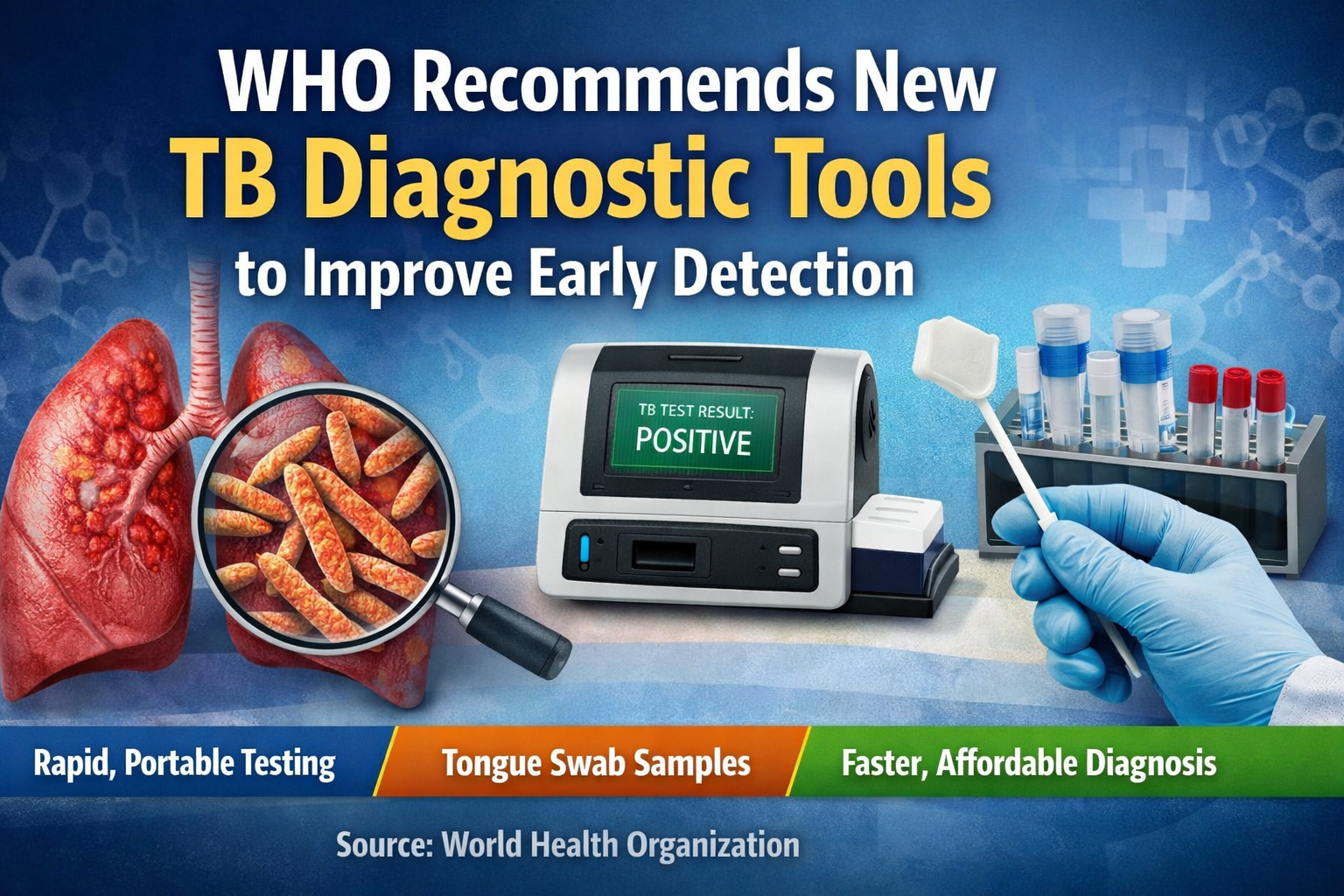
According to WHO, the new guidance supports near-point-of-care diagnostic tests. These are tests that can be used close to where patients actually receive care instead of depending only on centralized laboratories. WHO says these tools are portable, simple to use, can run on battery power, and can deliver results in less than one hour. It also notes that they are available at less than half the cost of many existing molecular diagnostic tools.
What Is New in the WHO TB Guidelines?
One major update is the recommendation for near-point-of-care TB tests. This matters because in many countries, TB diagnosis still depends on transporting samples to large labs, which can slow down results and delay treatment. WHO says these newer tools can bring testing closer to communities and help countries expand access more quickly.
Another important recommendation is the use of tongue swab samples. Traditionally, TB testing often depends on sputum samples, but not every patient can produce sputum easily. WHO says tongue swabs can help adults and adolescents who cannot produce sputum get tested, including people at increased risk of dying from TB.
The guidance also includes sputum pooling, a strategy in which samples from several people are combined and tested together. WHO says this can reduce machine time and commodity costs, especially in settings where resources are very limited.
Why Tuberculosis Diagnosis Still Matters
TB remains one of the world’s deadliest infectious diseases. WHO says that every day more than 3,300 people die from TB and more than 29,000 people become sick with the disease, even though it is preventable and curable. WHO also says global efforts since 2000 have saved an estimated 83 million lives, but warns that cuts in global health funding are threatening that progress.
WHO explains that the uptake of rapid TB diagnostic tools has been difficult in many countries partly because of high costs and the need to transport samples to centralized labs. By making testing faster, more affordable, and closer to patients, the organization believes countries can reduce delays in treatment and help curb transmission.
What This Means
In very simple terms, this means WHO wants TB testing to become easier, faster, and more available to ordinary people.
It means a person may no longer need to wait a long time for their sample to travel to a distant lab before getting results. With near-point-of-care tests, diagnosis can happen much closer to the clinic or health center where the patient is already receiving care.
It also means testing could become more comfortable and practical for some patients. For example, people who struggle to produce sputum may still be able to get tested through tongue swabs.
For health systems, it means lower-cost testing options and more efficient use of resources, especially in lower-resource settings. For patients, it means a better chance of getting diagnosed earlier and starting treatment sooner. That can improve outcomes and reduce the spread of TB in communities. This final point is an inference based on WHO’s explanation that faster diagnosis supports earlier treatment initiation and helps curb transmission.
Why These New TB Tools Could Be Important
The WHO announcement suggests that these tools are not just about new technology. They are about making care more practical and more patient-centered. WHO also notes that some of these devices may have potential beyond TB and could be used for diseases such as HIV, mpox, and HPV, which could support more integrated testing services in the future.
WHO is urging countries to move quickly by rolling out these technologies, strengthening people-centered TB care, and protecting TB services even during funding pressures and global crises.
Final Takeaway
The message from WHO is clear: better TB testing tools now exist, and using them more widely could help diagnose people faster, begin treatment earlier, and support the global effort to end tuberculosis. At the same time, WHO is warning that innovation alone is not enough without investment, strong health systems, and continued support for TB services and research.
Source: World Health Organization, “WHO recommends new diagnostic tools to help end TB,” published March 24, 2026.