How Are U.S. Doctors Using AI to Save 2+ Hours Daily?
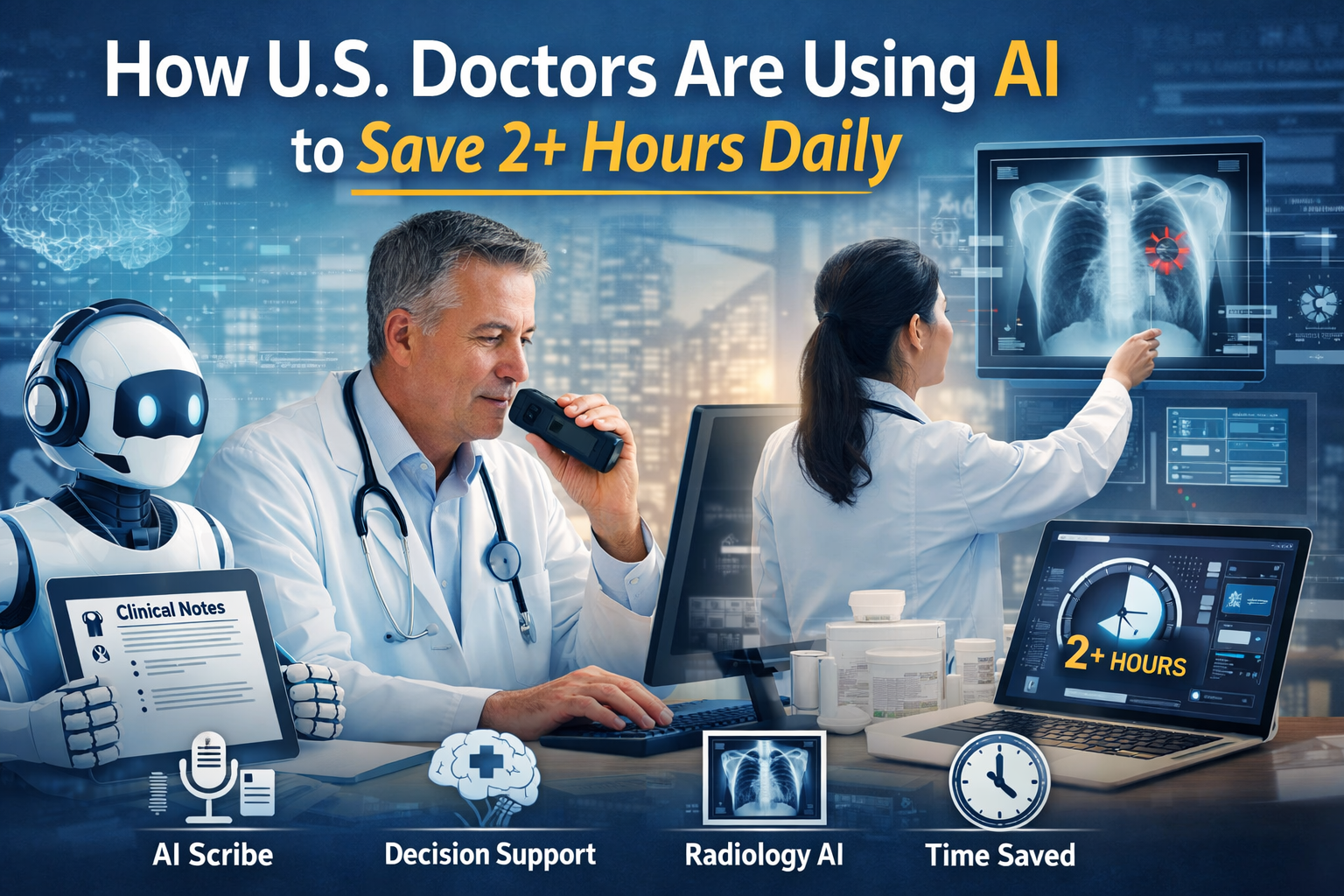
Artificial intelligence is helping U.S. doctors save 2 or more hours every day by automating repetitive tasks like documentation, improving decision-making, and streamlining workflows. The biggest impact comes from reducing administrative burden—not replacing clinical expertise.
This shift matters because doctors spend nearly half their workday on paperwork instead of patient care, according to a study published in Annals of Internal Medicine. AI is now reversing that imbalance.
Let’s break down exactly how.
Table of Contents
ToggleWhat Does It Mean for Doctors to Save 2+ Hours Daily Using AI?
Saving 2+ hours daily means reducing time spent on non-clinical tasks like documentation, charting, and administrative work.
In practice, this includes:
- Automating patient notes
- Reducing manual data entry
- Speeding up diagnosis workflows
- Streamlining communication and scheduling
Why it matters:
- More time for patients
- Less burnout
- Better clinical outcomes
A 2023 report from the American Medical Association highlights that administrative burden is a leading cause of physician burnout—AI directly addresses this problem.
Which Tasks Are Taking Most of Doctors’ Time Without AI?
Doctors spend the majority of their time on administrative tasks rather than direct patient care.
Key time-consuming tasks:
- Writing clinical notes
- Updating Electronic Health Records (EHRs)
- Reviewing lab results
- Managing billing and coding
- Handling patient messages
Data insight:
A widely cited study found physicians spend ~49% of their workday on EHR and desk work (Sinsky et al., Annals of Internal Medicine).
How Does AI Reduce Documentation Time for Doctors?
AI reduces documentation time by automatically generating clinical notes from conversations and structured data.
Instead of typing notes manually, doctors can rely on AI to capture and organize information in real time.
What Are AI Medical Scribes and How Do They Work?
AI medical scribes are tools that listen to doctor-patient conversations and automatically generate structured medical notes.
How they work:
- Use speech recognition + NLP
- Extract key medical information
- Format notes into EHR systems
Example tools:
- Nuance DAX (by Microsoft)
- Suki AI
- Augmedix
Impact:
- Doctors can finish documentation during the visit
- Eliminates after-hours “pajama time” charting
How Accurate Are AI Documentation Tools?
Modern AI documentation tools are highly accurate but still require human review.
Key points:
- Accuracy improves with training data
- Most systems achieve high transcription accuracy
- Doctors still validate final notes
Important:
AI assists—but does not replace—clinical judgment.
How Are U.S. Doctors Using AI for Clinical Decision Support?
AI helps doctors make faster, data-driven decisions by analyzing patient data and suggesting possible diagnoses or treatments.
How Does AI Help With Diagnosis and Treatment Planning?
AI systems analyze large datasets to identify patterns that may not be obvious to humans.
Examples:
- Flagging early signs of sepsis
- Suggesting drug interactions
- Recommending treatment pathways
Benefit:
- Faster diagnosis
- Reduced medical errors
- Improved patient outcomes
How Does AI Improve Diagnostic Speed in Fields Like Radiology?
AI speeds up diagnostics by quickly analyzing medical images like X-rays, MRIs, and CT scans.
Key use cases:
- Detecting tumors
- Identifying fractures
- Spotting early-stage diseases
Research insight:
Studies show AI can match or exceed human performance in specific imaging tasks, especially in radiology and dermatology.
What Are the Most Popular AI Tools Used by U.S. Doctors?
Doctors in the U.S. use a range of AI tools integrated into healthcare systems.
Common AI tools:
| Tool Type | Function | Example |
|---|---|---|
| AI Scribes | Documentation automation | Nuance DAX |
| Decision Support | Clinical insights | IBM Watson Health |
| Radiology AI | Image analysis | Aidoc |
| Voice Assistants | Workflow automation | Suki AI |
| EHR AI Integration | Smart charting | Epic Systems AI |
What Real-World Examples Show Doctors Saving Time With AI?
Doctors across U.S. hospitals report significant time savings using AI tools.
Example outcomes:
- Reduced documentation time by up to 50%
- Faster patient throughput
- Improved workflow efficiency
Case insight:
Microsoft reported that Nuance DAX users saved several hours per week on documentation tasks.
How Does AI Help Reduce Physician Burnout?
AI reduces burnout by eliminating repetitive administrative work and improving work-life balance.
Why burnout happens:
- Long hours
- Excess paperwork
- Cognitive overload
How AI helps:
- Reduces after-hours charting
- Simplifies workflows
- Improves job satisfaction
Statistic:
The AMA reports burnout affects over 40% of physicians, making efficiency tools critical.
What Are the Risks and Limitations of AI in Healthcare?
AI in healthcare has limitations, including accuracy concerns, data privacy risks, and over-reliance.
Key risks:
- Data privacy (HIPAA compliance issues)
- Algorithm bias
- Errors in AI-generated outputs
- Dependence on technology
Important:
AI must always be used under human supervision.
How Will AI Change Doctors’ Work in the Future?
AI will shift doctors’ roles from administrative-heavy tasks to more patient-focused care.
Expected changes:
- More time with patients
- Less manual data entry
- Increased use of predictive analytics
- Personalized medicine
AI will act as a co-pilot, not a replacement.
What Are the Key Takeaways About AI Saving Doctors Time?
- AI saves doctors 2+ hours daily, mainly by automating documentation
- Medical scribes and NLP tools are the biggest contributors
- AI improves both efficiency and patient care
- It reduces burnout significantly
- Human oversight remains essential
What tasks and work does AI help doctors with at the end of the day?
At the end of the day, AI helps doctors by handling the repetitive, time-consuming tasks that don’t require human judgment—freeing up hours for patient care.
In real clinical settings, the biggest time savings come from documentation, data processing, workflow support, and communication tasks.
Administrative and documentation tasks AI helps with
AI significantly reduces paperwork by automating routine documentation.
- Writing clinical notes from doctor-patient conversations
- Transcribing speech into structured medical records
- Auto-filling Electronic Health Records (EHRs)
- Generating visit summaries and discharge notes
- Assisting with medical billing and coding
- Drafting referral letters and follow-up documentation
- Organizing patient histories, medications, and lab results
- Managing inbox messages and routine communications
👉 These tasks alone account for a large portion of the 2+ hours saved daily.
Clinical workflow tasks AI helps with
AI improves efficiency by organizing and prioritizing clinical work.
- Flagging abnormal lab results instantly
- Identifying potential drug interactions
- Highlighting missed follow-ups or care gaps
- Prioritizing urgent or high-risk patients
- Suggesting evidence-based treatment options
- Supporting triage and care coordination
- Tracking chronic conditions over time
👉 This helps doctors make faster decisions with less cognitive overload.
Diagnostic and analytical tasks AI helps with
AI accelerates diagnosis by analyzing large datasets quickly.
- Reviewing X-rays, CT scans, and MRIs
- Detecting patterns in radiology and pathology
- Identifying early warning signs (e.g., sepsis, stroke)
- Comparing current and historical patient data
- Predicting risks like complications or readmission
- Tracking trends in vital signs and biomarkers
👉 This leads to faster, more accurate clinical insights.
Patient communication and follow-up tasks AI helps with
AI improves communication without increasing workload.
- Creating simple, patient-friendly visit summaries
- Sending automated follow-up reminders
- Assisting with appointment preparation
- Responding to routine, non-urgent patient queries
- Translating complex medical terms into plain language
- Improving care continuity through better documentation
👉 This enhances patient experience while saving time.
What is the biggest takeaway?
The biggest takeaway is simple:
AI helps doctors most with documentation, data review, workflow management, and routine communication—and that’s exactly where the biggest time savings come from.
It doesn’t replace doctors. It removes friction from their day.
Why AI is Giving Doctors Their Time Back
AI is quietly transforming healthcare by solving one of its biggest problems—time pressure.
By automating administrative work and supporting clinical decisions, AI allows doctors to:
- Spend more time with patients
- Reduce burnout and after-hours work
- Make faster, more informed decisions
- Deliver higher-quality care
In practical terms, saving 2+ hours daily is not just about efficiency—it’s about restoring the human side of medicine.
At the end of the day, AI gives doctors something incredibly valuable: time, focus, and the ability to care better.
Frequently Asked Questions (FAQs)
What is the main way AI saves doctors’ time?
AI saves time primarily by automating documentation and reducing manual data entry.
Can AI replace doctors?
No, AI supports doctors but cannot replace clinical judgment or human care.
How much time can AI save per day?
Many doctors report saving 2–3 hours daily, especially with AI scribes.
Is AI in healthcare safe?
Yes, when used with human oversight and proper regulations.
What is an AI medical scribe?
It is a tool that listens to patient visits and automatically creates medical notes.
Do all hospitals use AI now?
No, adoption is growing but not yet universal.
What is the biggest benefit of AI in healthcare?
Improved efficiency and more time for patient care.
Conclusion
AI is not just a futuristic concept—it’s already reshaping how doctors work in the United States. By removing time-consuming administrative tasks, AI allows physicians to focus on what matters most: patients.
The result? Better care, less burnout, and a more efficient healthcare system.