What Is POS 11 in Medical Billing?
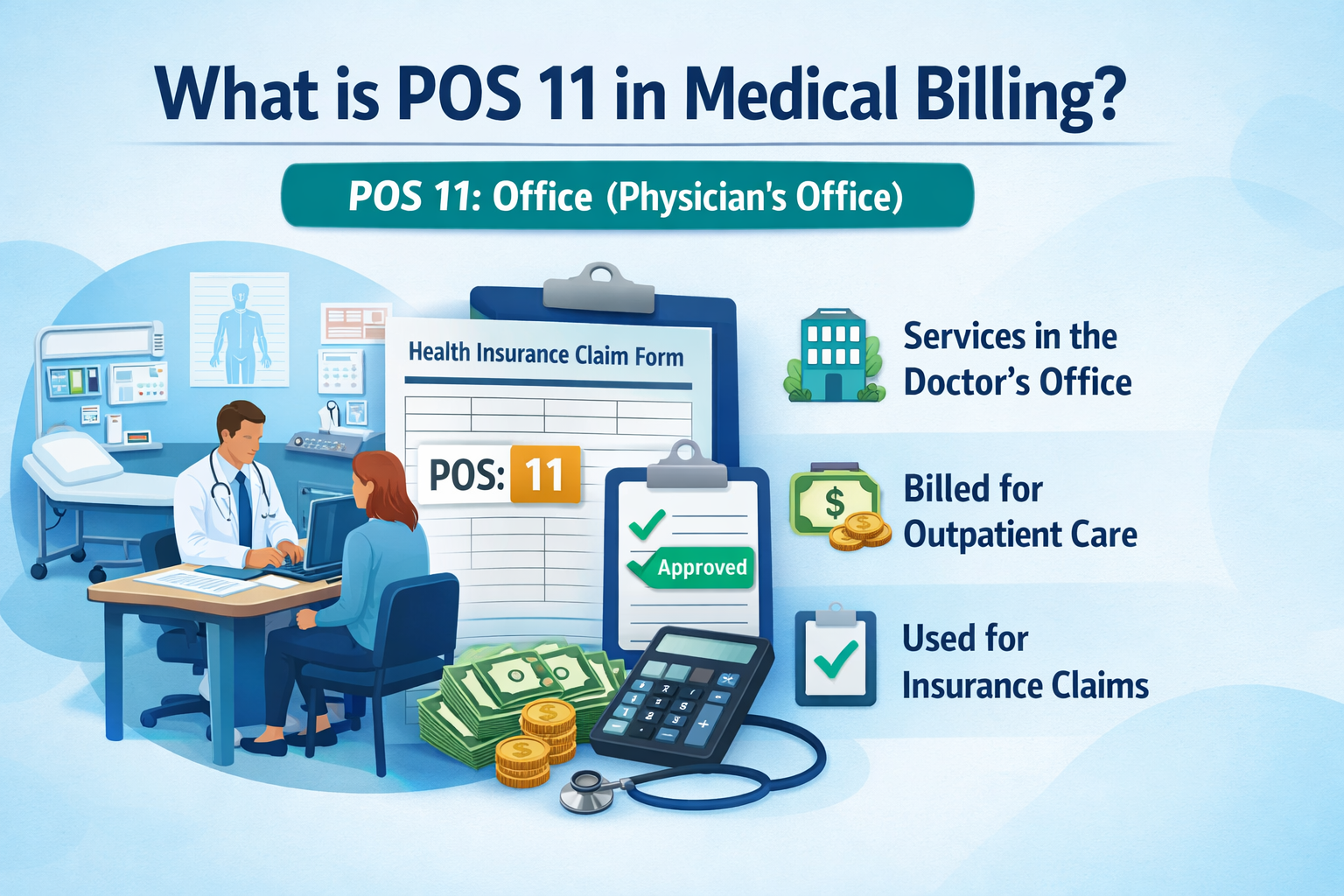
POS 11 in medical billing means “Office.” CMS defines POS 11 as a location, other than certain facility settings like a hospital or skilled nursing facility, where the health professional routinely provides exams, diagnoses, and treatment on an ambulatory basis.
Table of Contents
ToggleIn simple words, POS 11 is used when care is provided in a regular medical office setting. The patient comes in, gets seen, and leaves without being admitted as a hospital inpatient.
This matters because place of service codes are not just labels. CMS says POS codes identify the setting in which care was provided on professional claims, and the Medicare claims manual says the exact location helps determine claim processing and the correct physician fee schedule amount.
What does POS 11 mean in medical billing?
POS 11 means the service was provided in an office. The official CMS wording says POS 11 is an office location where the health professional routinely provides health examinations, diagnosis, and treatment of illness or injury on an ambulatory basis, and it specifically excludes settings such as hospitals, SNFs, military treatment facilities, community health centers, public health clinics, and ICFs.
What is the official CMS definition of POS 11?
The official CMS definition is the best starting point. CMS defines POS 11 as: an office location, other than several listed facility types, where the health professional routinely provides exams, diagnoses, and treatment on an ambulatory basis.
That definition gives three big clues:
- It is an office
- It is not one of the excluded facility settings
- The care is provided on an ambulatory basis, meaning outpatient rather than inpatient care
What does “office” mean in plain English?
“Office” means a regular practice setting where a clinician normally sees patients. It is the kind of setting people usually think of as a doctor’s office, a specialist’s office, or a group practice office. CMS also ties POS codes to professional claims rather than institutional facility claims.
A plain-English test is this: if the service happened in a routine office-based outpatient setting and not in a hospital outpatient department, patient home, or telehealth patient-location setting, POS 11 is often the right code.
When should POS 11 be used on a medical claim?
POS 11 should be used when the service is performed in a routine office setting that fits CMS’s office definition. It belongs on a professional claim when the clinician is furnishing care in that office environment. CMS says POS codes are used on professional claims to specify where the service was rendered.
Common examples include:
- office evaluation and management visits
- routine follow-up visits
- office-based consultations
- minor office procedures
- office-based diagnosis and treatment of illness or injury
Which services are commonly billed with POS 11?
Many standard office services fit POS 11. If the clinician sees the patient in the office and the claim is a professional claim, POS 11 is commonly used for the visit or service location. CMS’s definition supports this because it refers to routine health examinations, diagnosis, and treatment in an office setting.
Which providers commonly use POS 11?
POS 11 is commonly used by non-institutional professional providers. CMS says professional claims on CMS-1500 and 837P are used by non-institutional providers and suppliers, including physicians, nurse practitioners, clinical psychologists, clinical social workers, physical therapists, physician assistants, chiropractors, and others.
That does not mean every service by those providers is POS 11. It means those provider types often submit professional claims, and POS 11 may be appropriate when the service is truly delivered in the office.
When should POS 11 not be used?
POS 11 should not be used when the service happened somewhere other than a qualifying office setting. The biggest mistakes happen when people confuse office care with home care, hospital outpatient care, telehealth, or another type of clinic. CMS’s POS code set gives separate codes for those settings.
Why is POS 11 different from POS 12 for home care?
POS 12 is for the patient’s home, not the clinician’s office. CMS defines POS 12 as a location, other than a hospital or other facility, where the patient receives care in a private residence. If the patient is seen at home, POS 12 is the better fit, not POS 11.
Why is POS 11 different from POS 19 and POS 22 for hospital outpatient care?
POS 19 and POS 22 are hospital outpatient settings, not office settings. CMS defines POS 19 as an off-campus hospital provider-based outpatient department and POS 22 as an on-campus outpatient hospital setting. If the service happened in a hospital outpatient department, POS 11 is not the correct code.
This is one of the most common POS mix-ups because both settings can feel “outpatient.” But in billing, an outpatient hospital is not the same as an office.
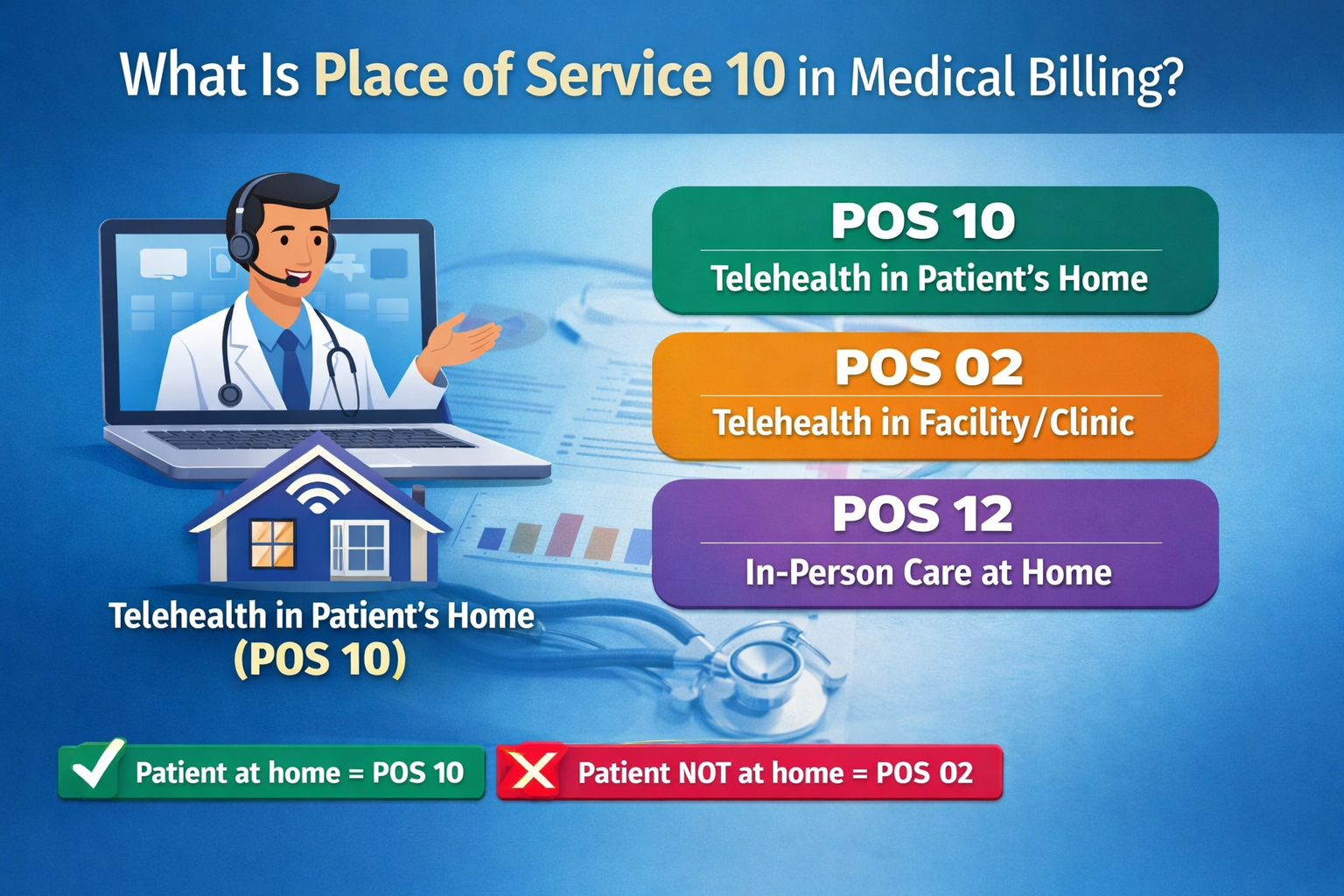
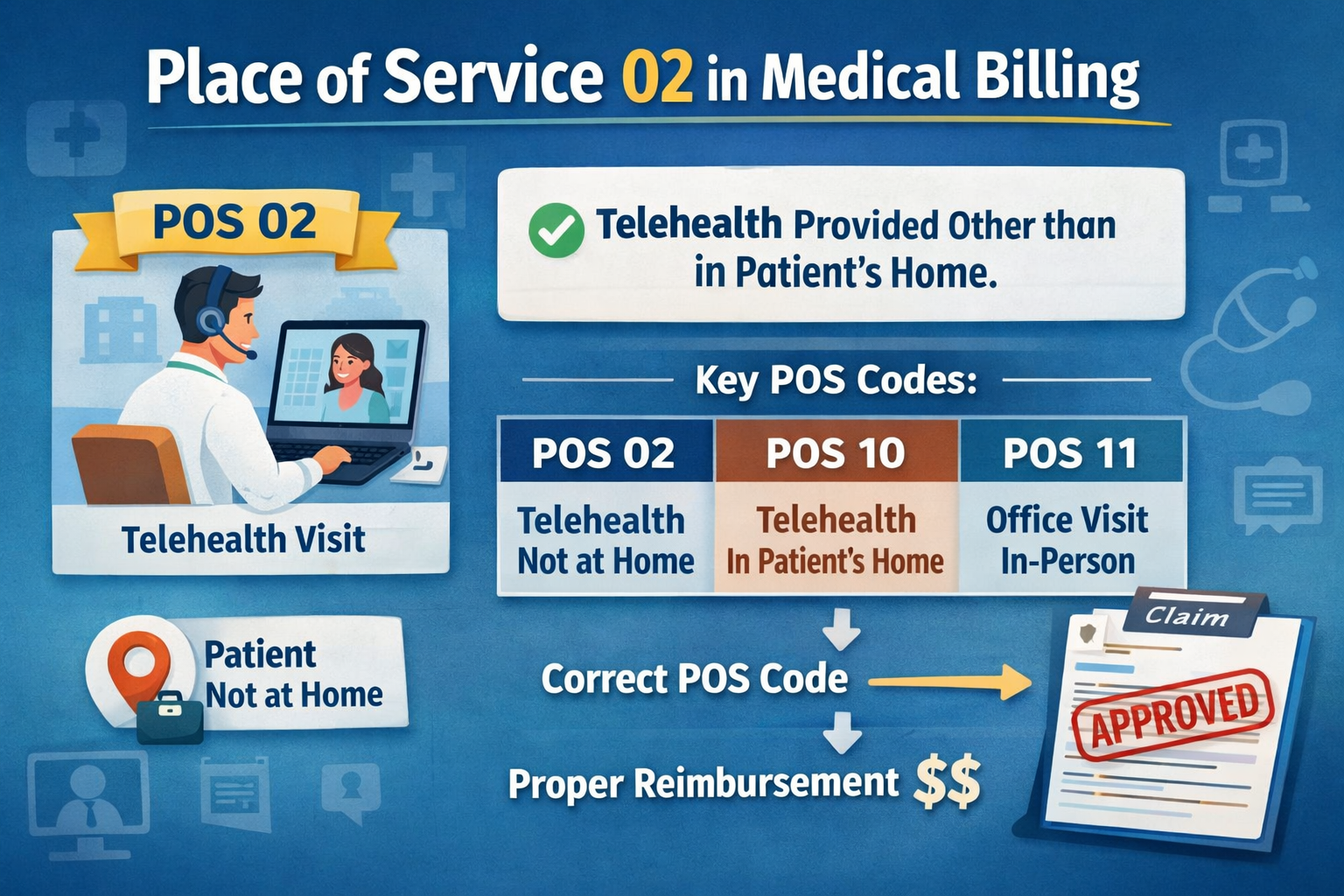
Why are POS 11 different from POS 02 and POS 10 for telehealth?
Telehealth has its own POS codes. CMS defines POS 02 for telehealth provided other than in the patient’s home and POS 10 for telehealth provided in the patient’s home. That means telehealth is not automatically POS 11 just because the clinician may be sitting in an office while delivering the service.
What about POS 49 for an independent clinic?
POS 49 may apply when the site is an independent clinic rather than an office. CMS defines POS 49 as a location, not part of a hospital and not described by another POS code, organized to provide outpatient preventive, diagnostic, therapeutic, rehabilitative, or palliative services. That makes POS 49 another code worth checking when the site is clinic-based but not truly an office.
Why does POS 11 matter for claim accuracy and payment?
POS 11 matters because the place of service affects claim processing and payment logic. CMS says POS codes identify the setting in which the service was provided on professional claims, and the Medicare claims manual says the specific location is needed so Medicare can determine processing jurisdiction and apply the correct physician fee schedule amount.
CMS also tells providers to check with individual payers for reimbursement policies regarding POS codes. That means the code does more than describe a location. It can influence how a payer reviews and pays the claim.
In short, a wrong POS code can lead to:
- claim edits
- denials or rejections
- wrong payment amounts
- compliance risk if the billed location does not match the real service setting
How is POS 11 different from other common places of service codes?
POS 11 is the office code, but it sits next to several similar codes that mean different things. The table below simplifies the most common comparisons using CMS’s official POS code set.
| POS code | Setting | Simple meaning |
|---|---|---|
| 11 | Office | Routine office-based outpatient care |
| 12 | Home | Care delivered in the patient’s private residence |
| 19 | Off-campus outpatient hospital | Hospital-owned outpatient department off the main campus |
| 22 | On-campus outpatient hospital | Hospital outpatient department on the main campus |
| 02 | Telehealth other than the patient’s home | Telehealth when the patient is not at home |
| 10 | Telehealth in the patient’s home | Telehealth when the patient is at home |
| 49 | Independent clinic | Outpatient clinic not part of a hospital and not described by another POS code |
These definitions come from CMS’s official POS code set for professional claims.
What are the common mistakes people make with POS 11?
The most common POS 11 mistake is using it for any outpatient service that is not inpatient. That is too broad. POS 11 is only for the office setting defined by CMS.
Common errors include:
- using POS 11 for a home visit that should be POS 12
- using POS 11 for a hospital outpatient department that should be POS 19 or 22
- using POS 11 for telehealth when POS 02 or 10 is more appropriate
- Assuming every clinic is automatically POS 11 when POS 49 independent clinic may fit better in some cases
Another mistake is treating the POS field like a minor detail. CMS’s own claims guidance shows the service location is important enough to affect jurisdiction and fee schedule application.
How can you quickly decide whether POS 11 is correct?
Use POS 11 only if the service truly happened in a routine office setting. A quick checklist helps:
- Was the claim a professional claim on CMS-1500 or 837P?
- Did the service happen in an office, not a hospital outpatient department, home, or telehealth patient-location setting?
- Does the site match CMS’s office description: a place where the clinician routinely provides exams, diagnoses, and treatment on an ambulatory basis?
- Does the payer have any special reimbursement policy or billing rule for that location? CMS says to check with individual payers for reimbursement policies.
If the answer to those questions is yes, POS 11 is usually the right choice.
What is the key takeaway about POS 11 in medical billing?
POS 11 means office-based outpatient care on a professional claim. It does not mean home care, hospital outpatient care, or telehealth by default. The safest way to use POS 11 is to match the claim to the real setting where the patient received the service.
What are the most common FAQs about POS 11 in medical billing?
Is POS 11 only for professional claims?
Yes, POS codes are used on professional claims. CMS says POS codes are two-digit codes placed on healthcare professional claims to indicate the service setting. CMS also says CMS-1500 and 837P are the standard professional claim formats.
Is POS 11 the same as an outpatient hospital?
No. POS 11 is the office. POS 19 and POS 22 are hospital outpatient settings. CMS gives separate definitions for each.
Can a clinic use POS 11?
Sometimes, yes, but not always. If the site meets CMS’s office definition, POS 11 may fit. If it is better described as an independent clinic, POS 49 may be more accurate.
Can telehealth be billed with POS 11?
Not by default. CMS has specific telehealth POS codes: 02 when the patient is not at home and 10 when the patient is at home.
Does POS 11 mean the patient stayed overnight?
No. CMS’s definition says POS 11 is ambulatory, which means outpatient-type care rather than inpatient admission.
What is the difference between point of service and place of service?
The place of service is the claim code showing where the care happened. Point of service is a different phrase and can refer to other insurance or care-delivery concepts. For billing accuracy, the CMS term here is Place of Service.
Does POS 11 affect reimbursement?
It can. CMS says payers use POS codes for reimbursement policies, and Medicare’s claims manual says service location helps determine the correct physician fee schedule amount.
Where can I verify POS 11 officially?
The best source is CMS’s official Place of Service Code Set. That page lists the current CMS definitions for POS 11 and related codes.
A short conclusion: POS 11 is simple once you focus on one question—where did the patient actually receive the service? If the answer is a routine medical office, POS 11 is usually the code you are looking for.