Table of Contents
ToggleUS Patient Engagement Solutions Market — Quick Snapshot
-
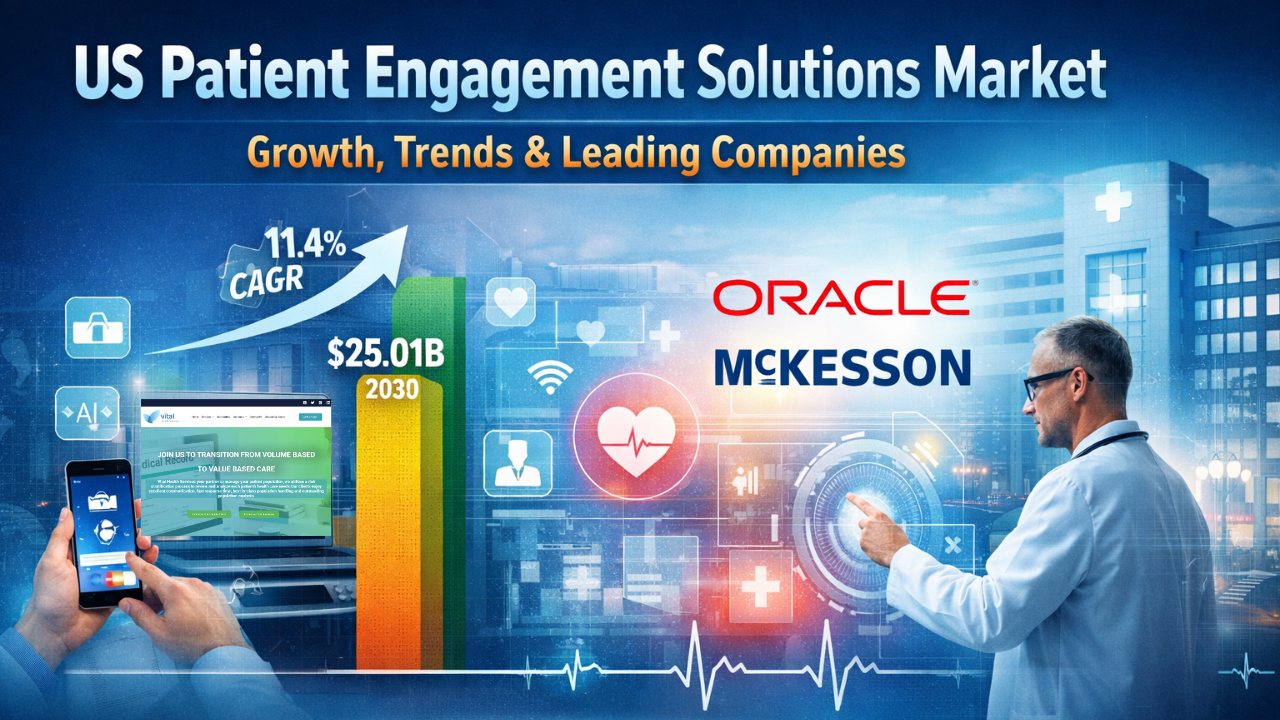
Market expected to grow from $14.55B (2025) to $25.01B (2030)
-
Strong 11.4% CAGR driven by digital health adoption
-
Growth powered by telehealth, remote monitoring, and AI-driven engagement
-
Value-based care and chronic disease management are major drivers
-
Smartphones and patient portals are reshaping patient interaction
-
Oracle and McKesson lead through cloud platforms + ecosystem partnerships
-
Healthcare providers are investing heavily in data-driven engagement tools
-
Market moving toward personalized, seamless, connected care experiences
US Patient Engagement Solutions Market: A Deep Dive into Growth, Innovation, and Industry Leaders
The US patient engagement solutions market is entering a fast-growth phase as healthcare systems shift toward digital-first, patient-centered care. Organizations are no longer focused only on treatment — they are investing in platforms that improve communication, adherence, and long-term outcomes. The result is a rapidly expanding ecosystem built around smarter engagement, automation, and interoperability.
Let’s break down what’s driving the market and how major players are shaping the future.
Market Growth Outlook: Why the Sector Is Expanding Fast
The US patient engagement solutions market is projected to reach $25.01 billion by 2030, up from $14.55 billion in 2025. This expansion reflects a strong 11.4% compound annual growth rate, signaling a structural shift in how healthcare is delivered and managed.
Several forces are pushing this momentum:
Digital Health Becomes the New Standard
Healthcare is moving beyond physical clinics. Telehealth, mobile apps, and remote monitoring tools are now central to care delivery. Patients expect real-time access, digital scheduling, and online communication — and providers must adapt.
Rise in Chronic Conditions
Long-term illnesses require continuous monitoring and consistent engagement. Engagement platforms help track progress, remind patients about medications, and maintain communication between visits.
Government Support for Health Data Exchange
Federal programs promoting interoperability and health information sharing are accelerating adoption of integrated engagement platforms.
Data-Driven Care Models
Healthcare organizations are investing in analytics-powered tools that personalize patient communication and improve clinical efficiency.
The shift isn’t temporary. It reflects a permanent evolution toward connected care ecosystems.
Innovation Strategies Shaping the Market
The market is driven by two dominant strategic approaches:
Continuous Product Innovation
Companies are upgrading core engagement platforms with:
-
AI-powered personalization
-
Mobile-first patient access
-
Telehealth integration
-
Advanced analytics
-
EHR interoperability
-
Automated communication workflows
The goal is simple: deliver seamless experiences that reduce friction for both patients and providers.
Strategic Partnerships and Acquisitions
Industry leaders are expanding their reach through alliances and acquisitions. This allows them to:
-
Enter new care segments
-
Expand technology ecosystems
-
Accelerate innovation cycles
-
Deliver end-to-end engagement platforms
Together, innovation + collaboration are shaping a more unified digital health infrastructure.
Leading Companies Driving the Market
The US patient engagement space includes a mix of healthcare IT giants, cloud innovators, and specialized engagement providers.
Key players include:
-
McKesson Corporation
-
Oracle Corporation
-
Veradigm LLC
-
athenahealth
-
Health Catalyst
-
Epic Systems Corporation
-
Cognizant
-
Luma Health
-
Experian Health
-
AdvancedMD
-
Televox
-
Nuance (Microsoft)
-
Tebra Technologies
-
Oneview Healthcare
-
And several emerging digital engagement platforms
Each brings a unique strength — from pharmacy engagement to analytics, cloud infrastructure, or provider workflow tools.
Oracle Corporation: Cloud-Driven Patient Engagement
Oracle plays a central role in modern patient engagement through its Oracle Health portfolio. Its strategy focuses on scalable, cloud-native healthcare infrastructure.
Oracle’s solutions support:
-
Interoperable patient portals
-
Secure digital communication
-
Online scheduling
-
Personalized outreach campaigns
-
Population health analytics
-
Value-based care programs
By combining Oracle Cloud Infrastructure with healthcare analytics, organizations can streamline patient access, improve care coordination, and create connected digital experiences.
Oracle’s strength lies in building data-driven engagement ecosystems that scale across entire healthcare networks.
McKesson Corporation: Engagement Across the Care Continuum
McKesson stands out as one of the most influential healthcare services companies in the US. Its engagement capabilities extend deeply into pharmacy and provider networks.
Core strengths include:
-
Medication adherence programs
-
Personalized patient communication
-
Clinical program management
-
Secure engagement platforms
-
Pharmacy-focused engagement workflows
McKesson uses its nationwide healthcare infrastructure to help providers and pharmacies engage patients consistently across the care journey.
This positions McKesson as a critical connector between patients, clinicians, and medication management systems — improving outcomes and continuity of care.
Market Positioning: How Leaders Compare
The market is anchored by providers specializing in digital engagement, care coordination, and intelligent communication systems.
-
McKesson dominates pharmacy-driven engagement and adherence ecosystems
-
Oracle leads in cloud-based patient experience infrastructure
-
athenahealth strengthens outpatient and practice-level engagement
Together, these companies are shaping a future where patient engagement is integrated, automated, and data-informed.
Their combined innovation accelerates:
-
Better communication
-
Coordinated care delivery
-
Improved patient satisfaction
-
Stronger treatment adherence
-
Value-based healthcare transformation
The Future of Patient Engagement
The next phase of growth will revolve around:
-
AI-guided patient journeys
-
Predictive engagement models
-
Real-time remote monitoring
-
Integrated telehealth ecosystems
-
Personalized digital care experiences
Healthcare is moving toward continuous engagement — not episodic treatment. Companies that deliver frictionless, intelligent platforms will define the next generation of care.